Activity Changing States
Ages 12 and older.
Percy Julian was a professor and a chemist. He practiced
chemistry and helped make many different medicines and
household products. Chemistry is sometimes called the science
of change—chemists watch how materials interact with
each other, and they observe how molecules change with heat or
mixing. In this activity, you will observe changes in the
materials that are mixed.
You Will Need
- 1 resealable sandwich bag
- 1 tsp baking soda
- 2 tbsp vinegar
- 1 plastic bottle cap
- 8-oz paper cup
- safety goggles
What to Do
Ask an adult to help you with this activity.
-
Read all the instructions first. If possible, work with a
partner to make it easier to handle the materials.
- Put on your safety goggles.
-
Open the sandwich bag. Place it in the cup and fold the open
end of the bag over the top of the cup. Pour the vinegar
into the bag.
- Put the baking soda in the bottle cap. Set it aside.
-
Take the bag out of the cup, being careful not to spill the
vinegar. Feel the bottom of the bag and note the temperature
of the vinegar.
-
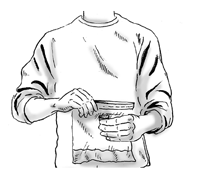
Use one hand to place and hold the bottle cap (and baking
soda) inside the bag. Without dropping any baking soda into
the vinegar, hold the bag against your body and use the
other hand to carefully remove the air from the bag. Seal
the bag.
-
Drop the bottle cap into the vinegar. Gently move the bag to
mix the baking soda and vinegar.
-
Observe the changes that occur.
Questions
- What changes did you notice?
-
How did the baking soda change? How did the vinegar
change?
-
Did the temperature of the liquid in the bag change? If
so, how?
-
What happened to the bag? Why do you think this
happened?
-
Percy Julian sometimes made new substances in the laboratory
by mixing different chemicals. Did you end up with a
different substance than the ones you started with? Was this
new substance a solid, a liquid, or a gas?
Learning More
The Science Discovery Book
by Anthony D. Fredericks, Brad K. Cressman, and Robert
Hassler. Scott Foresman, 1987.
Discusses the scientific process and includes chemistry
activities for students in grades 4-6.
The Science Explorer
by Pat Murphy, Ellen Klages, Linda Shore, and the staff of the
Exploratorium; Jason Gorski (Illustrator). Henry Holt,
1996.
Includes many hands-on science experiments, some related to
chemistry.
Chemistry
by Ann Newmark. DK Children, 2005.
Considers the nature of chemistry and different types of
chemical reactions.
Chemistry
library.thinkquest.org/j001539
Provides chemistry information and experiments for children in
grades 4-8.
|
Percy Julian, Chemist
Percy Julian earned his Ph.D. in chemistry from the University
of Vienna in Austria in 1931. He worked in chemistry
laboratories and was a careful observer of change in the
materials he used. For example, he saw changes in soybean oil
when water leaked into a tank. This observation helped him
discover an inexpensive process for making the hormone
progesterone.
|


|
|
Forgotten Genius Home |
Send Feedback |
Image Credits
|
Support NOVA
|
© | Created
January 2007
|