Previous Episode
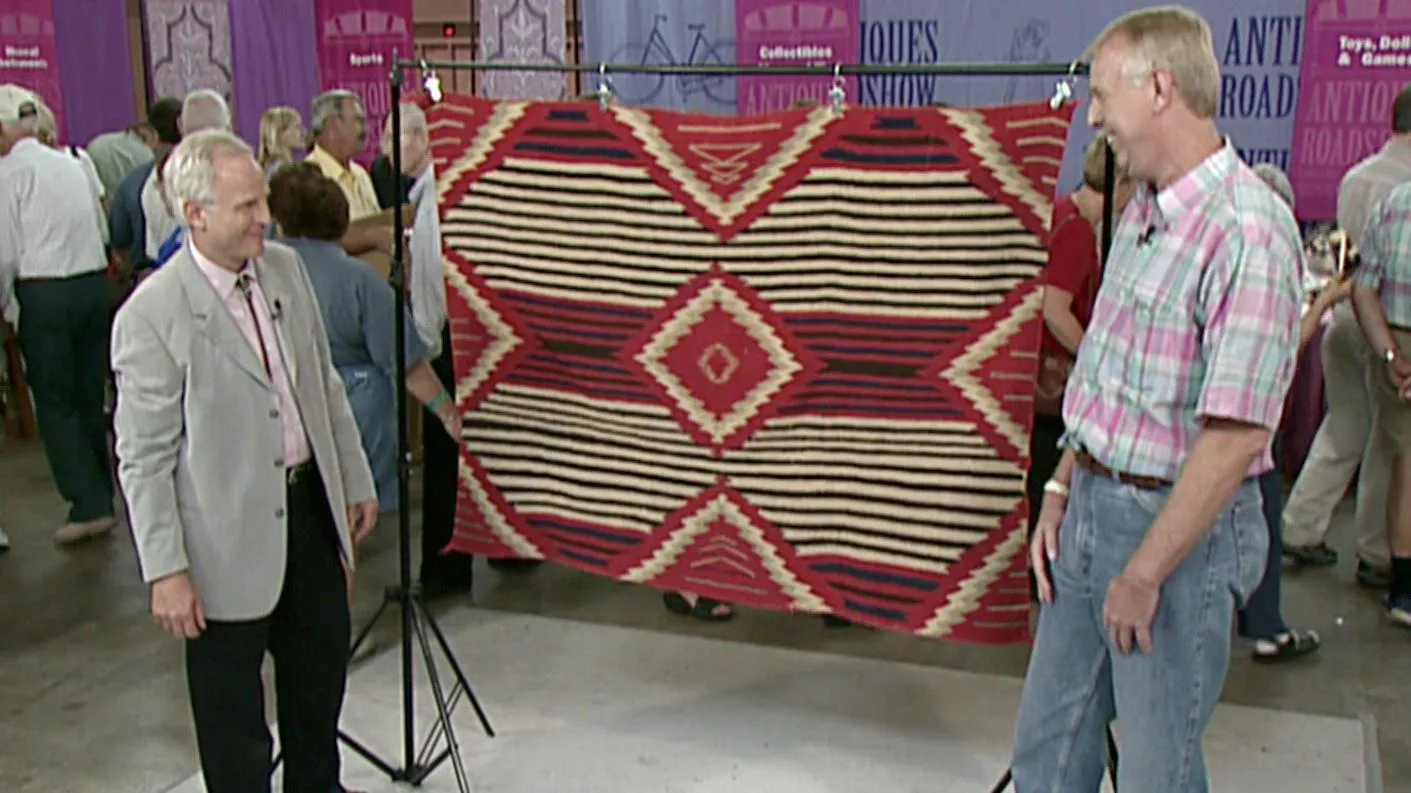
episode
Season 21
Vintage Albuquerque
Revisit updated fan favorites from 2002, including a find that moves the expert to tears!
Next Episode

episode
Discover how appraisals from 15 years ago have changed in the market!
GUEST: Well, it's a... we're not really sure what to call it, but it's colored sand in a jar. And it was presented to my great-grandfather around the end of the Civil War. He was a sergeant in the Union army, I believe from New York, and they moved to Hot Springs after the Civil War and settled here. And this was a gift from two of his friends, and it's been in my family ever since.
APPRAISER: And what do you do with it now?
GUEST: We look at it, it sits on the bookshelf, and we enjoy it.
APPRAISER: Do you keep it in a safe place?
GUEST: No, we keep it high enough where my four-year-old granddaughter can't reach it.
APPRAISER: Yeah, please do. Well, let's start with, you know, what it is. It is... it's sand in a jar. But what sand in a jar. It's an incredible piece of sand art. Let's start with who your great-grandfather was. He didn't come from New York, he came from Illinois.
GUEST: Close enough.
APPRAISER: And he spent most of his Civil War career in the Hot Springs, Arkansas, vicinity. The real interesting thing about this remarkable piece of sand art, though, is just what you see here. Not only is his name on it, but on the back you see this wonderful eagle with the 36-star flag. You spin it around, you see his name is written in script, there's a mortar and pestle. All of this is done with individual grains of sand. And when you flip it up, the label on the bottom says, "Pictured rock and sand by A. Clemens, deaf-mute" from McGregor, Iowa. While you were sitting back in the green room, on a whim, while I was finding out about your grandfather, I went to the internet and just typed in "McGregor, Iowa, sand." And bingo, we got a hit.
GUEST: Really?
APPRAISER: On A. Clemens, the guy who made this. When he was five years old, he had what his family called "brain fever." And he went to the deaf-mute school in Iowa, and would come home in the summers, and he started going to this spot on the Mississippi River in McGregor, Iowa, and collecting sand, and sort of experimenting with making these bottles. He used a big fishhook, a great big oversized fishhook, and, like, a popsicle stick. And he would take the sand that he'd collect along the Mississippi River, and then he would pack it in this bottle, and manipulate it with the fishhook. He gained national fame for making these, and today, there's an exhibit on this guy at the Iowa State museum.
GUEST: Is that right?
APPRAISER: It is a remarkable piece of folk art. On today's market, I would guess that it's between $4,000 and $6,000 is what we'd estimate.
GUEST: Really?
APPRAISER: It might bring more than that in the right auction-- great piece.
GUEST: That's great.
Discover how appraisals from 15 years have changed in the antiques market, including Andrew Clemens sand art, ca. 1880, a 1933 All-Star game signed baseball, and an 1886 Jasper Cropsey painting. Can you guess which item is valued at $100,000?
More ways to watch
episode
Revisit updated fan favorites from 2002, including a find that moves the expert to tears!
episode

appraisal

appraisal

appraisal

appraisal

appraisal

appraisal

appraisal

appraisal

appraisal

appraisal

appraisal

appraisal

appraisal

appraisal

appraisal

appraisal

appraisal

appraisal

appraisal







A weekly collection of previews, videos, articles, interviews, and more!
Funding for ANTIQUES ROADSHOW is provided by American Cruise Lines and Ancestry. Additional funding is provided by public television viewers.
ANTIQUES ROADSHOW is a trademark of the BBC and is produced for PBS by GBH under license from BBC Studios. PBS is a 501(c)(3) not-for-profit organization.
A weekly collection of previews, videos, articles, interviews, and more!