Who Were the Zouaves?
More on the history of the Civil War soldiers in exotic — and distinctly uncamouflaged — uniforms.
Oct 18, 2016
Originally published on: May 18, 2015
BY Ben Phelan
GUEST: I brought my great-grandfather's Civil War uniform. These are articles related to his service.
APPRAISER: And who did he serve with?
GUEST: He was with the 5th New York, which is also known as Duryee's Zouaves.
APPRAISER: In April 1861, a wealthy Manhattan lumber merchant, Abram Duryee, formed the regiment of Zouaves. Zouave regiments patterned their uniforms after the French Zouaves. And we notice it has a real flair to it. A fez... the small, short coat. How long did he serve?
GUEST: He served for two years, it was a two-year regiment. He mustered in spring of '61 and mustered out after Chancellorsville in '63.
APPRAISER: Well, during the war, most of the regiments had standard uniforms. These guys considered themselves elite. And they liked having something that was different than everybody else, which is why they wore this style of uniform. Did he serve again?
GUEST: Yes, he reenlisted in 1865 and served until '68, was discharged from Fort Laramie in Wyoming.
APPRAISER: And was he in regular Army then?
GUEST: Yeah, he was in the 4th Regulars.
APPRAISER: Okay. And that's probably why we have this coat today. When he mustered out, we notice he has the chevrons on the sleeves. What rank's that?
GUEST: He's a corporal.
APPRAISER: There you go. So we know he would have put this coat in the closet. When he enlisted in '64, being regular Army, he would have had a regular Army uniform.
GUEST: Right. Saved this one.
APPRAISER: It's one of the few that survive. It's one of the tougher coats to find in collecting. And it's pretty. It's one of those, when you look at it, you're like, that's real. We've got his coat, his fez, and we have a few other things. We have his discharge paper. These are reproductions of his service records. After the war, these guys were really proud of their service. They had veterans' organizations where they would have reunions. He was a member of the G.A.R., the Grand Army of the Republic, and this is his membership medal. It has the membership medal on a lapel pin. You could order these badges, they call them ladder badges, and you can order them in the back of the veterans' magazines. And the more you wanted to pay, the more rungs they put on your ladder. It's pretty, and being that regiment makes a lot of difference. Because it is one of the most famous of all New York regiments. As a group, it's something that, if it were my family, I would want to insure the group for about $16,000.
GUEST: Yeah, I thought it would be worth quite a bit. (chuckles)
APPRAISER: The coat and hat are about $15,000, and then we have about $1,000 worth of other pieces to go with it.

The Briarwood Pipe, ca. 1864, by Winslow Homer. The painting depicts two men in the distinctly uncamouflaged uniform of "Duryée's Zouaves," the 5th New York Volunteer Infantry.
The Civil War dyad of blue and gray has become so entrenched over the years that blue and gray are often used as shorthand for Union and Confederacy. In truth, things were a little more complicated. “In the early days, there was a lot more variety,” says Arms & Militaria expert Rafael Eledge, owner of Shiloh Civil War Relics, in Savannah, Tennessee. In New England, says Eledge, Union forces were often drawn from militia units that wore gray uniforms, which they continued to wear after joining the U.S. Army. “So during early battles, like First Manassas,” he says, “both sides had gray uniforms and both sides had blue uniforms. It was hard to tell who was who out in the field.”
A more extreme example is found in the Zouaves, military units that existed on both sides of the conflict. A soldier in Zouave dress typically wore flowing pantaloons, a fez and an embroidered waistcoat with false pockets. Because of their rarity, few Civil War-era Zouave uniforms are known to have survived. During the August 2014 ROADSHOW in Charleston, West Virginia, Eledge was surprised and delighted to find himself appraising a well-preserved Zouave uniform from the 5th New York Volunteer Infantry, a famous unit known as "Duryée's Infantry" after its commander, Col. Abram Duryée — 85 percent of whom were either killed or wounded during a single battle. Because of its excellent condition, Eledge estimated the uniform's auction value at $15,000 (plus $1,000 for associated militaria).
A soldier in Zouave dress typically wore flowing pantaloons, a fez and an embroidered waistcoat with false pockets.
The Zouave-style uniform can be a shock to anyone expecting the navy blue or the heather gray of history books. Those uniforms were clearly designed for combat: trim, to reduce a soldier's profile on the battlefield; rugged, to stand up to months and years of marching and close combat; dignified but plain, to promote group cohesion and a sense of equality in the ranks. By such standards, the Zouave uniform was impractical, bizarre even: eye-catching blue coats piped in bright red; loose and billowing pants likely to snag on branches and brambles; a red fez. You might expect to see one on a juggler or a fire-eater — never a soldier.
The uniform's foreign appearance has the straightforward explanation of a foreign origin. As told in an essay found in the 1995 volume Don Troiani's Civil War, the first military unit known as Zouave was a French Army battalion, operating in Algeria in 1831, that consisted entirely of soldiers recruited from a North African tribe called the Zouaoua. At the time, the French were consolidating their colonial control over Algeria, which would remain a French possession for over a century, and they needed a local population of soldiers inimical to the government of Algiers. The Zouaoua fit the bill. They were fierce and independent, essentially hostile to any government that encroached on their freedom (though the Zouave units were commanded by Frenchmen, and eventually replaced entirely by them). The fez characteristic of the Zouave uniform is clearly drawn from Muslim-influenced fashions, the baggy pants designed to be comfortable during desert operations.
The Zouave units earned a reputation as elite troops during the French conquest. In the following decades, as their reputation spread around the world with emigrating Zouave and ex-Zouave soldiers, a sort of Zouave fashion-craze took hold among the world's militaries, eventually arriving in Civil War-era America. To wear the Zouave uniform was to partake of Zouave military prowess — so the latter-day Zouave units, Union and Confederate alike, hoped.
“They were elite in equipment, but not always in fighting ability,” says Eledge. During the Civil War, he explains, military units were typically formed out of like-minded, local groups of men and boys who enlisted together and equipped themselves as they liked. “The Zouaves were generally rich, generally flashy guys who liked standing out. There was no tactical advantage to standing out, but that was their intention, which is a great idea if all you're doing is marching. In a parade, it's a wonderful idea. If you're in battle? Not so much. It's a whole lot easier to shoot someone who's wearing circus colors than someone who blends in," Eledge adds.
As the Civil War continued, claiming its hundreds and thousands, and ultimately hundreds of thousands of lives, the Zouave units disappeared. They had never been all that common to begin with, and the lure of claiming a share of battlefield glory waned as certain death emerged as its price.
After the war, with the fatal consequences of enhanced visibility a fading memory, the impractical appeal of Zouave military fashion re-emerged. According to Eledge, many peacetime militia units chose to adopt the Zouave uniform rather than something more conventional. As a result, post-war Zouave uniforms are not that uncommon — but Eledge says he cannot remember ever coming across a single Zouave uniform from the Confederacy. And the less uncommon Union-affiliated uniforms are still rare enough that, if they are in comparable condition to the one Eledge appraised in Charleston, they might well bring in as much as $15,000. It's an extraordinary price tag for a piece of militaria so lovely to behold, but so entirely at odds with any practical military purpose.
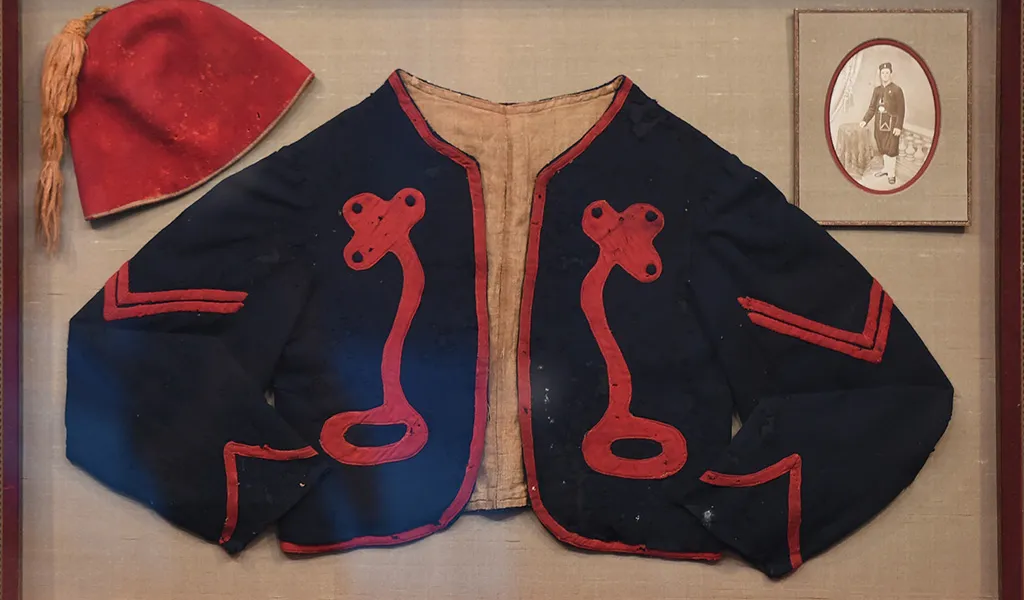
Appraiser Rafael Eledge discussed a collection of Civil War memorabilia related to the 5th New York Volunteer Infantry, known as "Duryée's Zouaves," at the August 2014 ROADSHOW in Charleston, W.Va. Eledge estimated the entire collection's insurance value at $16,000.
Ben Phelan is a freelance writer in Louisville, Kentucky. He has been a contributor to ANTIQUES ROADSHOW Online since 2007.


