Who Was Iron-Crutch Li?
More about the legendary Chinese Immortal Li Tieguai (Iron-Crutch Li).
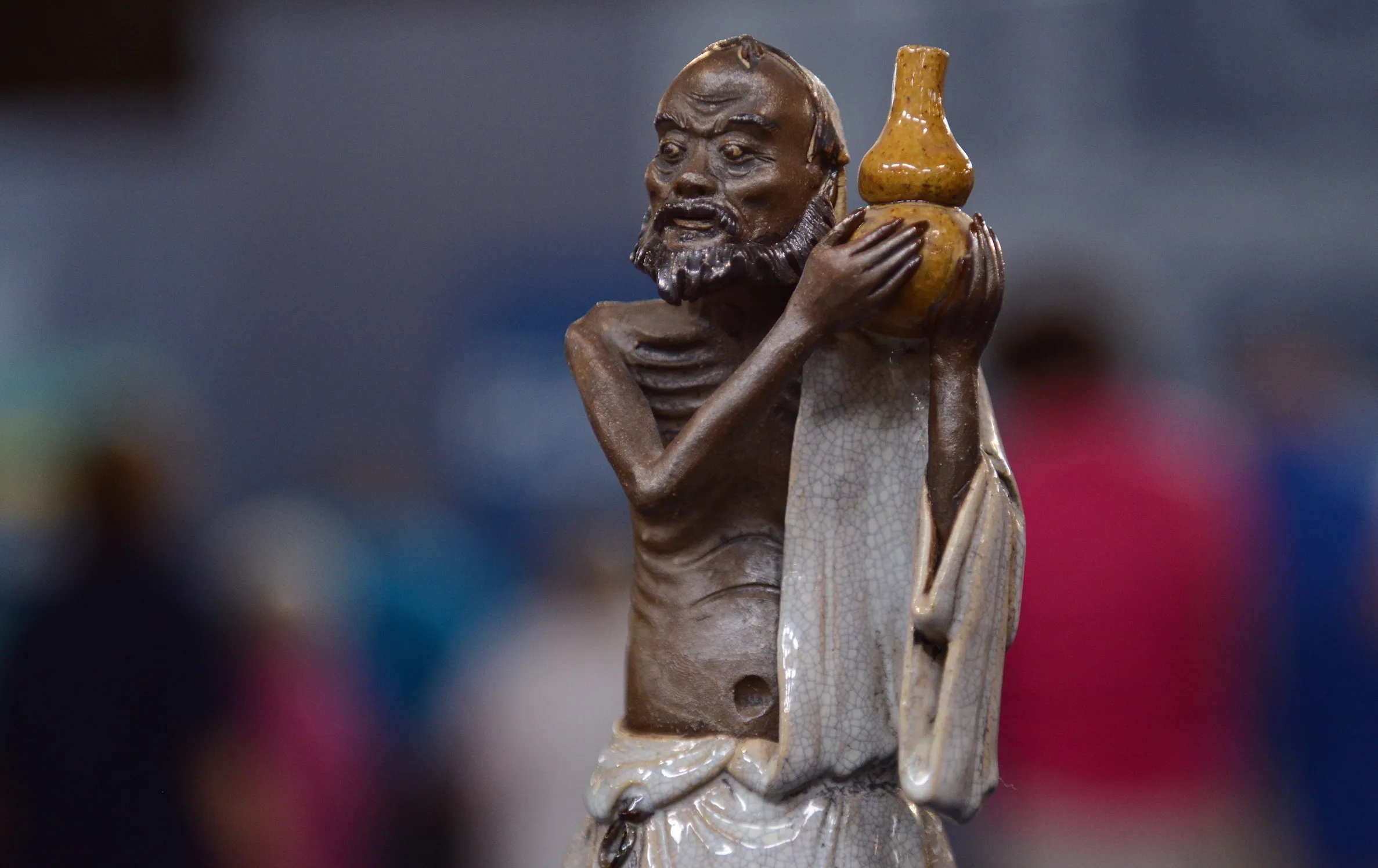
Richard Cervantes appraised this Chinese Li Tieguai Yixing figurine, ca. 1820, for $1,500 to $2,000 at the Fort Worth ROADSHOW in July 2016. He remarked, "We call him Li Tieguai, otherwise ‘Iron-crutch Li.’ ... Well, his crutch is missing [in this particular figurine], which is unusual — but nonetheless, this is certainly Li Tieguai."
Jan 2, 2017
Li Tieguai (Iron-crutch Li) is one of the Eight Immortals (Ba Xian) of Daoism. Li is commonly portrayed as an aged, hobbled beggar, often with bulging eyes and wearing ragged clothing. (As might be expected, he also often holds a crutch, though as Richard Cervantes explained in his July 2016 Fort Worth appraisal of this particular clay figurine brought in by guest Bryan, “his crutch is missing — which is unusual — but nonetheless, this is certainly Li Tieguai.”)
According to the Daoist tradition, Li Tieguai is benevolent to the poor, ill and infirm. Because of this, he also carries a gourd bottle, which contains a healing medicine. Many legends and myths involve Li Tieguai. One legend about how Li came to inhabit his feeble vagabond body is a fascinating tale.
After years of practice and study, Li was capable of separating his spirit from his body in order to travel to celestial realms. At this time, he is said to have been an attractive man. Li asked one of his disciples to look after his body while his spirit left on a celestial visit to his master, the divinized Laozi. Li’s instructions to his pupil had been for him to set fire to his body if he did not return within seven days. While Li’s body lay lifeless, his pupil received news that his own mother was gravely ill, and after waiting six days without the return of Li, the pupil burned Li’s body and set out to reunite with his mother.
Li came back on the seventh day to find his body had been cremated. Concerned he would now cease to exist, Li quickly entered the first available form he could: the body of a poor, elderly beggar who had died of starvation. At first, Li was dejected about his new, grotesque form, but Laozi appeared to him and said that accepting this body could be the last step in Li’s transformation to becoming immortal. Li then realized his physical form was irrelevant, and his path as a wandering healer and guardian of the underprivileged was set into motion.
Related
See the full Appraisal page for this object in our Archive
GUEST: It was given to us as a wedding gift in 1982. We've never known a lot about it. It's been in our family and on our bookshelf. We've always called it "the fertility dude."
APPRAISER: Where do you think he comes from?
GUEST: I've always felt like it was northern Africa just because of the proximity to France, but I really don't know, and everyone seems to suggest that there may be other origins, and I have no idea.
APPRAISER: I think based on the clues, you come up with a very interesting theory, but this fellow's actually Chinese.
GUEST: Okay.
APPRAISER: I think he's actually a very fun character. In the Daoist tradition... of course, there are three great religions/philosophies in Chinese history: Daoism,
Buddhism, Confucianism. This is one of the Daoist immortals. We call him Li Tieguai, otherwise "Iron-crutch Li." Well, his crutch is missing, which is unusual, but nonetheless, this is certainly Li Tieguai, and he embodies some of the ideals of Daoism. He's very skinny and starved, as you see, because he's homeless. He also represents the very, very poor, and he's a benefactor and a protector of the poor in Chinese tradition. This comes from a part of China in the southeast called Yixing. In fact, we refer to this pottery, this very distinctive brown pottery, as yixing ware. It's a kind of clay that is native to that area. They make it into teapots very often. They believe that yixing will absorb the flavor of the tea so much that eventually, you can make tea in a yixing pot without adding any actual tea. It has that quality. It's rarer to find figures made out of yixing. Now, there would have been eight of these originally for the eight immortals. This is just one of those. But you can see the quality is just superb, especially the detailing on the sandals here. To look around and to see some of the exposed ribs, and in the chest, and even the exposed vertebrae in the back, wearing very, very minimal, kind of draped clothing as a poor beggar would. He's just extraordinary, and even his expression with these kind of bulging eyes and this very extraordinary expression, he's so appealing, and I can understand why you've loved this and why this has inspired some theories as to...
GUEST: My whole family's enjoyed it.
APPRAISER: As far as the date, I would attribute this to the early part of the 19th century, perhaps 1810, 1825, somewhere in that pocket. It's quite old for the type. With the glaze, again, it's a rare feature of the piece, but I think it's absolutely fabulous. Do you have any sense of its value, or was it suggested to you?
GUEST: Not at all-- I can imagine some prices in a retail setting, but I'd be guessing.
APPRAISER: Make a guess.
GUEST: Oh, I would think in the hundreds.
APPRAISER: Well, I think you're a little low on this one. If this were to come up for auction in 2016 with the market being strong, an auction estimate that would be fair would be $1,500 to $2,000.
GUEST: Oh, excellent, excellent.
Sarah K. Elliott is a producer for ANTIQUES ROADSHOW and a frequent content contributor to the series website. Sarah has been a producer with the series since 2000.


