Who Faked the Texas Independence Documents?
Time and again on ANTIQUES ROADSHOW, we hear that valuable items can inspire forgeries, and the highly desirable imprints of the 1836 Texas Declaration of Independence did, in fact, spawn some very convincing fakes.
Feb 2, 2015
HOST: The Texas Declaration of Independence declared a free and independent Republic of Texas, permanently severing ties with Mexico in 1836. Appraiser Wes Cowan met up with ROADSHOW at the Texas State Library and Archives to highlight a story about the cherished document and fraud.
APPRAISER: This is a story as big as Texas itself. It involves oversized personalities, it involves oodles of money, and it involves faking some of the cornerstone imprints of the history of Texas. The story starts to unravel in the late 1980s, but it really stretches back probably sometime to the late '60s or early '70s, when there is a sudden interest in Texas history. And there are plenty of people who are willing to pay big money for imprints like this. And this says, "We are free from Mexico, baby," and if you're a collector, that's a thing you've got to have.
HOST: There were about 1,000 of these broadsides...
APPRAISER: Originally printed, that's right.
HOST: So how did it come to be that we even discovered there was a scandal, that these fakes were happening?
APPRAISER: Well, you know, look, in the early '70s, only a handful of copies were known to exist. And then, all of a sudden, there were more copies, and more copies, and more copies. Where were these all coming from? If it weren't for a printer and book dealer, a guy named Tom Taylor, we would not know this today. Tom had sold three copies. We're not talking about a few hundred dollars in the '70s, we're talking about $20,000, $30,000 apiece…
HOST: Certainly.
APPRAISER: …that he was selling. And he started to get a little suspicious, and other dealers were also becoming a little suspicious, so Taylor, the ethical guy that he was, he said, "Boy, I don't want to be selling any fakes. "Let me look at some known copies and compare them "with some of the ones that have appeared on the marketplace in recent years," and pretty quickly discovered some discrepancies between the known original and these more recent copies that had appeared in the marketplace. The one here on the left is an original copy of the 1836 printing of the Texas Declaration of Independence. The one on the right is the fake. The fakes were a little bit bigger. There are corrected pieces of typeface, and there is a spelling error in the fake.
HOST: The telltale spelling error.
APPRAISER: The telltale spelling error. But let me tell you, these fakes fooled a lot of people for many, many years. As Taylor began investigating where all the fakes came from, three names kept turning up. And before long, he was able to pretty definitively identify who the faker was and who were the two people that were then selling the fakes.
HOST: I understand none of them are alive today.
APPRAISER: All dead.
HOST: Were any of them brought to justice on this? Were they ever arrested?
APPRAISER: No. Tom Taylor, to his credit, when he discovered that two documents that he had sold were fakes, he went immediately to his customers and said, "I sold you a fake. Here's your money back."
HOST: Wow-- now let's play a game. What if one of those original 1,000 just kind of... just escapes, shows up someday, and we get our hands on it? What will we expect to pay for this?
APPRAISER: I think that if one of these originals appeared in a public auction, it would easily bring more than $1 million.
HOST: So I should stop looking, or save my money and look really hard.
APPRAISER: I think that's right.
HOST: But it bears to mind, these fakes have a place in history. This is a historical moment, as well, for Texas collectors, and there are only a few of those that we know still exist, and do they have value?
APPRAISER: Well, you know, look. I mean, I think that if I were to be so fortunate as to be an owner of one of these, I'd love to have a fake for my collection. And I probably wouldn't mind paying maybe up to $1,000 for one.
HOST: But more of a novelty than an actual collectible?
APPRAISER: Oh, yeah, absolutely. I mean, the story is so great.
HOST: It's an amazing story. Great to hear from you, Wes, thanks so much.
APPRAISER: It was my pleasure. It's great to see these.
“We, therefore, the delegates with plenary powers of the people of Texas, in solemn convention assembled, appealing to a candid world for the necessities of our condition, do hereby resolve and declare, that our political connection with the Mexican nation has forever ended, and that the people of Texas do now constitute a free, Sovereign, and independent republic...”
— From the Declaration of Independence of Texas, March 2, 1836
Baker and Borden of San Felipe are thought to have printed 1,000 copies of "The Unanimous Declaration of Independence made by the Delegates of the People of Texas in General Convention at the Town of Washington on the 2nd day of March 1836." In the 1960s, over a century later, Texans who had profited in large part from the success of the oil industry began searching for and collecting rare Texana (items with historical and/or cultural significance to Texas). The Declaration broadside was a must-have document to several serious collectors, and copies were being sold for $20,000 or more by the early 1980s. As we've heard time and again on ANTIQUES ROADSHOW, valuable items can inspire forgeries, and the highly desirable imprints of the Declaration did, in fact, spawn some very convincing fakes.
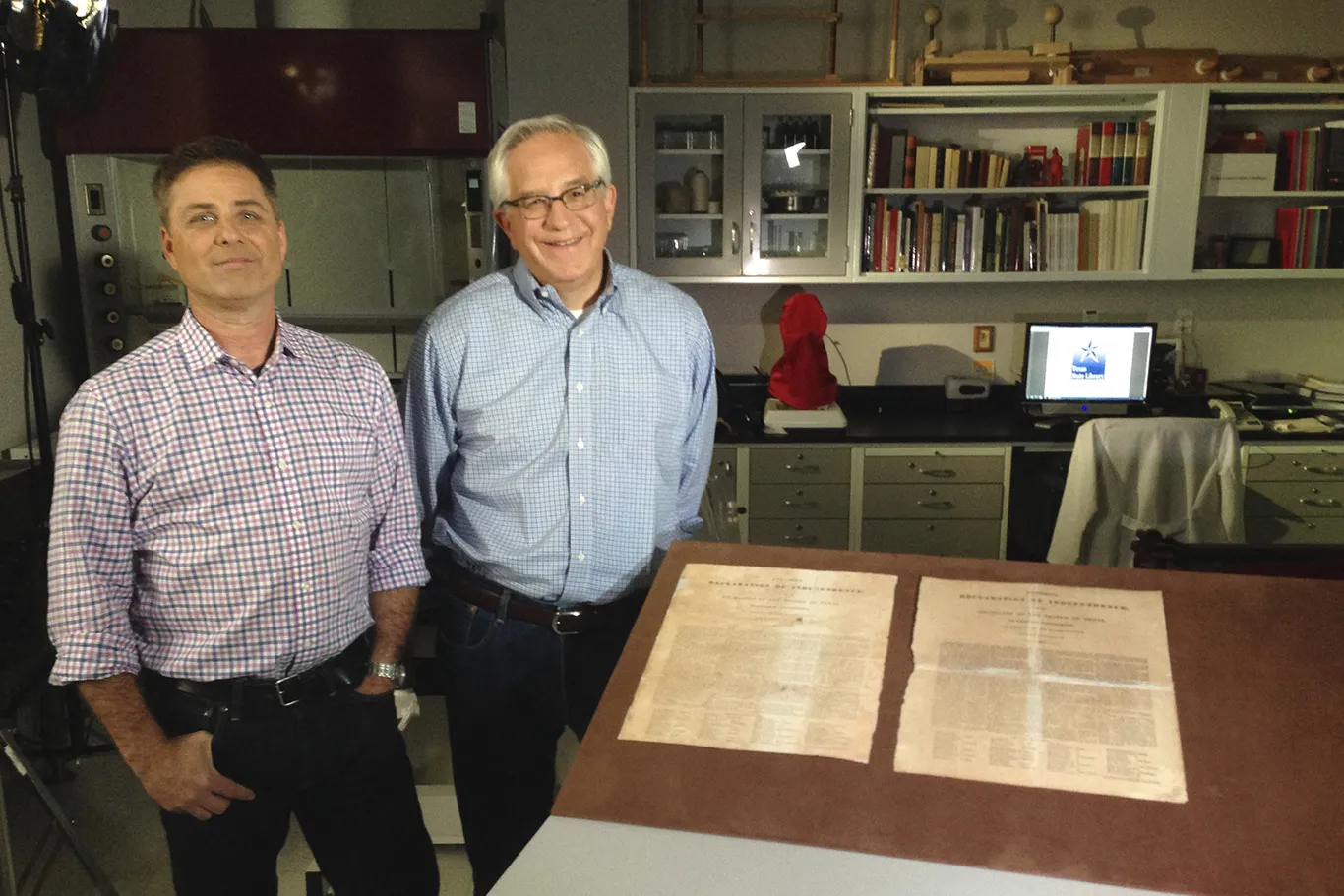
Host Mark L. Walberg and expert Wes Cowan discuss faked Texas Declaration of Independence documents in Austin, Texas.
During our visit to Austin in June of 2014, ROADSHOW host Mark L. Walberg and appraiser C. Wesley Cowan compared an original broadside printing of the Declaration with one of these very good counterfeits at the Texas State Library and Archives Commission (the counterfeit was on loan from the Briscoe Center at the University of Texas at Austin). Cowan discussed how the fraudulent copies were discovered when printer and book dealer, W. Thomas Taylor, became suspicious of the growing number of Declarations on the market. With the help of other experts, Taylor, who had sold three copies of the Declaration himself, was dismayed to discover that a number of copies were forgeries.
As he outlined in his book, Texfake: An Account of the Theft and Forgery of Early Texas Printed Documents, Taylor documented that there were only a handful of known copies of the Declaration in 1970, but by the late-1980s Taylor could find almost 20. This bothered him. After extensive research looking at every copy he could, Taylor determined there were 10 authentic, original broadsides with a legitimate provenance. The rest, he concluded, with their fuzzier type and narrower columns, were forgeries. Tom Taylor followed the ownership trail of the known fakes and discovered that every forgery had been sold by one of three Texas dealers: John Jenkins, William Simpson, or Dorman David.
“These fakes fooled a lot of people for a long time,” said Cowan.
"These fakes fooled a lot of people for a long time," said Cowan. "The one person who finally admitted to faking the documents, long after the fact, was Dorman David." Jenkins and Simpson always maintained that they had no knowledge that anything they sold was a forgery. Cowan added, "Jenkins and Simpson always professed innocence."
David admitted to Taylor and at least two journalists that he had reproduced the Declaration, although he said it was his intention to one day sell them as facsimiles. In a December 1989 New York Times Magazine article, "Lone Star Fakes," reporter Lisa Belkin described what happened:
Over a recent lunch with this reporter, David cheerfully admitted that he had reproduced copies of the Declaration. She continued, David explained that, as Tom Taylor had suspected, he photographed the one genuine copy he owned and made a negative that was much larger than the original. He repaired any damage visible on the magnified copy, then created a zinc plate from the negative and printed his fakes. His ink was a home brew, made by lighting a candle, collecting its smoke in a paper bag, and mixing the carbon that attached to the bag with various oils. His paper came from blank end pages in old books. But why did David make the forgeries? "There's speculation," Cowan explained, "that besides money, of course, there was also, perhaps, ego involved. The faker [David] was a flamboyant dealer who spent huge sums of money to buy rare Texas documents and sell them. He invariably got into trouble though with buying too high [and] that forced him then to sell low. And the same dealers were taking advantage of him, over and over again, and there's some speculation that he did this to get one over on those guys — to knock that chip off their shoulders."

As expert Wes Cowan pointed out in the segment, despite bearing tell-tale signs of forgery, including typographical errors like the one pictured here, fake Texas documents have fooled many people over the years.
Adding up David's complicated history of bad business dealings, alleged participation in a criminal ring that stole countless historic documents from public institutions (some purported to have been sold at his auctions), and several years of drug abuse and running from the law, Taylor pointedly directs his readers in Texfake how to draw their own conclusions about David's intentions with the Declaration copies.
Once he uncovered the truth, Taylor knew that two of the three Declarations he had sold were counterfeit. He reimbursed those clients.
No one was ever prosecuted for creating or selling the forgeries. John Jenkins died in 1989 under mysterious circumstances, his body found near Bastrop, Texas, with a bullet in the back of his head (the local sheriff declared it a suicide). William Simpson died in 2001. Dorman David died in 2013.
The price for an authentic Declaration of Independence of Texas today could fetch up to $1 million, according to Cowan. But do the fakes have value? "If you own the original, you gotta have a fake, right? I mean it's a big story and it's part of the whole history of the document. … What would a collector who owned the original pay for a fake? A thousand dollars maybe? Maybe."
Related Resources
Texfake: An Account of the Theft and Forgery of Early Texas Printed Documents, by W. Thomas Taylor, 1991
Unanimous Declaration of Independence by the Delegates of the People of Texas, at the State Library and Archives Commission
Sarah K. Elliott is a producer for ANTIQUES ROADSHOW and a frequent content contributor to the series website. Sarah has been a producer with the series since 2000.


