Nov 2, 2016
Originally published on: Jun 24, 2013
GUEST: My wife and I bought it at an auction. It was with some other pewter pieces. We have a lot of early-American pewter. But there was something about this that just spoke to me.
APPRAISER: And you have a price guide that you brought in.
GUEST: Yeah, we did some research trying to find something. It's marked on the bottom by the artist's name, and we have a piece here by the same artist who was sold at Christy's in 1994.
APPRAISER: Right, by Frederick Bassett.
GUEST: Frederick Bassett, right.
APPRAISER: New York City pewter. In your piece, this inkwell, the top opens up, and the quill comes in, of course, to...there might have been a little porcelain dish in there to hold the ink. It is marked Bassett. And I won't drag this out because I don't like...I have a lot of fun on this show, it's great, and you're a great guy, and I really mean this.
GUEST: I appreciate it.
APPRAISER: And I know this is marked Bassett, but one of the things that's good on this show is to learn what a fake is. And this is a fake.
GUEST: Right, okay.
APPRAISER: I want to tell you that off the bat, so you don't get your hopes up.
GUEST: Good, well, I'm glad you did. Because that's what I wanted to know.
APPRAISER: And I'll tell you, Richard, first of all, why this is a fake. First of all, pewter is an alloy, as you might know, with copper, lead, tin, and a little bit of antimony. And this has a lower percentage of lead than you'd usually expect for a Frederick Bassett piece. Usually those have a darker color. There's more lead in there. And that's why a lot of people ended up with lead poisoning. Of course, drinking out of these things, like tankards. Nobody drank out of this. But what this might have been made of is it's an inkwell probably made out of the dome... You see this dome here?
GUEST: Right.
APPRAISER: Of another piece. Okay, and a piece maybe from the 1820s or something, or early 19th century. And it's probably been reconfigured into an inkwell.
GUEST: Okay.
APPRAISER: On the bottom, what they've done is recreated Frederick Bassett's mark. You could see here F. Bassett. The letters are block letters, and on the fake marks, they're just a little too stiff. These ridges of the mark are very thick. Do you see all these lines from these flowers, and on the eagle, it almost looks like a decal. A very commercial looking mark. Also, do you see the abrasion that's on here, this rubbing?
GUEST: Right.
APPRAISER: And it looks like somebody sat there and scrubbed it.
GUEST: Yeah, okay.
APPRAISER: And somebody did that to wear away part of that mark, Richard. You can actually see the direction of the scraping. Where natural wear on the bottom of a pewter piece is kind of uneven and bumpy, and it doesn't... You can see that even where this is worn, this is a low point on the bottom. So natural wear, if I went like that with it on cement, it wouldn't wear like that. Somebody just said, "Let's make this look old."
GUEST: Okay.
APPRAISER: So basically you have two fake marks for Frederick Bassett, who was really a famous pewter maker. He worked in New York between 1761 and 1780. And this would have been from his early period.
GUEST: Okay.
APPRAISER: And had it been, it probably would have been upwards of $15,000 as a rare Frederick Bassett inkwell.
GUEST: Right.
APPRAISER: Because inkwells from early makers like this, from the 1770s, don't turn up.
GUEST: Exactly, right.
APPRAISER: But thanks for being a good sport about it also.
GUEST: No, I appreciate it. That's why I came. I wanted to know if it was real.
APPRAISER: It's probably worth about I'd say...if I had to put a value on it still, about $250 to $300.
GUEST: Okay.
APPRAISER: Okay?
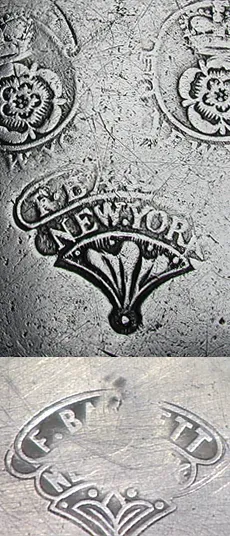
The real Frederick Bassett marks, top, are more detailed with uneven wear. The fake, bottom, is blocky and flat, showing signs of artificial wear.
(Image of real mark courtesy of Wayne & Phyllis Hilt, Hiltpewter.com)
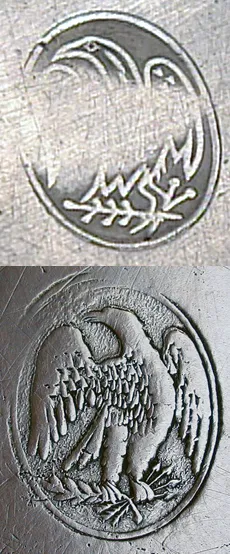
The fake eagle mark, top, is not typically associated with Frederick Bassett, but most closely resembles the real mark, bottom, of Thomas D. Boardman.
(Image of real mark courtesy of Wayne & Phyllis Hilt, Hiltpewter.com)
"I won't drag this out," Leigh Keno said during his appraisal of a Frederick Bassett pewter inkwell at ANTIQUES ROADSHOW's 1998 appraisal event in Los Angeles, "but one of the things that's good on the show is to learn what a fake is, and this is a fake." No less intrigued by his object, Richard, the owner of a pewter inkwell, was eager to learn more about his piece. He'd brought in a catalogue that included other Frederick Bassett pewter items, conjecturing that his piece fit in stylistically. The mark on his piece displayed "F. Bassett" with a fan design, which meant that it could be associated with highly regarded 18th-century New York pewter maker Frederick Bassett (1740-1800.) It also showed a simple eagle mark, which displayed signs of wear. In order to illustrate Keno's explanation of the difference between the real and fake marks, ANTIQUES ROADSHOW researched examples of these particular designs and has shared them in this feature for consideration.
Keno pointed out several "red flags" associated with this piece. As he showed, seeing and feeling the object helped determine whether or not it was real. While maker's marks were created to help identify different craftsmen and to ensure a piece's authenticity, the designs have been copied to augment value on cheap imitations.
In this case, the Frederick Bassett mark is incorrect for a number of reasons. Keno observes that the fake mark uses a stiff, blocky and flat font, unlike the real version. In researching real versions of these marks to associate with Keno's appraisal, it seems as though the eagle most resembles those featured on the pewter pieces of American maker Thomas D. Boardman (Hartford, CT, 1805 - 1870), not one of Frederick Bassett's marks. "It almost looks like a decal," Keno said, "a very commercial-looking mark."
Both marks on the inkwell show signs of artificial wear, Keno describes. Consistent rubbing dulled part of the imprint, giving it too streamlined an effect in contrast to natural wear, which would be more uneven and haphazard. "It looks like somebody sat there and scrubbed it," Keno said, "and somebody did that to wear away part of that mark."
By looking at the shape of it, Keno said that the inkwell was probably made from the dome of another piece from the early 19th century, to which somebody added the fake marks. Had the piece been real, "it probably would have been worth upwards of $15,000 as a rare Frederick Bassett inkwell because inkwells from early makers like this from the 1770s don't turn up," Keno said. Keno appraised the piece for $250 to $300, a value that has stayed the same 15 years later.
Related
Dylan Hayley Leavitt was ANTIQUES ROADSHOW's digital associate producer from 2012 to 2017.


