The Mysteries of Golf: What's In A Swing?
Can anyone solve the mysteries of golf? John Falter explores a plethora of swings in his Saturday Evening Post cover, "Golf Driving Range."
Oct 18, 2016
Originally published on: Apr 6, 2016
GUEST: I got it through my father. It was something that he had in his home for many years, and when he passed on, it was willed to me, and we've had it hanging in our living room ever since.
APPRAISER: And do you know who the artist is on this?
GUEST: It's John Falter. He's an illustrator, done a number of things for The Saturday Evening Post.
APPRAISER: What was this referred to as?
GUEST: It's called "The Driving Range," and it's a number of different poses of people in various stages of good or bad golf.
APPRAISER: Are you a golfer yourself?
GUEST: I am, yes, so it kind of has some special meaning.
APPRAISER: Yeah, do you identify with any of these characters?
GUEST: With a number of them over time.
APPRAISER: Yeah, your swing changes.
GUEST: Your swing changes, exactly right.
APPRAISER: Well, it's interesting. John Falter did a lot of work for The Saturday Evening Post. He did about 185 covers for them. He was born in 1910 and lived to about 1982. When did your dad get it?
GUEST: He got it back in the '70s, I believe. It was hanging up in the offices where he worked as kind of a rotating exhibit, and when it was time to move out, he contacted the artist to see if he could purchase it. They went back and forth and settled on a price, and that's how he ended up with it.
APPRAISER: How much did he pay for it?
GUEST: He paid $2,500.
APPRAISER: An interesting cover. You know, what's nice about it, it has a lot of appeal to it. Not only is there a lot of interest in illustration art these days, but also, this has appeal to golfers, as well. And going through, it's just really fascinating, all the anecdotes and little stories in here. And he writes in a letter here, he explains all of them. Some of these things, he has which types of swings he's trying to show here, like the low energy shot, over-extended backswing. And we can go up here and look at them and you can sort of go through these. Here's the Fall Forward. And then the Fall Back. And then the Lesson. Here's a man giving his wife a lesson. She doesn't look too pleased with him at that point. The guy here that says he looks really good, but doesn't hit very well. And one of my favorites up here is the Embraceable Youth, the golf lesson there in close quarters. But what's the centerpiece, I think, is this fellow here. You knew in the day, the most famous golfer in the day was Bobby Jones. And he refers to that as Bobby Jones. It also shows an interest in night things. One of Falter's most famous covers is a night game at Yankee Stadium. And also, in post-war, a lot of night sports. And this is what's going on. This is all under the lights here. We have these lights at night at the driving range. Also, you see it's expensive back then. Even 75 balls then is a dollar. That was a lot...
GUEST: A lot of money, yeah.
APPRAISER: For 1952, if you go to the driving range a lot. It's a really good example, and illustration art is one of the hottest things in American art market today. We think of Norman Rockwell and James Montgomery Flagg, but Falter's also one of those artists in the illustration pantheon. He's lesser liked than those, but still fairly valuable. Have you had it appraised, or...?
GUEST: About five or six years ago, we had it appraised for about $80,000.
APPRAISER: For insurance?
GUEST: For insurance purposes.
APPRAISER: That's interesting because in that time, in the last five or six years, the market has really gone up for illustration art. And in fact, he's recently spiked some prices at auction well into six figures.
GUEST: Oh.
APPRAISER: And one of the nice things about this painting is the fact that you have the letter here as well. That adds a certain amount of value to it because it's not just the painting, but you have the explanation, and that enhances the cachet of the piece. Right now, in 2014, it is really sort of at... not quite the peak, but it's really a high time for illustration art. If I were to insure it today, I would probably insure it for over twice that. I would put an insurance value of about $200,000 to $250,000 on it.
GUEST: Really? Wow. I need to make a phone call.
It's a very personal moment, setting up that perfect drive: you grip the club, strategize your aim, place your feet just so, and take a swing. Achieving the perfect drive takes a lot of practice and a dash of magic, which is what artist John Falter depicted in his 1952 cover for the Saturday Evening Post called "Golf Driving Range." A driving range filled with aspiring masters, the scene is set under the lights, which as appraiser Alan Fausel described at the June 2014 ANTIQUES ROADSHOW event in Birmingham, fell in line with other nighttime works by Falter. It also reflects the growing popularity of leisure sports during the prosperous postwar United States. Venues like driving ranges began to remain open at night during the nighttime to accommodate and incentivize increased use, and the cost to play was not inexpensive. "Even 75 balls then is a dollar," Fausel notices written in the painting.
“I tried to represent all of the bad swings in golf, as I know them and I should know I had them all.”
Falter’s goal in creating the piece wasn’t just to highlight a sport with growing popularity. “The idea of this cover came from the frustrations of the artist to solve the mysteries of Golf,” he wrote in a personal letter from 1978. In it, he reminisces about playing "Nebraska corn field golf that considered sand greens total luxury” as a youth. Later after the war when Falter was living on the East Coast, he picked up the sport again and became a "golf nut," still entranced by its complexities. "Golf Driving Range" illuminates the humorous, embarrassing, frustrating, and gratifying experience of practicing a golf swing, one that Falter understood intimately well.
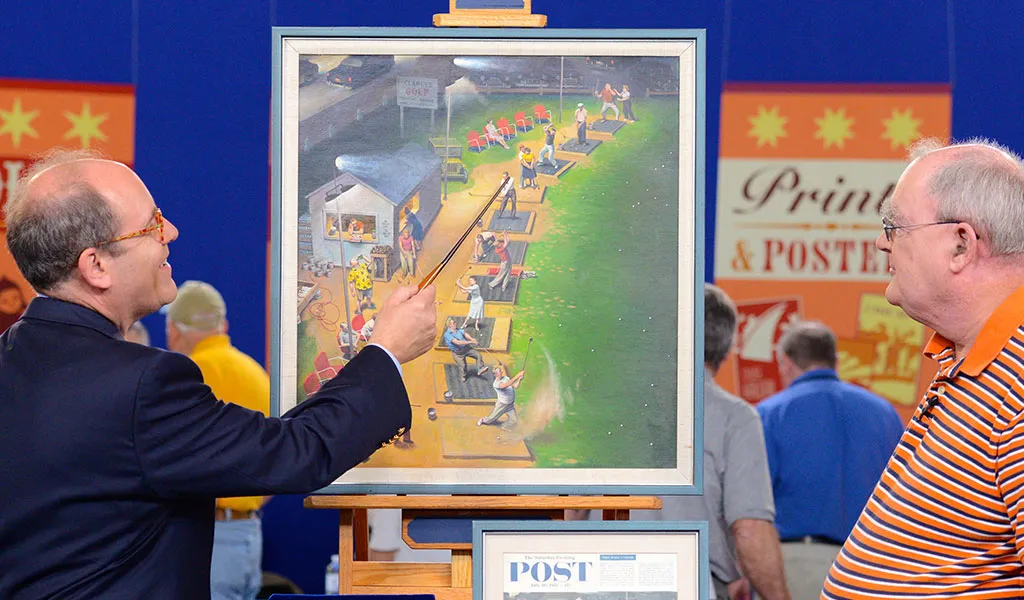
American paintings expert Alan Fausel points out a few of the figures featured in John Falter's original oil painting, "Golf Driving Range."
The letter below sheds more light on the caricatures in the painting, representing such well-known forms as the overextended back swing, the "eager beaver," and the fall back. It even features famous golfer Bobby Jones, whose presence adds contrast to the hackers seen across the canvas. According to Fausel, the letter adds to the value of the painting because it provides explanation, "and that enhances the cachet of the piece.” In the American art market today, "illustration art is one of the hottest things," Fausel said, comparing Falter to such illustration artists as Norman Rockwell and James Montgomery Flagg. In June 2014, Fausel placed an insurance value of $200,000 to $250,000 on the painting. A few months later in November 2014, the painting sold at auction for $197,000.
Read John Falter's full letter below.
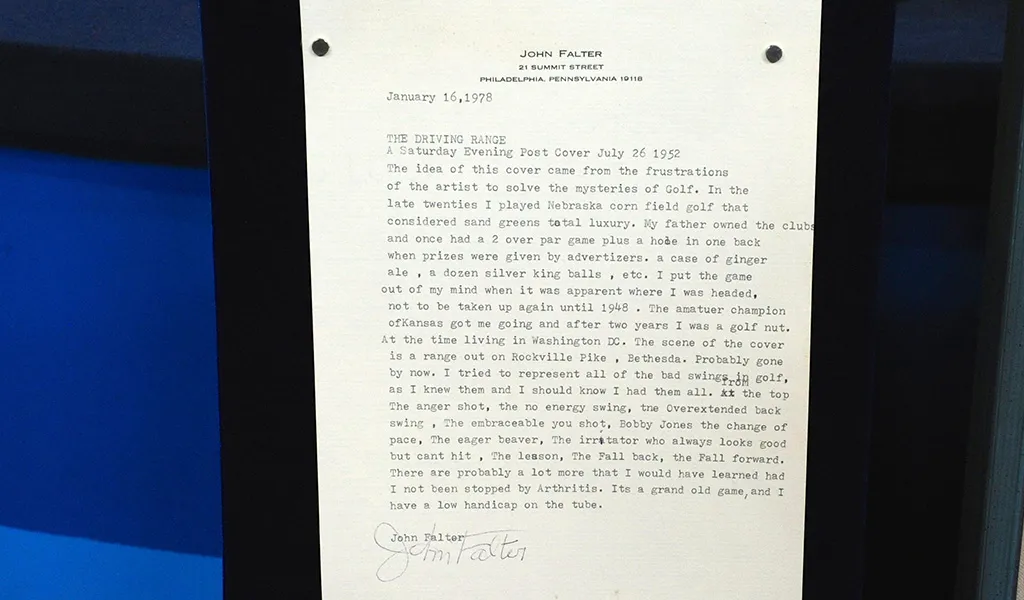
Falter wrote a personal letter in 1978 explaining the painting, writing, “The idea of this cover came from the frustrations of the artist to solve the mysteries of Golf.”
Dylan Hayley Leavitt was ANTIQUES ROADSHOW's digital associate producer from 2012 to 2017.


