See Frank Schoonover's Studio
During ROADSHOW’s visit to Winterthur, one guest brought in a painting by artist Frank Schoonover, and re-lived the memorable day of purchasing the painting at Schoonover’s studio with his family.
Jan 6, 2020
BY Juliet Fusco
At the 2019 ANTIQUES ROADSHOW event at the Winterthur Museum, Garden & Library in Delaware, a guest named Dennis brought in a 1923 Frank Schoonover oil painting on canvas titled, “Privateers of ’76,” that he had inherited from his parents. Frank Schoonover was a popular illustrator in the early part of the 20th century, known for illustrating classic books such as Robinson Crusoe and Swiss Family Robinson. He also illustrated Zane Grey western novels and produced illustrations for magazines. Dennis told Paintings & Drawings appraiser Debra Force how in the 1960s his mother had slowly saved from her $25 weekly food budget, over two years, until she could buy the painting for her husband.
“You can go down to the Schoonover studio and pick out a painting,” read the card that Dennis’s mother addressed to her husband. Dennis told Force how his family went to Schoonover's studio together to choose a painting. He recalled the studio having “dark, wooden floors,” with “big windows at one end” and “partially completed canvases.”
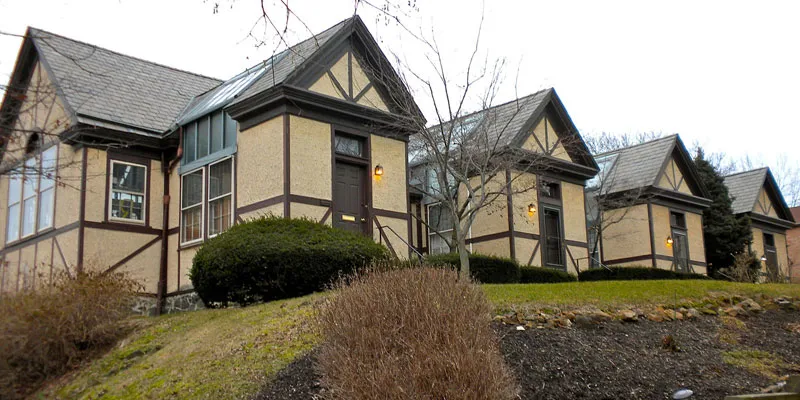
Fans of Schoonover can visit the studio today, which is located on North Rodney Street in Wilmington, Delaware, or visit the website to get a glimpse of what Dennis’s family experienced that day in the 1960s. The website also details a short history of the studio and provides a catalog of works by Schoonover and his mentor, Howard Pyle.
In the late 19th-century, illustrator Howard Pyle settled in Wilmington — then the “epicenter of American Illustration” — and built a boarding house for his incoming students. Still in need of more space for his pupils, Pyle’s two protégés, Stanley Arthurs and Frank Schoonover, enlisted support from philanthropist Samuel Bancroft, Jr., the CEO of Bancroft Mills, to build a four-studio building, which opened on March 8th, 1906.
Over the years, numerous artists and illustrators spent their time at the studio, including N.C. Wyeth. But only Schoonover spent his whole artistic career at the studio, and eventually came to own the property. Today, the studio is owned and run by his grandson, John Schoonover.
Back in Winterthur, Force gave Dennis’s painting a retail value of $125,000.
Watch the segment below and
click here to explore Frank Schoonover's studio!
GUEST: Well, I inherited this painting from my parents. My mother wanted to give my father a gift that he would really love, and he loved reading to his children books that had illustrations.
APPRAISER: Mm-hmm.
GUEST: And this is one of the illustrations. She knew how much he would love to get one of those, so she decided that she needed to make this a secret. So what she did was, she saved five dollars from her food money every week for probably two years.
APPRAISER: Oh, wow, that's amazing.
GUEST: And didn't tell him this.
APPRAISER: Right.
GUEST: And then it was either his birthday or their anniversary, gave him a card that said, "You can go down to the Schoonover Studios and pick out a painting."
APPRAISER: Oh, that's...
GUEST: And he was elated, to say the least.
APPRAISER: Oh, how exciting.
GUEST: And so we went down as four kids and a mom and dad, and we chose a painting.
APPRAISER: Oh, terrific.
GUEST: What I remember-- this would have been in the early '60s, early to mid-'60s, I'll say...
APPRAISER: Mm-hmm, okay.
GUEST: ...dark wooden floors, paint, I think there were big windows at one end.
APPRAISER: Mm-hmm.
GUEST: And there was partially completed canvases here. There was, you know, old, probably, I'll say, discarded ones there. And you know, then there was... There was sort of stacks of them.
APPRAISER: Mm-hmm.
GUEST: This is the one with a clipper ship, which he thought was extraordinary.
APPRAISER: Great.
GUEST: And then this galleon, and, I don't know, he just... He settled on that one, and we all, of course, were thrilled.
APPRAISER: Oh, that's great.
GUEST: And we literally loaded it into the car.
APPRAISER: And so it's been in your family ever since.
GUEST: Ever since.
APPRAISER: And the title of the painting is...?
GUEST: "Privateers of '76."
APPRAISER: Right. The story was written by an author named Ralph D. Paine, who apparently wrote several books in the early 20th century, and a lot of them relating to history. On the back we have the inventory number for the painting, which is number 1248.
GUEST: Mm-hmm.
APPRAISER: There is a label, which actually is handwritten, and maybe by Schoonover himself, that says that it's from chapter 13. The title of the illustration is: "At A Hail From the Boat, He Went to the Rail." At the hail of the boat, meaning the one below, the figure on top comes to the rail. Now, Schoonover, uh, of course, is one of the premier artists of the Brandywine School, and he studied with Howard Pyle...
GUEST: Yes!
APPRAISER: ...who's considered the father of the school...
GUEST: Yes.
APPRAISER: ...um, at Drexel Institute in Philadelphia.
GUEST: Oh, I didn't know that.
APPRAISER: And Schoonover was very good at, at wanting to get to reality. So not only did he go out west, but he also went down to the bayous in Mississippi to sort of get a sense of how the pirates would have lived in that environment. He had a house in Bushkill, Pennsylvania, in Pike County, which is in the Poconos.
GUEST: Mm-hmm.
APPRAISER: And he would spend his summers there. But he used the landscape of that area in, in many of his paintings.
GUEST: You know, I think that the card that Mr. Schoonover gave my parents when they purchased this said that it was painted in Bushkill-- is that what it's called?
APPRAISER: Yes, Bushkill, Pennsylvania.
GUEST: Yes, yeah.
APPRAISER: And certainly he was very popular, um, especially in the early part of the 20th century, because he illustrated such classic books as Robinson Crusoe...
GUEST: Mm.
APPRAISER: ...Swiss Family Robinson, and he did a whole series of books for, um, uh, on Zane Grey, uh, Western novels.
GUEST: Oh, really? Oh, my gosh.
APPRAISER: So, he was quite into it, as well as magazine illustrations.
GUEST: Mm.
APPRAISER: He was born in 1877 and he actually lived till 1972. So he was primarily painting in the early 20th century, and really, I think, up until he passed away. The painting, of course, is oil on canvas, and it looks like the original frame. This painting is dated in the lower right, '23, 1923, and that's when the novel was first published.
GUEST: Mm.
APPRAISER: He is popular as an illustrator nationwide. If this were in a gallery, I think that it would sell in the range of, uh, $125,000.
GUEST: (laughs) I know you're kidding me.
APPRAISER: No, I'm not kidding you.
GUEST: (laughs)
APPRAISER: It's a wonderful...
GUEST: (voice breaking): Really?
APPRAISER: Yes.
GUEST: Really?
APPRAISER: It's a wonderful painting.
GUEST: (inhales, exhales deeply) My father would be so thrilled to know that people were being turned on to illustrations.
APPRAISER: Yeah.
GUEST: And my mother would be really thrilled at what you just said.
APPRAISER: Yeah.
GUEST and APPRAISER: (both laughing)
APPRAISER: Well, it means that her investment was a good one.
GUEST: Oh, yes! Oh, yes! (laughs) (quietly) Wow.
APPRAISER: There's a big surge of interest in illustration.
GUEST: Well, I love this painting.
APPRAISER: Yeah.
GUEST: I love this painting.
Juliet Fusco is a former intern for ANTIQUES ROADSHOW.


