Psychedelic Style at the Apple Boutique
The store was "a beautiful place where beautiful people [could] buy beautiful things.”
Oct 18, 2016
Originally published on: Oct 19, 2015
GUEST: I brought these pieces from the Beatles' Apple Boutique. I was there in 1968 in London. I got homesick and decided to spend all my money and get these clothes and come home early.
APPRAISER: So you chose clothes over staying in London?
GUEST: I was there for six weeks, and I, I was gonna stay another month, but I just fell in love with the clothes.
APPRAISER: The clothes you bought are completely iconic from the late '60s. Do you know anything about the Apple Boutique?
GUEST: Yes, I was there when it had only been open for a few weeks. It was open for seven months, I think, before they closed it.
APPRAISER: That's right. They were open in December, they had a big party-- Pattie Harrison, Eric Clapton, a lot of the pop icons of the time were
there. This was the first business venture of the Beatles outside of entertainment.
GUEST: Yes.
APPRAISER: And it's the first actual apple logo that the Beatles used outside of the record world. And all of your pieces have this fabulous label here,
with the psychedelic apple. The reason the store only existed for seven months was because the people that worked at the store would steal the
clothes, the customers would steal the clothes, and the owners, the Beatles, thought it was very uncool...
GUEST: (laughs)
APPRAISER: ...to complain or do anything about it. So they were losing money. Their clothing was designed by The Fool, which was a artistic collective. Some of the designers were Dutch and some British, and they combined their talents to design clothing. They also designed the mural that was in front of the shop...
GUEST: Yes.
APPRAISER: ...which became very controversial. Did you see that?
GUEST: It was-- I did. It was wild. It was just very bright and colorful and you couldn't miss it.
APPRAISER: Psychedelic.
GUEST: (laughing): Yes. Very psychedelic.
APPRAISER: Well, they later got in trouble and had to paint it over white. The clothing you brought is a complete time capsule. It reminds me of the "Sergeant Pepper" years...
GUEST: Yes, they do.
APPRAISER: ...because that's, album had just come out when they were designing these clothes. Do you remember what you paid for any of them?
GUEST: For the lot of them, I think I paid close to $500.
APPRAISER: If you were to have these pieces at an, auction value today... They rarely come up on the market. I've never seen any Apple clothing.
I think this collection would be valued between $15,000 and $17,500.
GUEST: Wonderful.
APPRAISER: Easily. This dress woven with a very psychedelic pattern and early lurex, which is the sparkly threads, I noticed that it has a tag
hanging on it. Can you tell me about that?
GUEST: Well, I just realized that I still had the tag until just recently, and I thought... I never wore this one. It's just, uh, in, in the closet.
APPRAISER: Well, that one actually makes it more valuable, that you haven't worn it. So that one's probably worth 20% more than the others. So I, I would put that one at $3,500 to $4,000.
GUEST: Oh, good, thank you.
The corner of Baker Street and Paddington Street in London became the apex of psychedelic chic in December 1967 when the Beatles opened their Apple Boutique, an extension of their nascent brand, Apple Records. Adorning the shop's exterior was a vibrant mural designed by the Dutch art collective The Fool, featuring undulating colors and a mesmerizing motif. According to Paul McCartney at the time, the store was "a beautiful place where beautiful people [could] buy beautiful things.” At the 2014 Chicago ANTIQUES ROADSHOW event, a group of outfits purchased from the Apple Boutique in 1968 caught the eye of appraiser Karen Augusta, who said they were "completely iconic from the late 60s." Sumptuous, shimmering, and lavish, their beauty was certainly distinctive. Augusta gave an auction estimate for the group of $15,000 to $17,000.
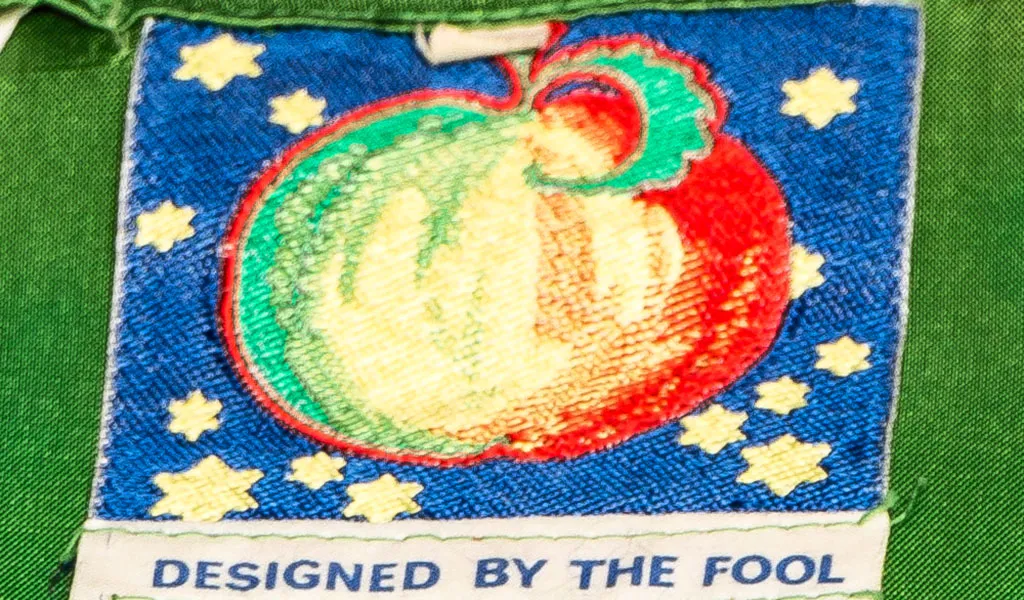
The clothes purchased from the Apple Boutique were iconic ensembles designed by the Dutch art collective, The Fool. This particular label shows the boutique version of the Apple logo. ©2014 Augusta Auction Company. All Rights Reserved
The Apple Boutique had a quality often shared by beautiful things: ephemerality. As the first business venture for the Beatles outside of entertainment, and the first time the Beatles used the Apple logo outside of the record world, the boutique epitomized experimentation in style, expression, and taste. The influence of The Fool gave the boutique its conspicuous appeal. Led by Simon Posthuma and Marijke Koger, the collective created colorful clothes not only for the boutique but for the Beatles' personal closets, too. One their Beatles commissions included the inner sleeve of the Sgt. Pepper's Lonely Hearts Club Band album, as well as front cover of the album that was never used. So when it came to designing a mural for the store building façade, The Fool took advantage of the large canvas they'd been given. But permission for painting the mural had not been granted, and thus Westminster Council required the wall to be repainted white. This marked the beginning of the boutique's downfall.
The store had a problem with liberation — of the shoplifting sort, that is. "People that worked at the store would steal the clothes, the customers would steal the clothes, and the owners, the Beatles, thought it was very uncool to complain or do anything about it, so they were losing money," Augusta said. The Apple Boutique only ended up staying open for seven months, closing on July 30, 1968. Instead of a conventional liquidation of assets, the Beatles decided to give away all products, first keeping some for themselves and their friends, then disseminated them to the public.
Despite the boutique's failure, the building was converted to apartments in 2013 as an homage to the Beatles' venture, calling the units the Apple Apartments. Although the mural is no longer present, that particular street corner is seeking to revitalize its distinctive beauty once more.
Take a look at the original mural below, which was painted over shortly after its creation.
Related
Dylan Hayley Leavitt was ANTIQUES ROADSHOW's digital associate producer from 2012 to 2017.


