Paul Revere: Plagiarizing Patriot?
During ANTIQUES ROADSHOW's June 2012 visit to Boston, appraiser Wesley Cowan and host Mark Walberg visited The Old State House to discuss the little-known pre-Revolutionary feud between one-time friends Henry Pelham and Paul Revere. Their dispute stemmed from a picture that Pelham had designed depicting the deadly incident later dubbed the Boston Massacre, which had erupted in front of the Custom House on the evening of March 5, 1770.
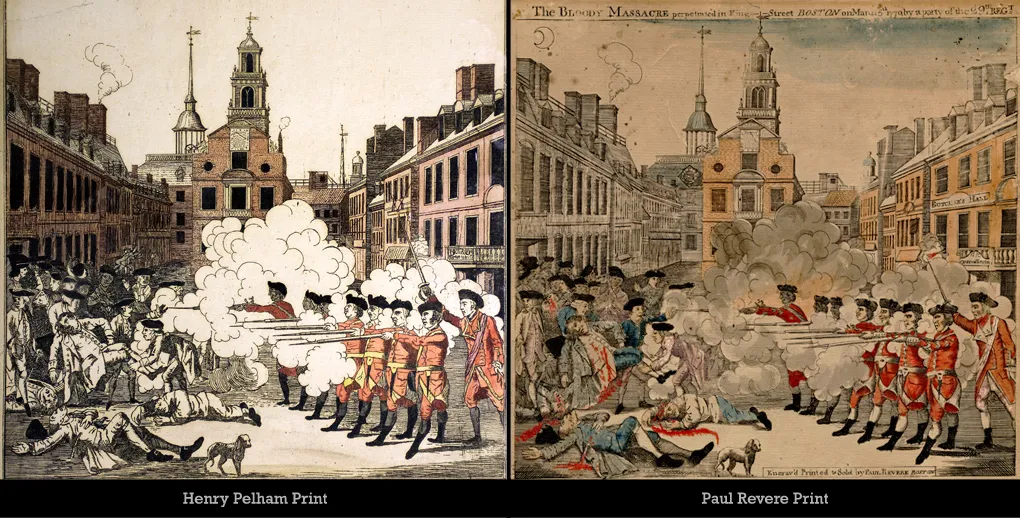
Paul Revere's version of the Boston Massacre (right) is slightly more colorful, but suspiciously similar in almost every detail to the drawing (left) that Henry Pelham, a Boston engraver and acquaintance of Revere's, had made only days before and planned to print. Unfortunately for Pelham, it was Revere's print that would gain wide circulation and acclaim.
Oct 19, 2016
Originally published on: Jan 28, 2013
During ANTIQUES ROADSHOW's June 2012 visit to Boston, appraiser Wesley Cowan and host Mark Walberg visited The Old State House to discuss the little-known pre-Revolutionary feud between one-time friends Henry Pelham and Paul Revere. Their dispute stemmed from a picture that Pelham had designed depicting the deadly incident, later dubbed the Boston Massacre, that had erupted in front of the Custom House on the evening of March, 5, 1770.
HOST: Here in Boston, structures, monuments and markers permeate the city as reminders to its important role in the Revolutionary War. Five victims of the Boston Massacre rest here at the Granary Burying Ground, only steps away from where they were shot. Near them lies Paul Revere, whose famous depiction of the incident fanned the flames of anti-British sentiment. Appraiser Wes Cowan joined me at the Old State House to discuss some lesser-known details of this revolutionary print. Wes, here we are at the Old State House in Boston, and it was right here where the Boston Massacre happened nearly 250 years ago.
APPRAISER: That's right, Mark. This was a pivotal moment in the history of the American Revolution. It's March 5, 1770, dusk is falling. There was a British soldier named Hugh White standing on the steps to the Custom House, guarding the entryway. A Bostonian walks by, hurls an insult at this British soldier, words are exchanged, Hugh White ultimately bludgeons one of the citizens with his rifle, a mob forms, snowballs are thrown, ice is being thrown, and eventually all hell breaks loose.
HOST: And shots were fired.
APPRAISER: That's right. Five Americans were killed, six were wounded. That's what we've come to know as the Boston Massacre.
HOST: And that event inspires this Paul Revere print, entitled "The Bloody Massacre."
APPRAISER: Well, I wouldn't exactly call it Paul Revere's print.
HOST: Why wouldn't you call it Paul Revere's print?
APPRAISER: Well, Revere copied this print from a fellow artist and engraver here in Boston named Henry Pelham. He made the drawing, showed it to Revere, and Revere then copied it before Pelham had time to bring it to press.
HOST: So you're saying Revere plagiarized this?
APPRAISER: Well, that's pretty strong, but I guarantee you that's what Pelham would have said. Pelham was furious, and he actually wrote Revere a letter. We don't know that Revere ever got the letter, but the letter basically said, "This is the most dishonorable thing "that I can imagine somebody doing. "You stole my advantage. I had already paid for all the paper and engraving." And he basically called him a highway robber.
HOST: So do you think Revere did this to get the edge on Pelham?
APPRAISER: One could argue that, but it's also important to remember that Revere was a patriot, and he was staunchly against British rule. It's a piece of propaganda. The print shows British soldiers firing indiscriminately into this crowd, and that's not exactly what happened. But Revere recognized that this would be a galvanizing image. He knew it was going to incite sentiments on the American side, but he also may have wanted to get the jump on Pelham because he knew he could maybe make a buck.
HOST: And did Pelham ever release a copy of his print?
APPRAISER: He did, two weeks after Revere issued his. He titled his, "The Fruits of Arbitrary Power, or the Bloody Massacre." And when you look at the two prints, you'll see that there's subtle differences, but they're very, very similar.
HOST: How many did Pelham make?
APPRAISER: Well, we don't know that. We do know one thing: that only two have survived.
HOST: And Paul Revere's print of the Boston Massacre, how many of those were made?
APPRAISER: Well, about 200, and there are at least 25 known copies still existing.
HOST: When original copies of Revere's print come to market, what have they gone for?
APPRAISER: One recently sold for just about $150,000, but that's not the record. About ten years ago, one sold for more than $200,000. So $150,000 to north of $200,000. The Pelham print is really rare, but it's probably not as desirable as Revere's print. If one were to come up at auction, I would expect it to have an estimate of at least $50,000 to $70,000. And this is a great example of one of those things where rarity does not necessarily equate with value.
HOST: Well, Wes, thanks so much for sharing all this information. It's just fascinating.
APPRAISER: Oh, it's great to see this print.
Not long after the incident, Pelham, an established artist and engraver in Boston, showed his drawing to Revere, but before it could be printed, Revere liberally borrowed (shall we say) from Pelham's work to create, print, and distribute his own remarkably similar version of the scene. As fate would dictate, it was Revere's print ― entitled "The Bloody Massacre" and bearing the mark "Engrav'd Printed & Sold by PAUL REVERE Boston" ― that would gain widespread circulation. The Revere print is today recognized as having been one of the most important pieces of political propaganda in America's early history, helping foment the anti-British feeling in the Colonies that a few years later would lead to all-out revolt.
What follows is the full text of the deeply indignant letter Henry Pelham wrote to Revere complaining of his "dishonourable" deed. You can also click on the image at right to see an enlarged side-by-side comparison of the two pictures and see for yourself just how alike the prints actually are.
Letter from Henry Pelham to Paul Revere
Thursday Morng. Boston, March 29, 1770.
Sir,
When I heard that you were cutting a plate of the late Murder, I thought it impossible, as I knew you was not capable of doing it unless you coppied it from mine and as I thought I had entrusted it in the hands of a person who had more regard to the dictates of Honour and Justice than to take the undue advantage you have done of the confidence and Trust I reposed in you.
But I find I was mistaken, and after being at the great Trouble and Expence of making a design paying for paper, printing &c, find myself in the most ungenerous Manner deprived, not only of any proposed Advantage, but even of the expence I have been at, as truly as if you had plundered me on the highway.
If you are insensible of the Dishonour you have brought on yourself by this Act, the World will not be so. However, I leave you to reflect upon and consider of one of the most dishonorable Actions you could well be guilty of.
H. Pelham.
P.S. I send by the Bearer the prints I borrowed of you. My Mother desired you would send the hinges and part of the press, that you had from her.
Paul Revere's version of the Boston Massacre (right) is slightly more colorful, but suspiciously similar in almost every detail to the drawing (left) that Henry Pelham, a Boston engraver and acquaintance of Revere's, had made only days before and planned to print. Unfortunately for Pelham, it was Revere's print that would gain wide circulation and acclaim.
Luke Crafton is ANTIQUES ROADSHOW's director of digital content and managing editor of the series website. Luke has been a producer with ROADSHOW since 2006.


