Nijinsky & the Psychologists: True or False?
Sometime in the early 20th century, when Russian dancer Waslaw Nijinsky began painting, a contemporary newspaper article claimed his artwork had caught the attention of Sigmund Freud and Carl Jung. These letters from the famed fathers of Western psychology suggest otherwise. Read the letters for yourself below.
Feb 10, 2014
GUEST: My husband's Aunt Bernice was an art student at Ohio University. She had read an article about Nijinsky having an art show of the paintings that he did when he was having a mental breakdown, and she, being an art student, was going to write about some mentally ill artwork. She wrote to Carl Jung and Sigmund Freud and received a reply from both of them. After Aunt Bernice passed away, I picked up one of her books to take home-- "The Writings of Sigmund Freud--" and inside the book was an envelope with these letters and the article inside of them. It was kind of fun to find the surprise inside the book.
APPRAISER: The first thing you brought sort of sets the stage for the rest of it. It's this news article called "The Mad Nijinsky," and basically it's a press release. I mean, he was, of course, the greatest dancer, and he had a tremendous career, but he always had some mental problems. And then, in around 1917, he had just about a complete breakdown and stopped dancing to a large degree. Part of his recuperation was to do artwork. Now, a few of the critics say his artwork started out with birds and insects, and then got darker and darker and darker. What was happening here in this article is, there was a Leggett Gallery in New York at the Waldorf Astoria, and they were exhibiting some of his paintings. They obviously wanted to sell the paintings. Well, within it, they said these were so important that Freud and Jung had made comments and appreciated the paintings. So your aunt, fact-checking, wrote to Freud, wrote to Jung, and said, "What's the story? "Did you see them? Did you like them?" And Freud writes back, "I never saw Nijinsky. "He was never a patient of mine. I've never seen his artwork." This is the original letter. It's in German. But someone in 1933, when these were written, translated it into English, and basically, he's saying, "You can never believe what you see in the press." Jung, on the other hand, said that he believes that he saw Nijinsky as a patient during the war. Now, of course, he was referring to World War I, which would have been the right date. And he says he was schizophrenic. He was essentially catatonic, and there was no way that he could even have a conversation. And he never saw his artwork, so he has no comment to make. But he's saying Van Gogh was a much better example, and maybe you wanted to study that. So here are two letters-- Freud and Jung. They wrote back, which is really wonderful, but they're talking about one of the greatest dancers of the time. I would say a fairly conservative retail estimate would be, for the two letters, $15,000 to $20,000. (no audio)
GUEST: Oh, my goodness. Oh, my goodness, I... Oh, my, that's wonderful. I think I'm going to have to preserve these a little bit better than just leaving them folded in the envelopes.
At the June 2013 Detroit ROADSHOW a guest named Norma showed appraiser Ken Gloss a pair of letters from two eminent psychologists, both dated 1933, which her husband’s aunt had apparently saved for many years. One letter was from Freud himself, and the other from Carl Jung.
When Russian dancer Waslaw Nijinsky began painting, a newspaper article claimed it caught the attention of Sigmund Freud and Carl Jung. These letters from the famed fathers of Western psychology suggest otherwise.


Sigmund Freud's letter regarding Nijinsky's condition.
As Norma explained to Gloss: “My husband's Aunt Bernice was an art student at Ohio University. She had read an article about Nijinsky having an art show of the paintings that he did when he was having a mental breakdown. She wrote to Carl Jung and Sigmund Freud and received a reply from both of them. After Bernice passed away, I picked up one of her books to take home, The Writings of Sigmund Freud, and inside the book was an envelope with these letters, and the article."
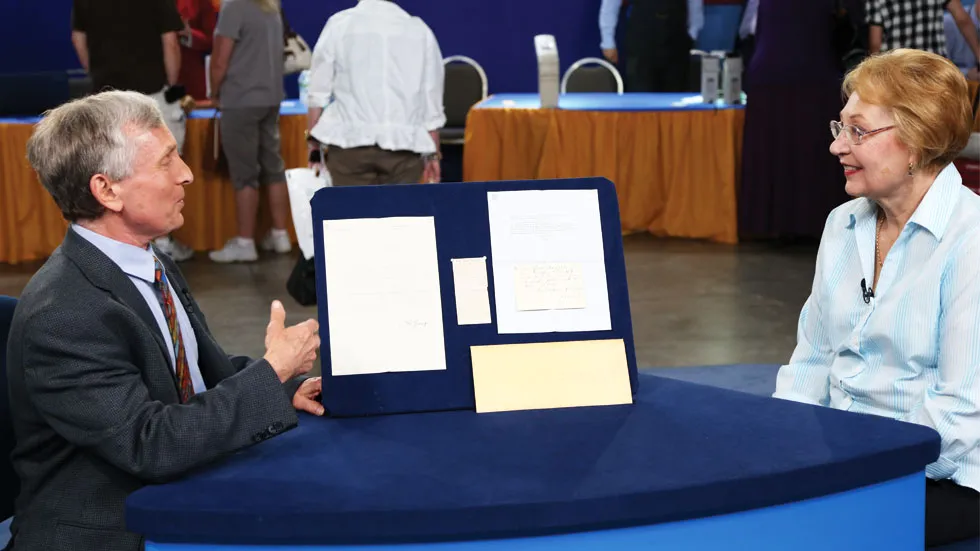
Books and manuscripts expert Ken Gloss explains the significance of the letters at the Detroit ROADSHOW event in 2013. He placed a retail value of $15,000 to $20,000 on the group.
Below, you can read the newspaper article about Nijinsky and the letters that “Aunt Bernice” received from Drs. Freud and Jung in reply to her inquiry.
The Mad Nijinsky
[contemporary newspaper article, source and date unknown]
Various stages of madness extending over a period of 13 years are illustrated in the paintings of Waslaw Nijinsky, famous Russian dancer, who was the star of the Diaghileff Ballet Russe, and who is now in a Swiss sanitarium, living as in a dream. When his breakdown began Nijinsky turned to painting, and his watercolors, pastels and drawings are of such psychological interest that Dr. Freud and Dr. Jung advised Mme. Nijinsky to exhibit them. A collection of more than 50, illustrating the progressive stages of Nijinsky’s illness, are to be exhibited on Feb. 2 at the Leggett Studios in the Waldorf-Astoria for three weeks. “As if detesting now the brilliant coloring which made the Ballet Russe resemble an agitated rainbow, Nijinsky,” says the New York Times, “has turned in the recent years of his illness to the macabre. He paints unmitigated gloom, for the most part large areas of somber color with perhaps a few lines to suggest the outlines of a soldier’s helmet — the object which he portrays over and over again.” In the first stage of his madness the dancer painted floral designs and insects. Later he turned to subjects which sometimes resembled haunted faces, with staring eyes, and sometimes grotesque mass. Then came the “black period” when he painted almost unrelieved dark spaces. Painting and drawing materials are kept before him always, but he only turns to them intermittently.
Letter from Sigmund Freud to Berniece Stanley
Translation of a communication received by Berniece S. Edwards from Dr. Sigmund Freud in 1933
Very honored Fraulein (Miss) Your letter gives me cause (Motivation) for a warning which you certainly sometime will find valuable: Namely, never believe something just because it is (stands) in a newspaper. In reality I have never seen the dancer Nijensky [sic] and I have never had anything to do with his case. With best wishes Freud
Letter from Carl Jung to Berniece Stanley
November 17th, 1933. Miss Berniece Stanley 21 Wolfe St. Athens, Ohio. If my memory is correct it was during the war [World War I] that I was consulted by Mme. Nijinsky. Mr. Nijinsky suffered then from a catatonic form of schizophrenia and was mentally so stuporous that conversation with him was impossible. No work of art of his was shown to me, nor was it in any way mentioned that he had produced anything during his illness. I suppose that van Ghogh [sic] is a more interesting case. I also recommend to you the German book, which you probably already know, about the art of insane people by the late Dr. Prinzhorn. I should also advise you to inquire with one of my pupils in New York, Dr. Eleanor Bertine, (108 East 38th, Street,) about the art in mentally abnormal conditions. She might be able to give you some first hand information. Sincerely Yours, C.G. Jung.
Luke Crafton is ANTIQUES ROADSHOW's director of digital content and managing editor of the series website. Luke has been a producer with ROADSHOW since 2006.


