Keith Haring: How Graffiti Entered the Mainstream
Keith Haring was ever an outsider to the art establishment in his lifetime, but since his death in 1990, his legacy as an artist of historic importance has only become more secure.
Jan 29, 2018
Originally published on: Oct 26, 2015
BY Ben Phelan
GUEST: I inherited it from my deceased partner. That was about 20 years ago. And when he lived in New York, he was in the subway with one of his friends telling him about Keith Haring. And this was all relatively new, I guess, in the early '80s. He was telling him about it, and he said, "You know what? I'm gonna take that for posterity's sake," and whipped out his little pocketknife, and cut it out. And it was already torn a little bit up there.
APPRAISER: Uh-huh.
GUEST: And I didn't know anything about it at the time. I've since learned about him, and that in the subways, this black paper was put up in between ad space. He got this idea of using chalk on this, and started doing, I guess it's graffiti.
APPRAISER: Keith Haring was such an interesting character who died much too young in 1990. He was born in Pennsylvania and came to New York City in 1978. New York embraced him and he embraced them. He was a superstar very early on, but along with that title, he was also very much of an artist of the people, and believed that art should belong to everyone. He was influenced by the graffiti movement and just thought it was great. He thought that people on the subways should enjoy the performance of him being there, and that it just should be a joyous art experience. Not in the museums or the galleries, but just everywhere. And the idea that he would go down to the subways, and paint over these pieces, people would come up and say, "What do they mean?" It was a happening. That's what he absolutely loved about it. He did these subway drawings primarily between 1980 and 1985, when he was already becoming famous. So your partner wasn't alone in tearing these off the subway walls.
GUEST: (chuckles)
APPRAISER: Haring was very prolific with them. Sometimes he would do 40 a day. There, there were hundreds of them. I mean, it was just this joyful underground movement of contemporary, interesting, energized art. And really at the forefront of graffiti art and street art. He was diagnosed with AIDS in 1988 and began his foundation then, and the foundation was to promote art and also to promote the work of children, and also to help with AIDS issues.
GUEST: Right.
APPRAISER: So he wasn't long with us, but he, he left doing some pretty remarkable things.
GUEST: That's interesting, the connection, because my partner died of AIDS 20 years ago.
APPRAISER: Yes.
GUEST: So it's, uh... It's something that I'll always keep and have, and that connection.
APPRAISER: Well... It's a lovely piece, in, in good condition, and framed under glass. At auction, I would estimate it between $30,000 and $50,000.
GUEST: You're kidding!
APPRAISER: No. (laughs)
GUEST: Oh, my God. (laughing): Oh, my!
APPRAISER: Yes, they're very rare now.
GUEST: Wow. They're important. And for insurance, probably around $50,000.
GUEST: (laughing): Oh, my God!
When the art installation Dismaland Bemusement Park opened in August of 2015, it did so with all the fanfare normally associated with a work of high art — a Cy Twombly installation perhaps, or one of Christo and Jeanne-Claude's draped monuments. There were notices in The New York Times and The Guardian, radio essays on NPR, and hype throughout the art world. The artist responsible was Banksy, whose real name and identity remain a mystery. He is one of the art world’s only superstars; but his approach to art is inimical to the idea of museums and galleries, and even to the indoors.
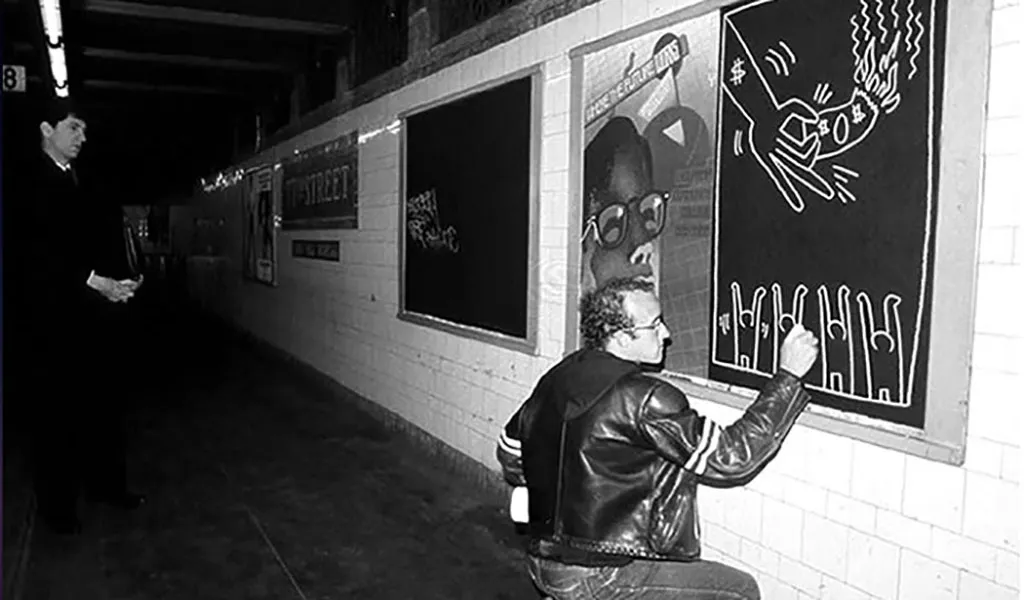
Keith Haring created his art in public places like subway stations, rather than more formal, academic settings. People left his art alone, even his fragile chalk drawings like the one above. Image source: publicdelivery.org.
Banksy is, in short, a graffiti artist. That he is not considered strictly as a criminal, but as something a bit more complicated, owes equal amounts to his trenchant sensibility and dark whimsy as to another graffiti artist, Keith Haring, who crossed into the mainstream.
Keith Haring came of age in New York City in the early 1980s, long before the economic boom of the 1990s (and its harsher policing practices) conferred (or imposed) on downtown Manhattan the respectability it now possesses. In Haring's New York, neighborhoods such as the Lower East Side and the East Village were rough and sometimes unsafe, but the cost of living was low, and the streets were full of people. Haring had moved to New York to study art in an academic setting, but found the city itself a more vibrant venue for art than the clean white walls of the city's galleries.
The energy and immediacy of graffiti — public art, as its supporters prefer — seized and colonized Haring's imagination.
At the School of Visual Arts, Haring studied art in the standard academic tradition. His studies provided him with a formal understanding of art, but it was in the subways that he found his inspiration. The walls of the subways and the outsides of the trains were covered with glyphs, initials, sketches, cartoons — an impenetrable text of symbols that seemed to represent the lived experience of the city much more immediately than the formal art world would allow.
Down in a subway station one day, Haring's attention was drawn to an empty rectangle of unused advertising space on the wall. The paper was soft and inviting, and pure black. Haring ran up the stairs, then down the street to a shop, where he bought a box of chalk, then back down into the subway system to draw. In the heart, or perhaps the bowels, of the city, where thousands and millions passed day in and day out, Haring had found his gallery.
Because these liminal black spaces were so fragile and surrounded by hostility or at best indifference, Haring said, people left his art alone. "They didn't rub them out or try to mess them up. It gave them this other power. It was this chalk-white fragile thing in the middle of all this power and tension and violence that the subway was. People were completely enthralled."
The energy and immediacy of graffiti — public art, as its supporters prefer — seized and colonized Haring's imagination. As he drew and sketched and doodled, a menagerie of figures, influenced by the short, quick strokes on the subway walls, flowed from his hand. "They were humans and animals in different combinations. Then flying saucers were zapping the humans. I remember trying to figure out where this stuff came from, but I have no idea. ... I was thinking about these images as symbols, as a vocabulary of things."
One of Haring's most recognizable images is a cartoon of a baby on all fours, surrounded by light. The "Radiant Baby" or "Radiant Child" is perhaps indistinguishable, on the surface, from graffiti you'd find on any building in any modern city. But the figure is also known as "Radiant Christ," which connects Haring's sensibility not only with his own deep moral sense, but also with two millennia of artistic depictions of the Savior. In his youth, Haring had been an evangelical Christian. When he was becoming an artist in New York City, the redemptive power of Christ was still a powerful image for Haring. Though by then he was far from a conventional Christian.
Another of Haring's most famous images, a sperm with horns, or "Devil Sperm," reveals how much his sense of spirituality had changed by the mid- to late-1980s. At the time, the scope of the AIDS crisis was clear to gay men living in New York City, such as Haring, but society had yet to fully recognize it. President Ronald Reagan was conspicuously silent on the subject of the disease, seemingly uncomfortable with its connection to gay sex. There were public concerns about toilet seats and the sharing of water glasses. In 1987, Haring learned that he, like many of his friends and peers, had contracted AIDS. His work was soon permeated with horned sperm, a symbol that linked physical love with death. As an artistic gesture, this was hardly new, but in Haring's rendering it was immediate and direct. At the time, Haring had risen to superstardom in the art world. When he went public with his diagnosis, his celebrity helped to normalize AIDS and rob the disease of its stigma as a "gay plague," as it was once known.
Keith Haring died of complications related to the disease on February 16, 1990, when he was only 31. Since his death, his reputation as an artist of historic importance has only become more secure. Like Jean-Michel Basquiat had done before him, Haring sought to erode the boundaries between the public, for whom art functions as conscience and subconscious, and the galleries that keep the public away by connecting art with money. The collection of Haring ephemera Betty Krulik appraised at the Chicago ROADSHOW completes the circle: It brings us into direct contact with an artist who believed contact with the public was art's highest virtue.
Related
APPRAISER: How did you come to know Keith Haring?
GUEST: Well, I was coming from the Art Academy, going to the art expo here in Chicago. I already had known about him, but I ran into him doing a mural project here in Grant Park and we stopped to talk some, and the next thing you know, we're helping out with this mural project that took place here.
APPRAISER: And in that time, you had him over for dinner?
GUEST: Towards the end of the week, yeah, we invited him over to dinner, there in northwest Indiana. Had tamales with my mom and dad and sisters and he met the whole family, it was cool.
APPRAISER: Nice. He was a pretty famous guy by 1989.
GUEST: Yes, he actually passed away in 1990, so...
APPRAISER: Right. This was probably at the climax of his career.
GUEST: Yes. He had AIDS.
APPRAISER: Was he very sick when he was here?
GUEST: When I met him, he didn't seem that sick. He was very active, you know? I didn't see him slowing down at all, you know? I didn't see it coming.
APPRAISER: So, tell me about this book.
GUEST: This is a black book that graffiti writers keep, keep other signatures from graffiti writers and keep some of your own pieces in. And this is a piece that he did for me in my book. Personally inscribed it to me, to "OMS ONE."
APPRAISER: That's your tag name?
GUEST: That's my tag name. The photograph was taken in front of the mural that was taking place at the time for the Art Against AIDS Foundation. I think it was in collaboration also with the MCA, Museum of Contemporary Art. That's myself, my brother, Keith in the middle.
APPRAISER: Then there's this very interesting object here.
GUEST: Yes.
APPRAISER: What is this?
GUEST: That's a history. Started in 1987, and in 1989 when we met him, he came to our house and placed this drawing here in the center while we had him over for dinner.
APPRAISER: What are all the other tags and... signatures?
GUEST: The other tags are just graffiti writers' tags from the area where I live, northwest Indiana, and some Chicago writers also.
APPRAISER: So, any time they'd visit you, you would have them sign this tabletop?
GUEST: Right, we sit around and congregate and plan our next hit. That's why we're called the Hit Men.
APPRAISER: Keith gave you this hoodie.
GUEST: Yeah, that was given to me by Keith and also signed by him.
APPRAISER: So it's signed by him, and he inscribes it "Hit Men," which was the name of your crew.
GUEST: Correct, that was the name of the crew at the time. "Hit Men Bombing Crew." The hat was also another item that was done by Keith Haring. It's from the Chicago Improv.
APPRAISER: Keith was raised in Kutztown, Pennsylvania. He came to New York after studying in Pittsburgh for a period of time, came to New York and studied at the School of Visual Arts. He was a little bit more commercially minded than many of the graffiti artists, and in the late 1980s, he opened his own pop shop.
GUEST: Right.
APPRAISER: And I would think that the hoodie came from the pop shop. The market for Keith Haring is very interesting. Because the Foundation no longer authenticates, it's really important to have an undisputed line of provenance, and nothing could be clearer than the photograph of Keith with you and your brother and crew, the inscription to you, the hoodie, the hat, and of course, this fascinating document.
GUEST: Right.
APPRAISER: The value for a Haring drawing in the retail market would be about $10,000.
GUEST: Wow.
APPRAISER: Hoodies have come on the market and sold at auction for about $1,800.
GUEST: Okay.
APPRAISER: The hat we have no comparables for, but I would expect that would be about $1,000 as well.
GUEST: Wow.
APPRAISER: And the linoleum we have absolutely no comparables for. I think you're talking about $2,000 for the linoleum.
GUEST: Wow.
APPRAISER: So the total value of the collection as a whole is $14,800.
GUEST: (laughs) That is great to hear. I like that.
Ben Phelan is a freelance writer in Louisville, Kentucky. He has been a contributor to ANTIQUES ROADSHOW Online since 2007.


