Explainer: What Was the Triangular Trade?
Historically, the triangular trade among Europe, West Africa and the New World ran on the backs of millions of enslaved people.
Jan 11, 2016
BY Ben Phelan
GUEST: This is actually handed down to me from my parents. It's a meat serving table from about pre-Civil War. They were in Andrew Jackson's estate, and they did a tour of Andrew Jackson's, and one of these was in there, and they told them what it was. And when they were in St. Louis, they saw this at an estate sale and they picked it up for about $750 in 1982. That's about all I know about it, except for this marble is not the original one, unfortunately.
APPRAISER: No.
GUEST: It had a darker piece of marble before with, like, a blood groove in it, and during one of my folks' moves, it broke, and I don't know where it ended up. I was very sad that it got lost in the move.
APPRAISER: I don't actually think it was a meat serving table.
GUEST: You don't think it was?
APPRAISER: No, I think what it is is a mixing table.
GUEST: A mixing table?
APPRAISER: A classical mixing table, and these tables were made in the early 19th century, so this table dates from about 1820 or so.
GUEST: About 1820, okay.
APPRAISER: And it was made to mix drinks, drinks with alcohol.
GUEST: Really?
APPRAISER: Because if you had a table with a top and you tried to mix your drinks and some of the alcohol fell on the wood, it would really ruin the wood. And they started to make these tables with marble tops and some of them would have ceramic tops. You told me that this is not the original top, and I agree with you, it is not, so let's take it off and put it back here. And notice, when you take the top off, it almost looks like a Greek column. It's very symmetrical. You don't have this long overhang on the side. So the original marble, do you remember it?
GUEST: It was about this size.
APPRAISER: It was this size. Well, then, probably, it was not the original marble top to the table.
GUEST: Okay.
APPRAISER: Because the original marble top fitted exactly the size of this. We call this a classical form. It's probably made in Boston. They did a lot of this kind of form in Philadelphia, but when we look at the secondary wood, we see that it's white pine. If it were yellow pine, it would have been a Philadelphia piece. So it's a very high style, classical piece of furniture. A very wealthy person would have owned this. It does a lot, also. You can see that there's a drawer here that comes out so you could have stored your mixing accoutrements in there.
GUEST: Cool.
APPRAISER: And then also, there's a little door in the front, which opens up. On my side, there is a lock mechanism because you are locking up your tea, you're locking up your spirits. It's not a time when people are feeling as though they can just leave their things of value out. I love the placement of the lock mechanism on this because it is on the side so that when you look at this piece from the front, the facade is perfect. The wood that they've used on the facade, it's a mahogany veneer, triangular trade mahogany, very, very expensive wood in its day. And you can see the lovely figuring on it. The top is equal to the bottom. It's really a wonderful specimen and a very, very rare piece of furniture. I would say an auction estimate is probably in the $2,000 to $3,000 range.
GUEST: $2,000 to $3,000 range, wow.
APPRAISER: Yes, yes. If this had its original top, I would say that we have a much more interesting specimen.
GUEST: Okay.
APPRAISER: And I would probably estimate it in the $4,000 to $6,000 range.
GUEST: $4,000 to $6,000?
APPRAISER: Yeah.
During the June 2015 ROADSHOW in Spokane, Washington, a guest brought in a small table, dating from the early years of the 19th century. From the runnel around its edge, seemingly designed to catch liquid and prevent it from spilling onto the floor, the table seemed to have played a food-serving role of some kind. The owner conjectured it was intended to hold a joint of meat while it was being carved and served. Not so, said appraiser Karen Keane. Rather, it was designed for mixing alcoholic drinks, and with its original top, it may have commanded $5,000 at auction. Without it, given the otherwise good condition, Keane estimates an auction value between $2,000 and $3,000.
The table’s mahogany veneer, said Keane, probably derived from three-legged trade routes between Africa, New England, and the lands of Central America and the Caribbean, generally referred to as the triangular trade. The “triangular trade” was not a specific trade route, but a model for economic exchange among three markets.
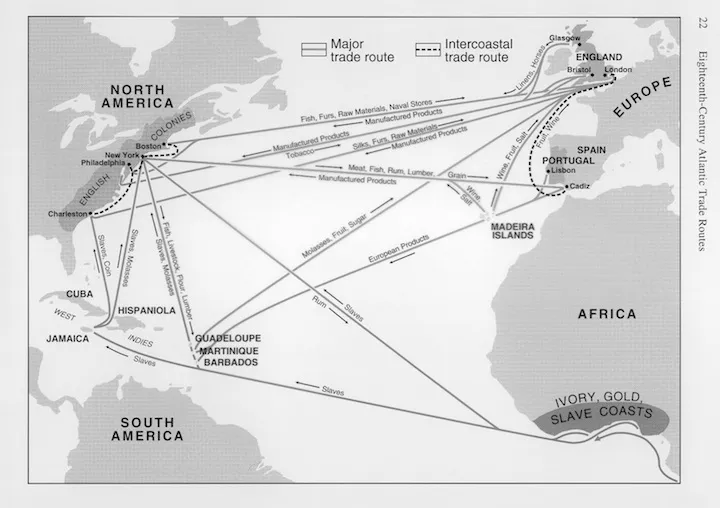
The triangular trade refers to a model for economic exchange among three markets. Historically, the triangular trade among Europe, West Africa and the New World ran on the backs of millions of enslaved people. Image source: web.horacemann.org
A triangular trade among Europe, West Africa and the New World is probably the best known. Following the colonization of the New World by European powers, Europe experienced a prolonged economic boom for reasons that are, from the economist’s perspective, self-evident. Suddenly, the world was a much bigger place. Novel and instantly prized goods that only existed in the New World seemed to blink into existence: sugar, tobacco, hemp. European merchants could command high prices for selling these goods to other Europeans, just as New World merchants could command high prices from their customers for manufactured items from Europe. But a direct exchange of these goods, between Europe and the colonizers in the New World, required start-up money. Transporting goods by sea was not cheap.
A solution to this economic problem appeared in the form of the transatlantic slave trade, which began operating as early as the 15th century, at the very beginning of the colonial period. European ships would travel to West Africa carrying manufactured goods to which Africans had no access: worked metal, certain types of clothing, weapons. Once there, as payment they would demand people captured for slavery, who would be loaded onto crowded ships and transported to the Americas. (This leg of the trade scheme is usually called the "Middle Passage," a term that has become a byword for suffering.) Upon arrival, the enslaved Africans who survived the voyage were sold to landowners looking for cheap labor. With the money derived from these slave sales, European merchants would then purchase the cotton, sugar and tobacco their customers back home were demanding, and the cycle continued.
(It’s important to note that single ships did not necessarily make all three legs of this voyage. The triangular trade was not a route, but a strategy for making trade among distant markets easier and more profitable.)
At the same time, a different triangular trade route arose between New England, West Africa, and Central America and the Caribbean islands that lay east of it.
The islands of the Caribbean Sea served as sources for cane sugar and molasses, which New World merchants would distill into rum, while the mahogany veneer on the mixing table probably came from Guatemala or Honduras.
Rum and manufactured goods taken by New World merchants to Africa were sold in exchange for enslaved people. These slaves were taken to the New World and sold. Slavers used the proceeds to buy mahogany and molasses, and the cycle continued onward.
It is obviously not necessary that one leg of a triangular trade route should consist of enslaved people. Triangular trade routes still exist today, although globalization and air travel have made international trade much more efficient. But during the colonial period in the New World and, indeed, well beyond the 1808 Act of Congress that sought to end the import of slaves, the triangular route between New England, West Africa, and the lands of the Caribbean ran on slavery. When the Civil War decided America's slavery question for good, enslaved people finally disappeared from the structure of international trade destined for America. In the meantime, untold millions had suffered and died in bondage.
Ben Phelan is a freelance writer in Louisville, Kentucky. He has been a contributor to ANTIQUES ROADSHOW Online since 2007.


