Explainer: Treated vs. Untreated Gemstones
Appraiser Katherine Van Dell mentioned “treated” emeralds in her appraisal of a beautiful circa 1900 emerald and diamond ring. What enhancements are performed on stones? And how do untreated gemstones compare to treated gemstones? Van Dell explains.
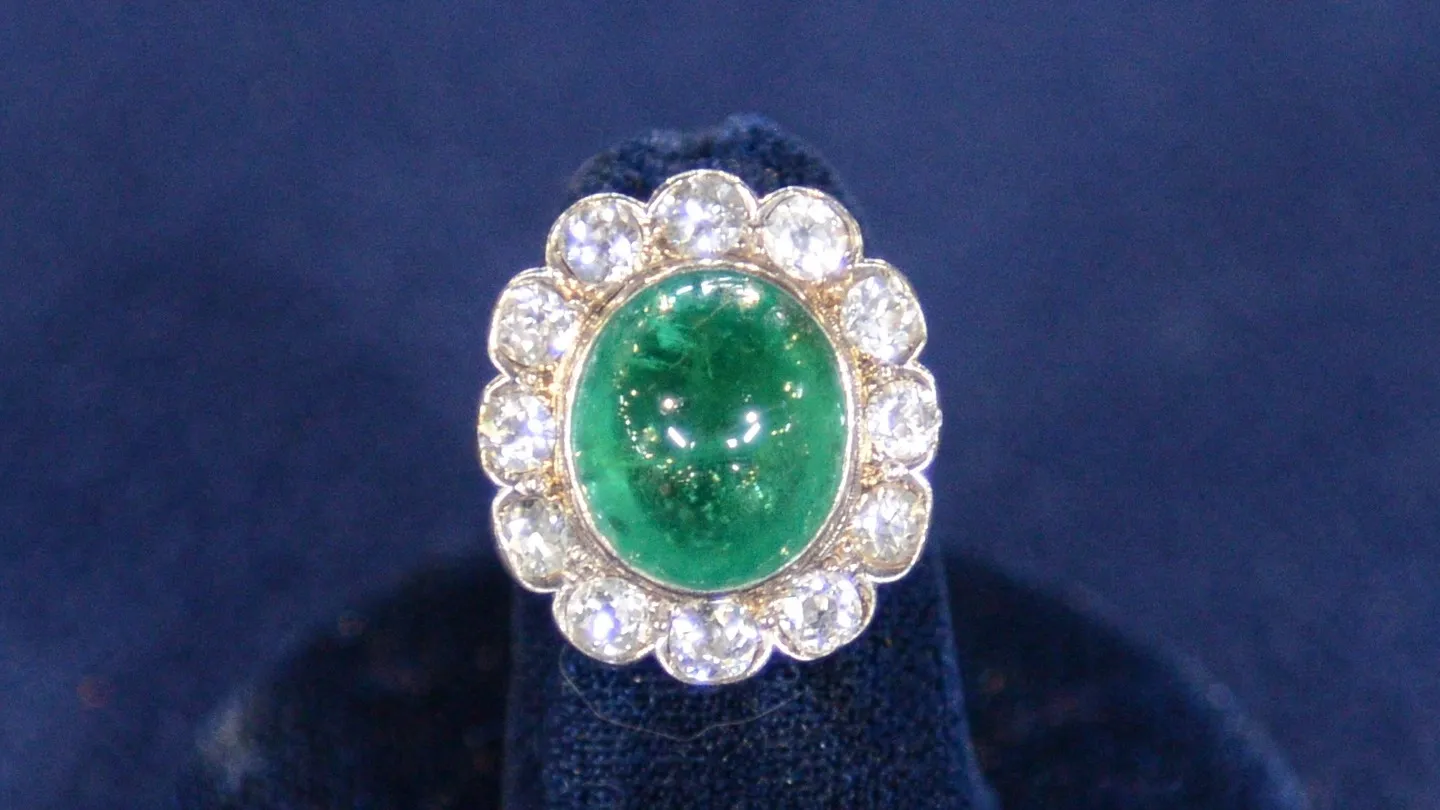
At the Salt Lake City ROADSHOW In August 2016, jewelry expert Katherine Van Dell appraised this ca. 1900 emerald & diamond ring for $6,000 to $8,000.
Apr 3, 2017
When ANTIQUES ROADSHOW visited Salt Lake City in August 2016, a lovely family heirloom caught the eye of jewelry appraiser Katherine Van Dell. The guest, Maurine, had been told by a jeweler that the ring was a costume jewelry piece. Van Dell had good news for Maurine: the ring was not costume, but made of real diamonds and a beautiful cabochon emerald weighing almost 20 carats. Furthermore, Van Dell was impressed with the emerald’s strong green color. “What you want in a gemstone is that vibrant color. You want to see green from across the room when you wear it.”
“What you want in a gemstone is that vibrant color. You want to see green from across the room when you wear it.”
Van Dell expanded on the color of the emerald, speculating that the precious stone was from Colombia, a very desirable source for emeralds, and that it may have been treated, as “they’re normally oiled to enhance color.” Appraisers have mentioned enhancing or treating gemstones on ANTIQUES ROADSHOW before, so we decided to follow up with Van Dell and find out more about treated versus untreated stones.
Here's What We Learned
ANTIQUES ROADSHOW: There are many methods used to treat or enhance gemstones: heating, bleaching, surface coating (such as oiling), dying — just to name a few. When did treating gems become commonplace?
Katherine Van Dell: Depending on the mineral, gemstones have been altered to improve color and clarity for thousands of years. For example, emeralds have been traditionally oil-treated or soaked with a kind of cedar oil solution for thousands of years to improve clarity. Depending on the mineral, different treatments have been available for hundreds of years or have become more available very recently.
AR: Are the gemstones of antique jewelry pieces therefore just as likely as contemporary gemstone pieces to be enhanced in one those ways?
KV: Again, gemstones have been synthesized, oiled and dyed for centuries, but in the case of a genuinely antique stone, it is less likely that it was treated to the same potential extent that a modern gemstone may be.
AR: Generally speaking, are untreated stones more valuable than treated stones?
KV: In the case of two stones of equal saturation of color and clarity, one being treated and the other not, the untreated stone is always going to be more valuable. Knowing that the vast majority of gems have been altered in some way by man, when a stone in its natural state is not needing of enhancement — that makes it exceptionally rare and likewise more valuable.
AR: Some gems are not usually treated, like spinel, garnet and tourmaline. Why?
KV: While it is true that these minerals are less often treated — usually because standard treatment methods like heating, for an example, are not as effective on gems like garnets — it is important to know that there are still man-made or "synthetic" varieties of these stones.
AR: Where can precious stones be assessed to determine if or how they have been enhanced?
KV: The Gemological Institute of America offers certification for diamonds as well as colored stones. The American Gemological Laboratory and the Swiss Gemological Institute are labs that also produce reliable certifications, detailing origin and enhancement levels of the colored stones.
(This interview was edited for length.)
Related
Watch the Appraisal
GUEST: This ring came to me by way of my mother-in-law's death.
APPRAISER: Okay.
GUEST: And my husband received it in a velvet drawstring bag with a few other things. And we saw my mother-in-law wear it often, so we never saw it off to look at the back.
APPRAISER: Really look at it.
GUEST: To see if we knew anything about it.
APPRAISER: Okay.
GUEST: I wear it occasionally.
APPRAISER: Okay.
GUEST: And one time I had it to a jeweler just by chance because I was having my wedding bands replaced and repaired.
APPRAISER: Okay.
GUEST: And he pushed it away and said it's costume.
APPRAISER: Okay.
GUEST: And so I... I know nothing about it.
APPRAISER: And do you know where your mother-in-law got the ring?
GUEST: We have no idea.
APPRAISER: I'm glad that you wear it.
GUEST: Thank you.
APPRAISER: It's a lovely ring. And what's great about it is that strong green color, and do you know what that stone is?
GUEST: I assume it's an emerald.
APPRAISER: Right, and you're correct in assuming that. And what you want in a gemstone is that vibrant color. You want to see green from across the room when you wear it. And you have that here. What's great about it, beyond that, and interesting as well, is that it's actually foil-backed, pretty much. This is a platinum backing, and that acts as a foil that really accentuates the light that comes through the green. So that makes it an even stronger and more vibrant color.
GUEST: I didn't know that.
APPRAISER: Yeah. The ring dates to the early 20th century. And we know that because surrounding the emerald are about 2.5 carats of antique-cut stones.
GUEST: Oh, my.
APPRAISER: The emerald itself is just under 20 carats.
GUEST: You're kidding me.
APPRAISER: Right. Because most emeralds are heavily included, and this emerald is included. Even though it has that great strong green color, whoever cut this stone made the decision to not facet it. And it's been cut into a cabochon. The inclusions in the stone would have probably prohibited it from being a faceted stone, or an emerald cut, like we normally see.
GUEST: Interesting.
APPRAISER: It might be worth your while to look into finding out origin in this case. I believe that it's probably from Colombia.
GUEST: Oh.
APPRAISER: And you want your emeralds to be from Colombia. They're synonymous with that grass green color, that vibrant green...
GUEST: That is.
APPRAISER: ...that you see here. Beyond that, in terms of where it's made, it's unmarked. But I assume that it could either be American, or maybe even English. Many times emeralds are treated. They're likely normally oiled to enhance color. I would assume that this maybe has minor traditional oiling. But again, all of that would... we'd have to find that out from... from a certification...
GUEST: Did you say 20 carat?
APPRAISER: Just under 20 carats.
GUEST: My stars.
APPRAISER: Yeah, so it's quite a... quite a stone. If this were to come into auction, I would give it a conservative estimate somewhere in the neighborhood of $6,000 to $8,000.
GUEST: Oh, my stars! Oh!
APPRAISER: And I expect it could maybe do more.
GUEST: Oh, that's just amazing.
APPRAISER: Good.
GUEST: Costume, right?
APPRAISER: Yeah, not so much.
GUEST: That's just amazing, thank you.
APPRAISER: You're welcome.
Sarah K. Elliott is a producer for ANTIQUES ROADSHOW and a frequent content contributor to the series website. Sarah has been a producer with the series since 2000.


