Cigar Store Indians: Trading on Stereotypes
Cigar store Indians, made of carved wood or molded metal, were popular symbols of the 19th and early 20th-century tobacco trade. Today, collectors of these statues appreciate both their striking visual appeal and the considerable skill of their carvers. But the figures also draw criticism for being simplistic and demeaning stereotypes of American Indians.
Oct 19, 2016
Originally published on: Oct 26, 2015
GUEST: I have an original cigar store Indian. My grandfather, I believe, paid $75 for it in 1938. He procured it from the corners of Milwaukee Avenue and, I believe, Division Street in downtown Chicago. They transported it back to their home and it has been in our family for 74 years.
APPRAISER: Wow. We know the carver's name because of its distinctive style, and it was John Cromwell. And he was one of the first early carvers in New York City. He was a ship carver-- most of them were-- and they morphed into making cigar store figures, tobacco shop figures all throughout New York, and they started shipping them throughout America. The tobacco figure became the figure of the Indian, and the reason for it is the Indians taught the settlers how to raise and plant and harvest tobacco.
GUEST: I see.
APPRAISER: Cromwell has a very distinctive style, and right here, this is a key to assigning a carver's name to it. It's this triangular headdress, and the way it comes to a point. The headdress has a wonderful fan shape to it that goes back to the head, flowing down the shoulders, all very distinctive styles of Cromwell, as well as the bear claw over his shoulder, and the necklace, which what is really the imagery of a peace medal that were given out by the United States government to the great chiefs throughout the Indian nations. So, we do know it's a John Cromwell. He operated in New York City, 1840, 1850, 1860. And it is indeed a rare figure. These full-bodied figures tended to be a little top-heavy, and sadly, this piece did meet that fate of toppling over, and we know that because of the fact that the face is not a John Cromwell face. The face has been at some point in its time, prior to your family's ownership, recarved.
GUEST: Okay.
APPRAISER: When the face was damaged, the arm snapped off. And it was probably the same day that this fell forward, arm snapped off, face was damaged. This entire arm is new.
GUEST: Okay.
APPRAISER: New meaning prior to 1938.
GUEST: Right.
APPRAISER: When you go further down, you see this wonderful skirt with feathers, but then your eye starts to look at the legs, and these legs are a tad short, and Cromwell's figures would have had legs that were about six to eight inches longer.
GUEST: Okay.
APPRAISER: It's a very common story for these cigar store figures that lived out on the streets.
GUEST: Right.
APPRAISER: The paint is old but not original, so the surface we say is pre-1938, which is good, because it was being used up to that point. In terms of valuation, prices have a very wide range, most of it tied to the rareness of the carver and the condition of the piece. So, do you have any idea approximately what your $75 in 1938 is now translating to?
GUEST: I would guess maybe $10,000.
APPRAISER: Okay, it's actually a pretty good guess. I think a retail price would be somewhere in the $10,000 to $15,000 range.
GUEST: Okay.
APPRAISER: One in original paint, beautiful carving, total integrity, can be as much as $700,000.
GUEST: Interesting. He's a great keepsake, and we'll continue to pass it through the family.
New York carver John L. Cromwell, who had made his name largely as a maker of ship figureheads, was capitalizing on what had become, by the mid 1800s, a conventional marketing idea: the commercial association of American Indians and tobacco. Thousands of these tall, sculptural figures were created in America during the 19th and early 20th centuries for the hugely profitable tobacco trade. And although not all tobacco figures portrayed Native American men and women, as folk art appraiser Allan Katz explained, "The reason for it is the Indians taught the settlers how to raise, plant and harvest tobacco."
The figures were a product of their time, a period fraught with prejudice against indigenous peoples.
The figures were a product of their time, a period fraught with prejudice against indigenous peoples. The statues helped to invent and then reinforce the quintessential stereotype of an “authentic” Native American by often depicting figures with bronze-colored skin wearing feathered headdresses, long fringed skirts or shirts, and moccasins. Critics have compared the characters to racist lawn ornaments of black jockeys. Two of the more common types of Indian cigar statues portray the “noble savage” with a stoic expression and passive stance; or the warrior, who brandishes a weapon he’s poised to use.
In their day, these silent statues were effective communicators, meant to indicate to all — including the illiterate and non-English speakers — what was for sale. What they represent today to citizens of the 21st century is a more complicated message, eliciting both appreciation and disapproval.
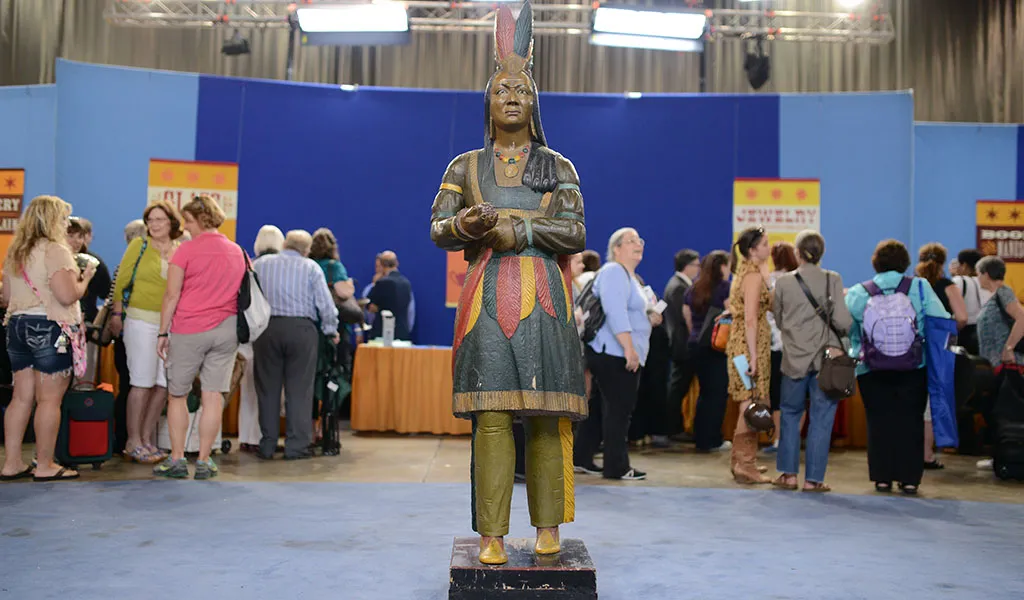
Figures such as this reflect the prevalence of prejudices against indigenous peoples during the 19th and early 20th centuries.
Sarah K. Elliott is a producer for ANTIQUES ROADSHOW and a frequent content contributor to the series website. Sarah has been a producer with the series since 2000.


