Art Pottery & The Imitation Game
The difference in value between the real deal and an imitator can be thousands of dollars.
Oct 18, 2016
Originally published on: Oct 5, 2015
GUEST: My husband's grandfather passed. He was about 100 years old. This was up in the attic in their house, and I told him to go get it and bring it down because I wanted it.
APPRAISER: And how long have you had it?
GUEST: Almost 30 years now.
APPRAISER: This vase was made by Thomas Wheatley. Thomas Wheatley was a potter from Cincinnati, Ohio, and in 1880, opened the T.J. Wheatley Company, where he made copies of a famous style of work called Limoges ware that other people in Cincinnati, Ohio, were doing. He filed a patent for the technique, eventually went out of business, and in 1903 formed another Wheatley Company, which is this one. And this company, also in Cincinnati, copied the work of Grueby Pottery in Boston, Massachusetts. So Wheatley was big into copying work that others did. And I mean, that's not necessarily a bad thing, because a lot of companies copied each other. I would date this piece, since he's copying a Grueby precedent, the Grueby precedent would have been made around 1900 to 1902, so I would date this to around 1905 or 1906. This is almost an exact copy of a vase that Grueby made: straight-sided vase with leaves encircling the top, and then these fern fronds forming tight little handles, covered in this vegetal matte green glaze. The difference between this piece and a Grueby piece is, were this Grueby, the pot itself would be hand-thrown on a wheel. You'd see the finger marks on the inside. And then further, these leaves that we see on the outside of the vase, that thrown vase would have clay stuck to the side and the leaves would be sculpted out with a carving tool, as opposed to being part of the mold that was used to make this piece. And finally, these handles would be formed from flat pieces of clay, where they would stretch them out and roll them and apply them to the side at Grueby, rather than cast and applied as they are here. So Wheatley approximated the Grueby look in a very good way. It's a fairly honest representation, but at a much lower cost. The Grueby's green glaze is a signature. Over 100 companies copied the matte green glazes that Grueby used. When you walked up to the table, I knew this was Wheatley because this is their signature glaze.
GUEST: Ah.
APPRAISER: The Grueby glaze would be a little bluer in color, a little less texture, a matte crystalline surface to it. There'd be a lot more distinction to the Grueby vase. There is one issue with this pot. It's not marked, or if it's marked, the bottom is covered with a sufficient amount of glaze that we can't see it. But there's a crack running through the bottom of the piece that does come up the side, which is going to limit the value. It's a pretty good-sized body crack. I still think because it's such an extravagant example, at auction, it's still worth $1,000. Without the crack at auction, it's about a $3,000 piece. And if this were a piece of Grueby made a couple years earlier in Boston, Massachusetts, at auction, it'd be about $7,000.
Imitation is the sincerest form of flattery, or so the saying goes. But when it comes to American art pottery from the Arts and Crafts period, it was so common for competing companies to take inspiration for shapes and glazes from each other, it can be hard to tell who deserves the compliment. But when a guest at the 2014 Albuquerque ANTIQUES ROADSHOW event brought in a piece of art pottery she inherited, it was clear who imitated whom. And the difference in value between the real deal and an imitator can be thousands of dollars.
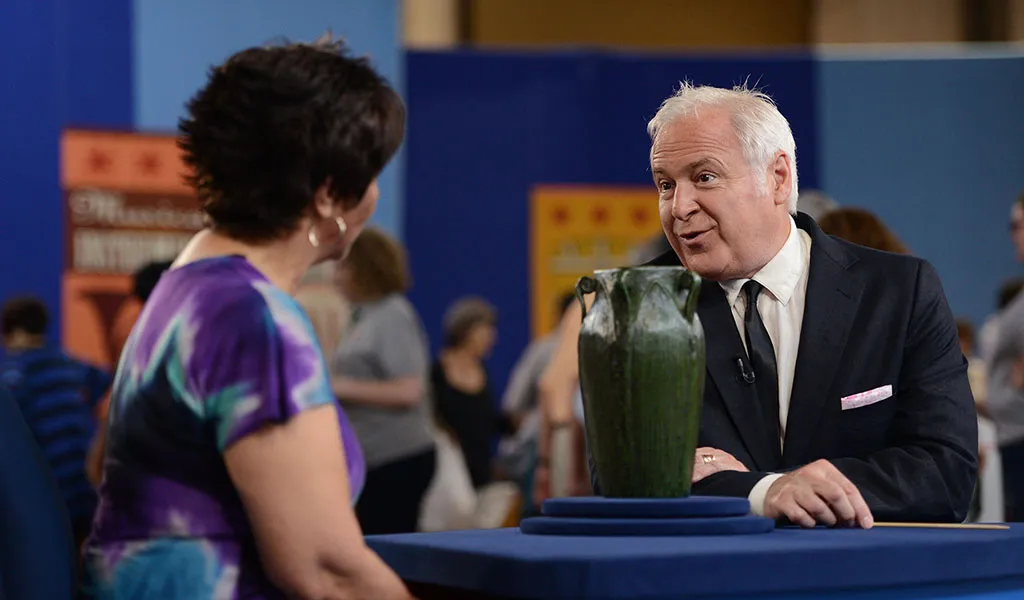
At the 2014 Albuquerque ROADSHOW event, expert David Rago identified a piece of Thomas J. Wheatley art pottery that closely resembled Grueby Faience.
The vase was made by Thomas J. Wheatley to resemble a specific piece of Grueby Faience pottery. Wheatley, a potter from Cincinnati in the late 1800s, was "big into copying work that others did," expert David Rago said. Wheatley had started his first company in 1880, called the T.J. Wheatley Company, where he made copies of Limoges-style pottery and filed a patent for the technique. It later went bankrupt and in the 1890s Wheatley briefly worked for Weller. Wheatley then opened another company in 1903, one that produced vases that were modeled after Grueby, including this particular vase seen in Albuquerque. But there were noticeable differences in technique, style, and material between the original Grueby and the Wheatley.
Pieces in a mold are a little mushy around the edges whereas handwork is very crisp
The covetable aesthetic of Grueby pottery finds its core in Arts and Crafts-period taste: simple hand-thrown and carved designs that reflect the natural environment. The Grueby Faience Company was founded in 1894 in Boston by William H. Grueby, where he developed characteristic matte green crystalline glazes for which the pottery became renowned. "Grueby's green glaze is a signature." Rago said. "Over 100 companies copied the matte green glazes that Grueby used." Matte green glaze became ubiquitous in Arts and Crafts potteries, but each one had slight differences that were noticeable to the trained eye. Grueby Faience, under the guidance of director of design George P. Kendrick, was also known for crafting naturally shaped hand-thrown vessels that were usually carved by female modelers. With a Grueby, "you'd see the finger marks on the inside," Rago said, among other irregularities.
The design of the Grueby precedent features alternating flat leaf and scroll elements, with this particular example likely being made around 1900 to 1902. The sharp edges and deep grooves on the leaves demonstrate that the carving was done by hand. The Wheatley vase made a few years later, on the other hand, was made from a mold, though it does feature some pieces that were cast and applied. "Pieces in a mold are a little mushy around the edges whereas handwork is very crisp," Rago described. The darker green glaze color is a signature of Wheatley, one that is less blue than the Grueby but makes it instantly recognizable. "Wheatley approximated the Grueby look in a very good way," Rago said. "It's a fairly honest representation, but at a much lower cost."
The craftsmanship behind the Grueby and the Wheatley is reflected in their values today. Rago said the Wheatley vase, in its current condition, would command an auction estimate of $1,000. "If this were a piece of Grueby made a couple of years earlier in Boston, Massachusetts, at auction, it'd be about $7,000."
Related
- Check out another Wheatley in the archive
- See a rare mustard-colored Grueby in The Metropolitan Museum of Art's collection
- Learn more about the Arts and Crafts movement in the United States

This example of Grueby Faience was the inspiration for the Wheatley vase found in Albuquerque. Note the attention to detail in the carving and modeling work of the leaves and scrolling. Rago Auctions/Lambertville, NJ
Dylan Hayley Leavitt was ANTIQUES ROADSHOW's digital associate producer from 2012 to 2017.


