A Tiffany Presentation Pitcher for a Family Hero
Over the course of his steamboating career in the mid-19th century, Captain William H. Laughton saved 11 lives. One of these heroic efforts rose to the surface at the ANTIQUES ROADSHOW event in Rapid City, South Dakota, in the form of Tiffany & Company silver.
Apr 22, 2013
GUEST: This is what has been known in our family as the Tiffany pitcher. It was presented to my great-great-grandfather back in the 1850s. At the time, he was a mate on a riverboat called the Nominee. They had a charter boat from New York, citizens on the boat. One of the children fell overboard, and my great-great-grandfather jumped in and saved him. The passengers then created a reward for him, which he refused to take. When they got back to New York, they took the money and went to Tiffany's and had this pitcher cast for him.
APPRAISER: All of that is so well documented. It's one of the more interesting pieces of presentation silver I've ever seen. Most of the pieces of silver like this that we see are given for awards for sports events, retirement things, marriages. But for saving someone's life, this is a pretty amazing sort of trophy. I've never seen one quite like this. There's this wonderful repoussè chased scene of the captain retrieving the boy from the water, right here on the front. With the Victorian sense of death and so many children dying, this was quite a romantic idea to be depicted on a piece of silver at the time. Also very interesting, you have the steamboat on the other side, and the name of the steamboat, the Nominee, is engraved on the wheel. So this is quite interesting to people who collect rare silver, especially American silver and early American silver, Tiffany silver being a very prominent maker in the 1850s, and continuing today. But also, people would be interested in this who collect things related to the river and steamboats. And then on the front here you've got the wonderful story that gives the date and the little boy's name that he saved, and where he was from in New York. It was sold by Tiffany and made by Tiffany. But at the time that Tiffany was making silver in the 1850s, their business was expanding and growing, and they were actually using a lot of different silversmiths and then putting their own mark in conjunction with the silver maker's marks. However, we're not going to be able to see how it's exactly marked, because if you look at the foot, it's a little bit bent here. And if we turn it over, where the mark would be has been obscured by lead. Not that that's going to make a huge difference in determining the value, because pieces that were made by other people for Tiffany in the 1850s are just as valuable as those that are made exclusively by Tiffany. One thing that we're comfortable about is your claim that it is actually by Tiffany, because it is so well documented in this book, along with the photograph. I would estimate it for auction probably in the $4,000 to $5,000 range. I think to have the lead removed, to have a good hand polish on the silver. Don't let them buff it by any means, but have a good hand polish. And to have the dents raised up out of the base would cost less than $500. And I would push that estimate up to about $5,000 to $7,000, perhaps even as much as $8,000.
GUEST: Wonderful. Thank you.
Depicted on an ornate presentation pitcher was the tale of Laughton's courageous dive into the Mississippi River in April, 1854. Heading northbound, the Nominee's trip was interrupted when a boy fell off the upper deck of the steamboat. Laughton jumped overboard, swimming close to a mile as the boat turned around to fetch them. According to documentation that the guest brought to Rapid City, the parents presented Laughton with a monetary gift, which he refused, "asserting that he was only doing his duty." When the family returned to its native New York, they still felt obliged to honor Laughton's selfless act and therefore had the relatively up-and-coming New York City-based Tiffany & Co. cast a silver presentation pitcher to commemorate the event. Ever since Laughton accepted the gift, it has been a family heirloom, passed down from generation to generation. "This is what has been known in our family as the Tiffany pitcher," the ROADSHOW guest said.
This is what has been known in our family as the Tiffany pitcher
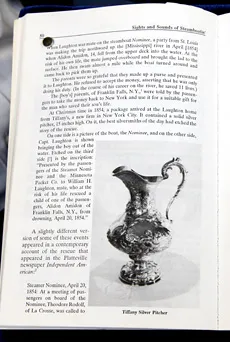
An excerpt from "Sights & Sounds of Steamboating: The Life and Times of Captain William H. Laughton."
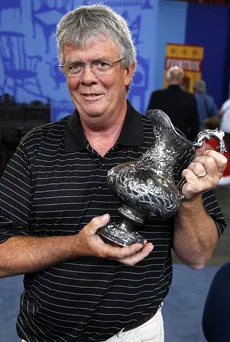
The guest holding his family heirloom, the Tiffany presentation pitcher.
At the time that this pitcher was made, Tiffany & Co. was growing as a silver company. In 1851, Tiffany began to use English Sterling standard (92 percent pure) and was the first American firm to do so. Rapid expansion required much output, so the company used many different silversmiths, whose marks could be found on their pieces. In this appraisal, Reid Dunavant reveals that the mark has been obscured by a slight bend in the foot. Although the specific maker cannot be determined in this instance, the piece's provenance and dating provided enough information to craft an auction estimate on the item of $4,000 to $5,000. Presentation silver is typically associated with sporting events, marriages, and other milestones. For example, in Cincinnati last summer, Dunavant appraised a 1908 Tiffany & Co. equestrian humidor, a silver presentation box, for $30,000 to $40,000.
But this Tiffany pitcher represents more than just a regular achievement; it depicts an act of heroism using detailed design on multiple surfaces of the pitcher. On one side, there is the actual scene of Laughton saving the boat from the water, with an image of the steamboat Nominee on the other. So although this piece of silver is showing some signs of age in its tarnished surfaces, its moral core persists through family history.
Related
Dylan Hayley Leavitt was ANTIQUES ROADSHOW's digital associate producer from 2012 to 2017.


