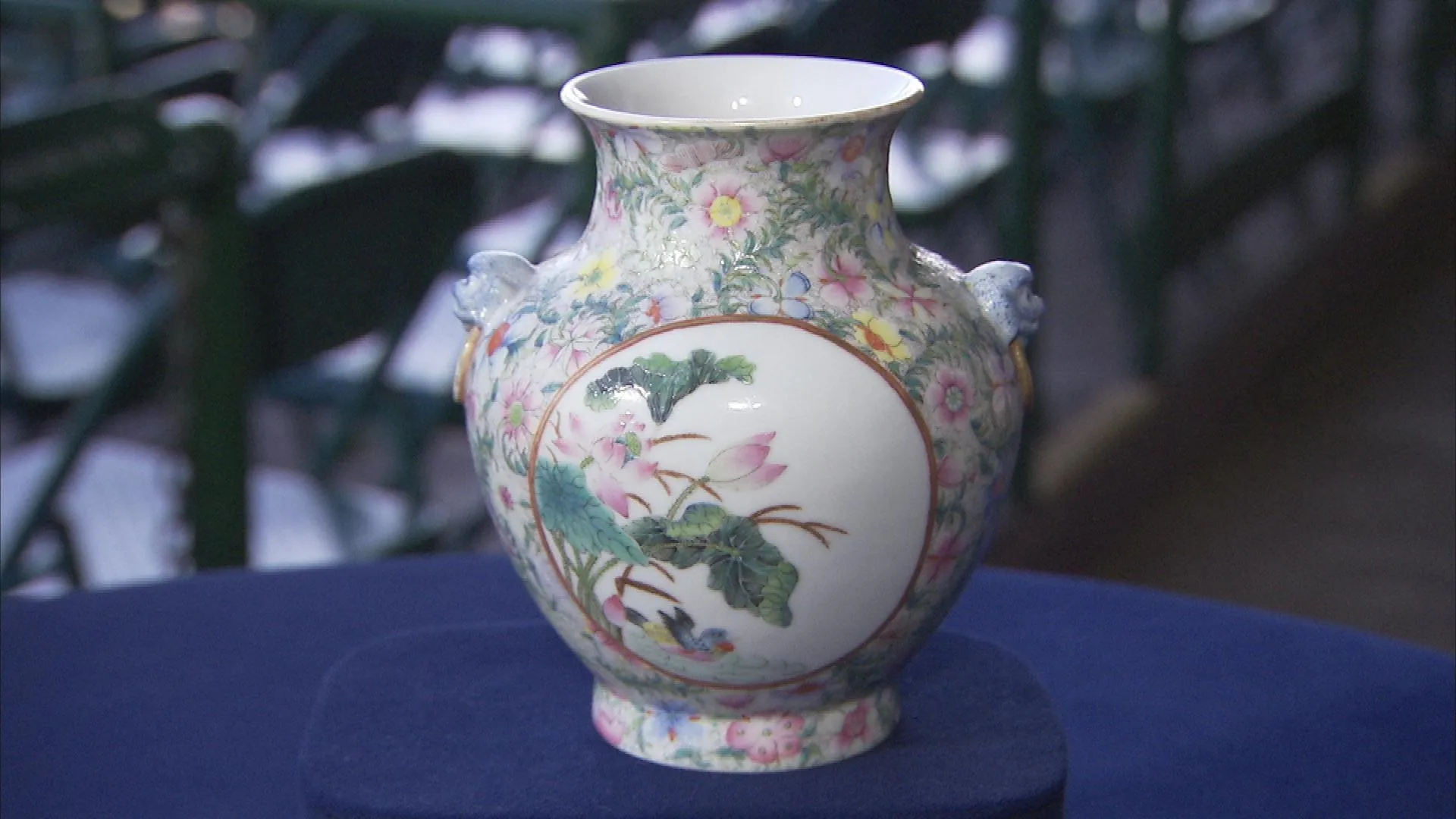
GUEST: It belonged to a gentleman named Jack Sawyer from New Orleans that collected antique glass, and he does have an exhibit in the New Orleans Museum. But we had gone to see him in Waveland years before Katrina. And I admired it...
APPRAISER: Waveland, Mississippi.
GUEST: Yes, Waveland, Mississippi. And I had admired the vase and told Jack, "That's one of the prettiest things I've ever seen." Well, Katrina hit, a lot of his pieces were lost, but this and a bunch of others were saved, and he washed them and cleaned them up. When Jack found out that he was terminally ill, he sent this to me.
APPRAISER: Very nice.
GUEST: So that's really all I know about it.
APPRAISER: So when you walked up to the table with it I thought immediately I knew what the pottery was. I know you thought initially it was glass.
GUEST: Yes.
APPRAISER: It does look like that, it looks like iridescent glass from the turn of the century, but it is a piece of pottery, and my suspicions were correct, it's a piece of Zsolnay pottery, a Hungarian company.
GUEST: Oh!
APPRAISER: And this is their eosin glaze. And it changes as you turn it to the light, but it's a golden green luster. But what's really special about this, because the vase itself is okay as far as Zsolnay goes, but the metalwork is rather exceptional. And so we have two full peacocks on the piece, encircling it, their tails end in the base that covers the entire bottom, and then there are glass tiles inset to look like the eyes of the peacock feathers.
GUEST: Is this a metal base?
APPRAISER: It is.
GUEST: I thought it was.
APPRAISER: Again, the research I did said it was gilded pewter. It's also marked, it's marked "Orion" and "272," which is the shape number. And there's another one out there with the same number on the bottom. So I did a little bit of research, it turns out this is a collaboration between a Hungarian Art Nouveau company and a German Art Nouveau company.
GUEST: Oh.
APPRAISER: Orion was located in Nuremberg, Germany. There were only in business for three years-- 1903 to 1906. They were bought out by a competing company in 1906. George Schmidt was the artist who worked this piece so you have an Art Nouveau design in the German style, which is called Jugendstil, it means "the children's style," and that's the German interpretation of Art Nouveau. Each country that practiced Art Nouveau had a different interpretation of it. We tend to the think of the French interpretation, which is far more florid, whereas the Germans, they geometricized it, it's a little more angular in the German style.
GUEST: Uh-huh.
APPRAISER: This is a very special thing. On today's market at auction I would value it between $7,000 and $10,000. One almost identical to this sold at auction within the last two years for $12,000. So my $7,000 to $10,000 is a bit on the conservative side, but I'd rather be that way, but easily worth $7,000 to $10,000.
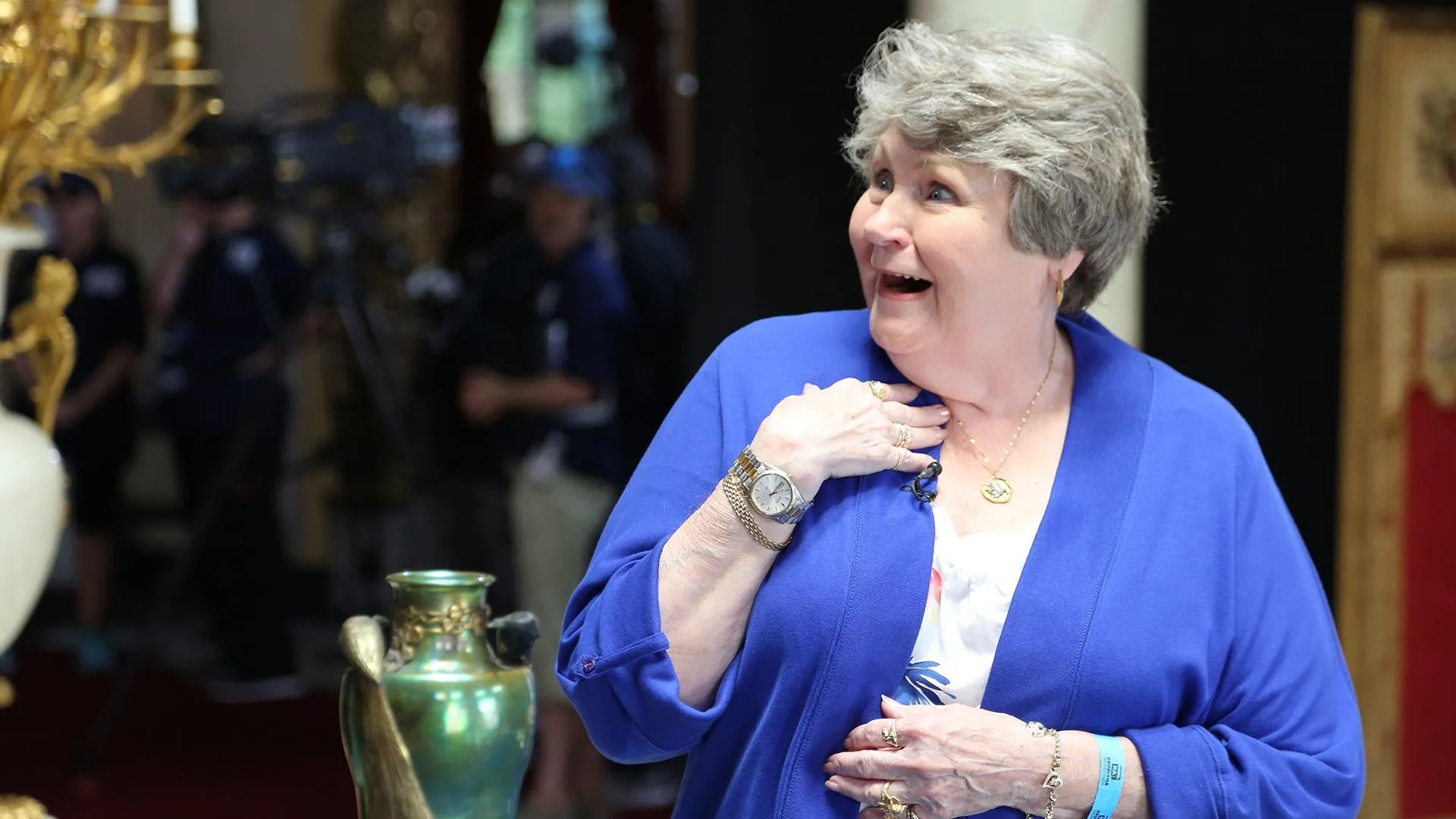
GUEST: Well, I loved Jack, but I didn't know he loved that much. (both laughing) Oh my gosh! Well, I can't even think now. Oh gosh, well David, you have taken my breath away. You absolutely have.