William Hart Landscape Oil, ca. 1860
GUEST: This is one of the Hudson Valley School paintings that was given to me by my parents, who inherited it from my grandmother and my great-aunt.
APPRAISER: And who is the artist?
GUEST: William Hart.
APPRAISER: He is considered one of the Hudson River School artists. The father of the Hudson River School was Thomas Cole. William Hart is considered sort of a second-string painter in that group, but certainly very accomplished. And he exhibited all during his lifetime. And his paintings are in museums around the country. He was born in Paisley, Scotland, in 1823. He immigrated to the U.S. around 1830, and eventually to Albany and Troy, New York, area in 1831. What we find here is a landscape that is of Keene, New Hampshire.
GUEST: Mm-hmm.
APPRAISER: This was a favorite area of his. Most of the works we see by him are of cows in landscapes, and the cows are rather large and dominate the composition.
GUEST: Oh.
APPRAISER: Those are his later works, done sort, in the late 1870s to '80s. He, he died in 1894. This is really refreshing, because it's an early example. It was done around 1859 to 1861.
GUEST: Oh.
APPRAISER: You can see it's, it's rather fresh. He has an interesting approach. He has figures on the right side, the cows are more minimal in the background. And then, of course, the beautiful landscape and the more or less luminous sky make it a, a rather creative composition for him. It's signed in the lower right "W.M. Hart." And that's a typical signature for him. The medium is oil on canvas, and the frame is wonderful. It's, uh, original frame. Condition-wise, I think it might need a cleaning. There is a catalogue raisonné of William Hart's work.
GUEST: Mm-hmm.
APPRAISER: This work is listed there. It does mention that it went through American art galleries in 1925. You said you got it from your great...?
GUEST: My great-aunt.
APPRAISER: Your great-aunt. So would she have been in New York around 1925?
GUEST: She was visiting her brother, who lived in Connecticut, but was a stockbroker in New York. So, yes, I'm sure she... So she has... ...traveled into New York.
APPRAISER: Perhaps that's where she acquired it. Unfortunately, the Hudson River School in general is not as much in vogue today...
GUEST: Yes.
APPRAISER: ...as it was, let's say, 20 years ago. If it were in a gallery, I think it would probably sell in the neighborhood of $15,000.
GUEST: Oh, my goodness! (chuckling): That, that surprises me, thank you.
APPRAISER: Well, you're welcome. And for insurance, I would suggest $18,000 for insurance.
GUEST (stammers): Thank you very, very much, Debra.
APPRAISER: Well, you're welcome.
GUEST: I truly appreciate. It gives me pleasure every time I look at it.
APPRAISER: Aw, well, that's great.
GUEST: So I'm very pleased to hear all of this.
APPRAISER: Oh, good.

$15,000 Retail
$18,000 Insurance
Featured In

episode
Filoli, Hour 2
Golden State treasures shine at Filoli, with an appraisal valued up to $150,000!
19th Century

appraisal
1876 John Alexander Stoneware Cooler

appraisal
Braided Rawhide Lariat, ca. 1850
appraisal
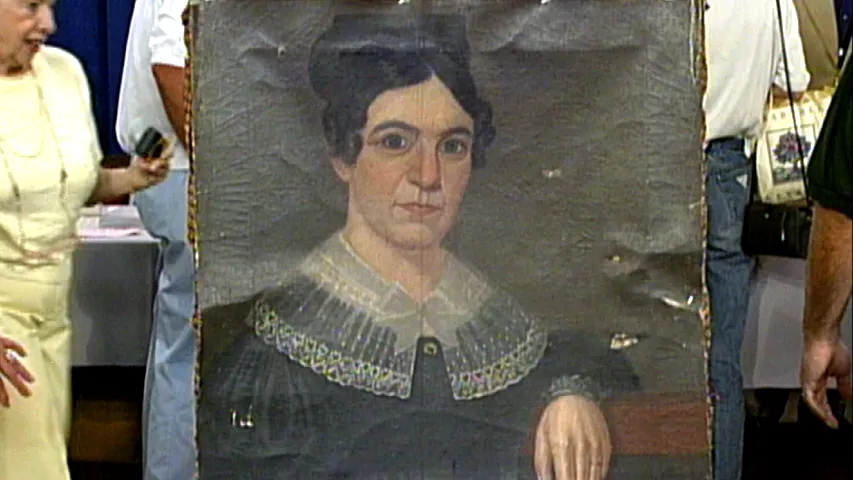
American School Portrait, ca. 1820

appraisal
Eskimo Hunting Helmet, ca. 1820
Understanding Our Appraisals
Executive producer Marsha Bemko shares her tips for getting the most out of ANTIQUES ROADSHOW.
Value can change: The value of an item is dependent upon many things, including the condition of the object itself, trends in the market for that kind of object, and the location where the item will be sold. These are just some of the reasons why the answer to the question "What's it worth?" is so often "It depends."
Note the date: Take note of the date the appraisal was recorded. This information appears in the upper left corner of the page, with the label "Appraised On." Values change over time according to market forces, so the current value of the item could be higher, lower, or the same as when our expert first appraised it.
Context is key: Listen carefully. Most of our experts will give appraisal values in context. For example, you'll often hear them say what an item is worth "at auction," or "retail," or "for insurance purposes" (replacement value). Retail prices are different from wholesale prices. Often an auctioneer will talk about what she knows best: the auction market. A shop owner will usually talk about what he knows best: the retail price he'd place on the object in his shop. And though there are no hard and fast rules, an object's auction price can often be half its retail value; yet for other objects, an auction price could be higher than retail. As a rule, however, retail and insurance/replacement values are about the same.
Verbal approximations: The values given by the experts on ANTIQUES ROADSHOW are considered "verbal approximations of value." Technically, an "appraisal" is a legal document, generally for insurance purposes, written by a qualified expert and paid for by the owner of the item. An appraisal usually involves an extensive amount of research to establish authenticity, provenance, composition, method of construction, and other important attributes of a particular object.
Opinion of value: As with all appraisals, the verbal approximations of value given at ROADSHOW events are our experts' opinions formed from their knowledge of antiques and collectibles, market trends, and other factors. Although our valuations are based on research and experience, opinions can, and sometimes do, vary among experts.
Appraiser affiliations: Finally, the affiliation of the appraiser may have changed since the appraisal was recorded. To see current contact information for an appraiser in the ROADSHOW Archive, click on the link below the appraiser's picture. Our Appraiser Index also contains a complete list of active ROADSHOW appraisers and their contact details and biographies.


