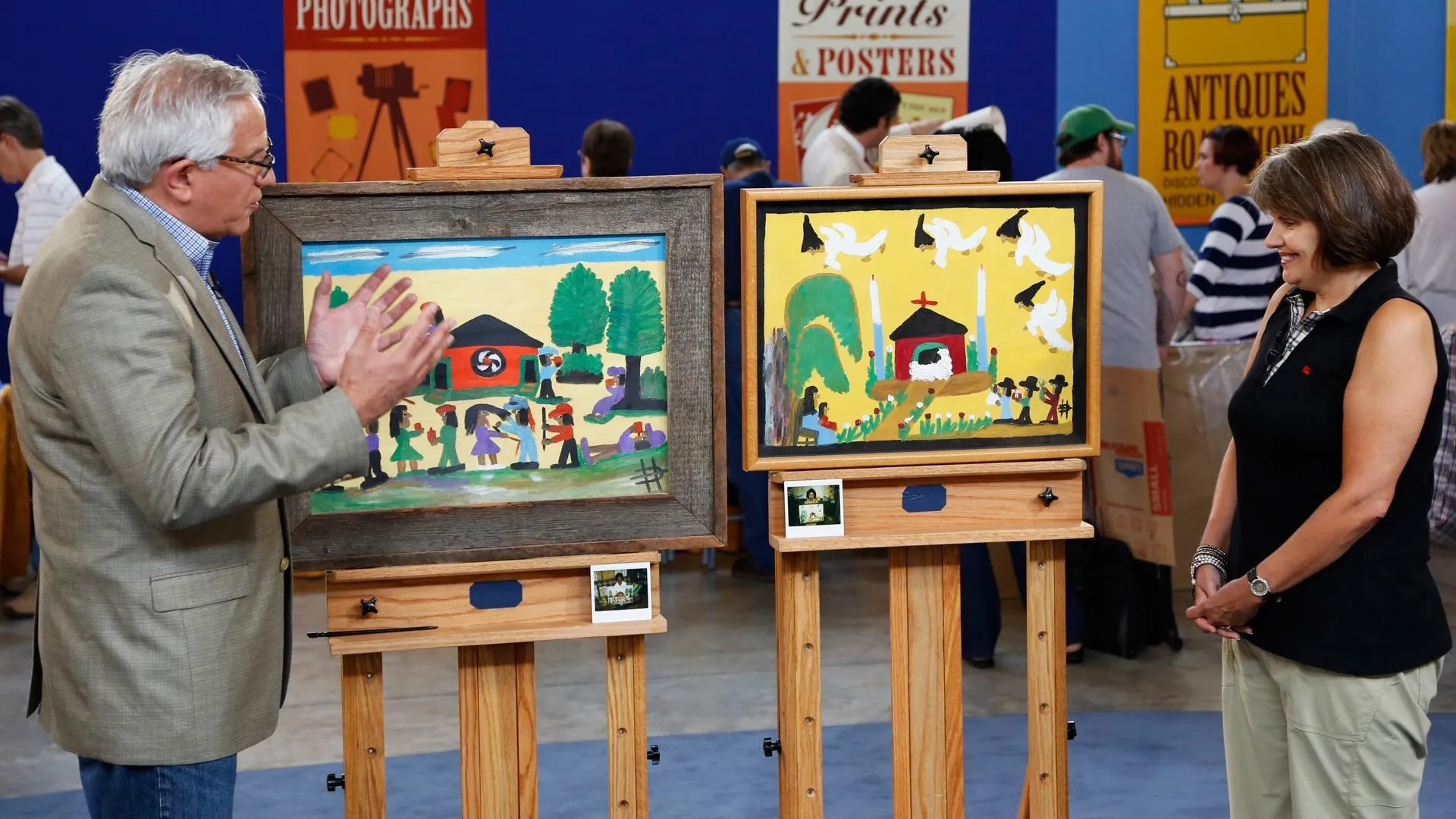
GUEST: This is my grandmother Pauline, and she completed a math degree at Ole Miss and then went after her really first love, which was art, and went to Newcomb College. She studied there and later taught there, and so these are some Ellsworth Woodward paintings from that time period. And this one was a class study that he gave to her after the class.
APPRAISER: That's terrific. So she studied with them both.
GUEST: Yes.
APPRAISER: They were the two brothers: William and Ellsworth. Although the Woodward boys are very much associated with New Orleans, they actually were both born and bred in Seekonk, Massachusetts. So they come from my neck of the woods, although they really belong here to Louisiana. The boys moved down here in their teens and just loved it here and were smitten. And their two loves were art and the teaching of art. By 1885, Ellsworth, who's the younger brother, was a professor at the Newcomb school. His brother William followed the year later. This is actually the piece by William. And by 1890, Ellsworth was the first dean of the art school. The Woodward brothers were instrumental in starting the Newcomb School of Art, and in starting that, they also began the very famous Newcomb pottery. And that's really one of their most important claims to fame. But the other claim, of course, is their talent as great artists. This, of course, is a drawing of your grandmother Pauline. It's a wonderful little pastel and it's a quick sketch. It's not something that William was terribly well known for. He was known for his landscapes. So in terms of value, this is historically incredibly interesting. It sort of solidifies the provenance of the pieces in the collection. But in terms of monetary value, realistically, if you were to put this little picture up at auction, you'd probably only be looking at about $300 to $500 for it.
GUEST: Okay.
APPRAISER: But when we come over to look at Ellsworth's pieces, things change a little bit. There's very much a hierarchy of media in the art market. Watercolors, although they're very difficult to work with, tend to be less desirable. So we have this wonderful little watercolor over here. And it's a view of the Newcomb College campus, but at auction this little piece would probably only bring about $500 to $700. Then we come to the big view. This is also a view of Newcomb College. It's a chapel in the background. You can just make it out behind the fountain. And this picture is an oil painting. It's from 1917 and it is the quintessential example of what he does. If the oil painting were to go to auction, it would probably bring between $30,000 and $50,000.
GUEST: Ooh. That's more than I thought.