GUEST: I don't know too much about it other than I inherited it from my aunt, because nobody else wanted it in the family. They thought it was kind of ugly. And I thought, well, maybe I kind of thought it was pretty. But anyhow, she had gotten it from a couple that she had given money to and could not pay her back. She didn't even know if there was any value to it, but she accepted it because the couple could not pay back.
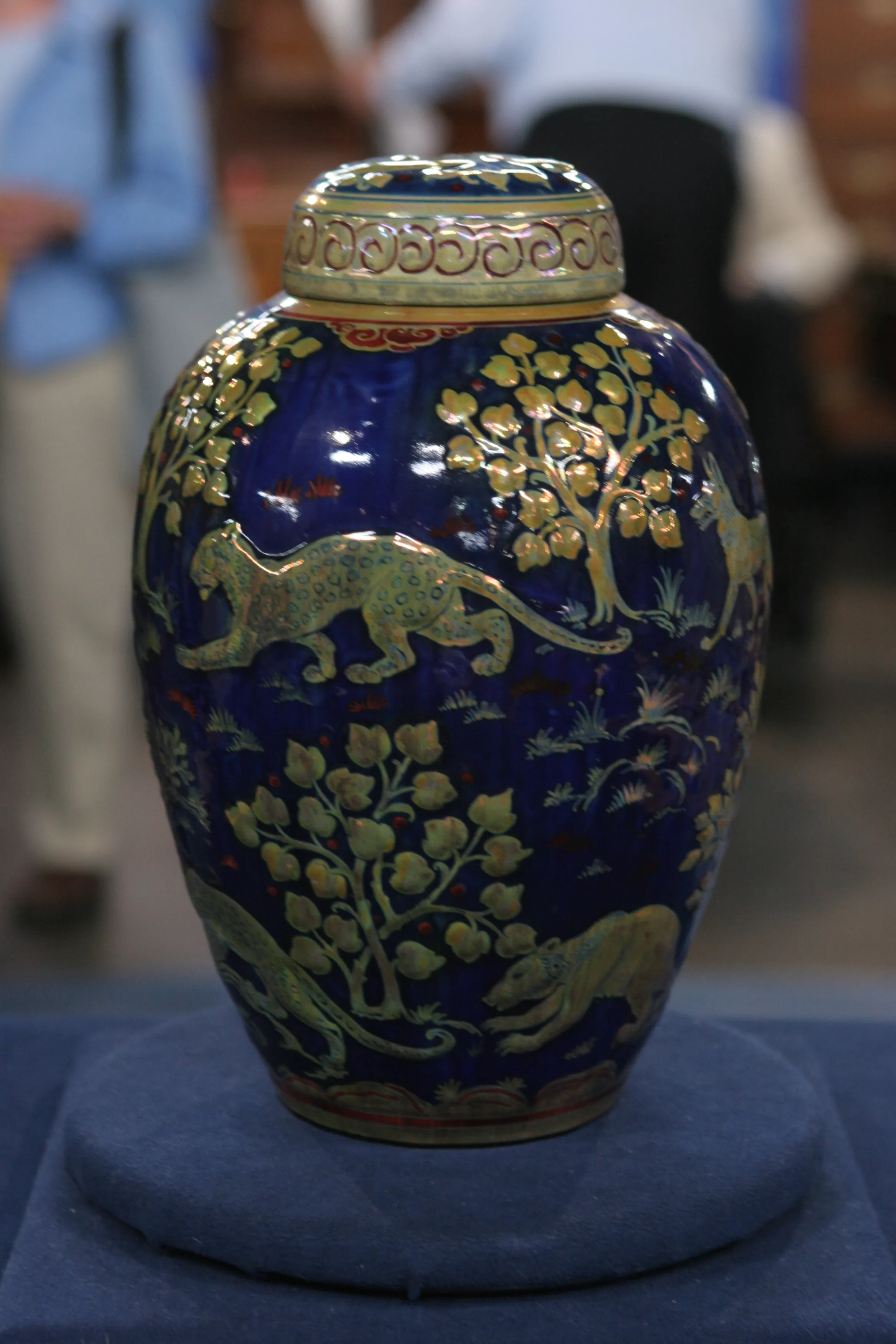
APPRAISER: You know it's Weller Pottery, which was made in Zanesville, Ohio, and very quickly, I'm gonna show the mark on the bottom where it says Weller. Has a very big, bold mark here.
GUEST: Mm-hmm, mm-hmm.
APPRAISER: The interesting thing about this vase, was actually done by a Frenchman named Jacques Sicard, who was employed by Sam Weller, came to Zanesville, Ohio, because he did this particular type of metallic glaze that Sam Weller was very fascinated by. We've kind of got an amalgamation of cultures here. The form itself is very English, because Weller also employed an Englishman named Frederick Hurten Rhead, who brought many very interesting English shapes. And so we've got an American company, an English shape, and a French decorator who did the work on this vase. It has a sunflower design. There are recesses, four recesses, and the sunflower design.
GUEST: That's what I kind of liked about it, that recess was so different...
APPRAISER: Very nice, and then the four handles, but one of the keys to Weller, which is important with this vase, is the color. And you can see the whole spectrum of color on this vase, which is very, very nice. The age on this piece is roughly 1900 to 1905. Now, someone appraised this vase a few years ago for you?
GUEST: Mm-hmm.
APPRAISER: And what did they tell you?
GUEST: A gentleman wanted to buy it from me for $500, the appraiser.
APPRAISER: I think that at auction, this piece would easily sell for between $2,500 and $3,500.
GUEST: Really?
APPRAISER: Really.