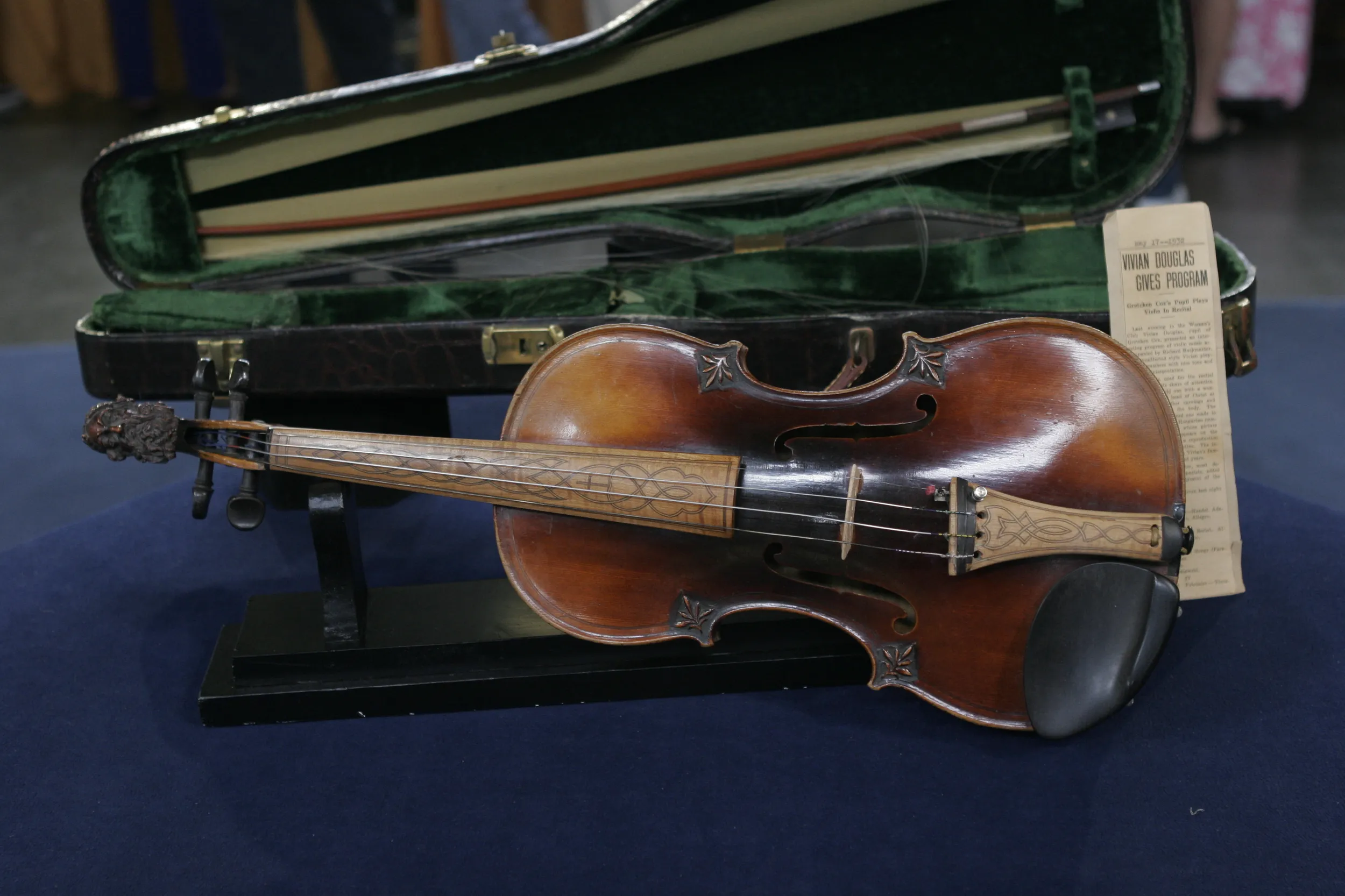
GUEST: My father is a violin maker. He used to collect violins, repair them, sell them, aside from making them.
APPRAISER: So this is a picture that you brought in of your father in his workshop in Albuquerque, is that correct?
GUEST: Yes, that's correct, uh-huh.
APPRAISER: So you can see all of his tools in the picture and his workbench, and he seems very hard at it.
GUEST: Yes, very... very devoted. (laughs)
APPRAISER: And how did you come to own these two violins, then?
GUEST: My mother had them after he passed away, and when she passed away, I inherited the violins.
APPRAISER: And what about the two labels? We see that there's two manila tags that were attached to the violins at one time, right?
GUEST: Yes.
APPRAISER: The first label says "Georges Chanot, France, 1855," and has a price of $1,950, and that goes with this violin.
GUEST: Yes, uh-huh.
APPRAISER: And then the other tag says "Benoist Fleury, France, 1760," and that would be $3,500. And you can see that there's a label inside the violin, and it says exactly what those tags say. And I can see also, from the other information that you brought, that your father did a lot of research. And so this is a book that has labels in it. It has labels of all the makers. So in our business, what you find a lot is that the labels in the violins have been replaced.
GUEST: Okay.
APPRAISER: And it's very hard to distinguish between the instruments that have their original labels and the instruments that have false labels. So we've spent some time looking at these instruments today, and this particular violin that has the label of Georges Chanot, it's a false label.
GUEST: Okay.
APPRAISER: And also, the varnish has been redone, and that in itself decreases the value of the instrument by 80%.
GUEST: Mmm.
APPRAISER: So even though it has a valuation of $1,950 from a price tag from 30, 40 years ago, this violin has minimal value, $400 to $500 retail.
GUEST: Okay.
APPRAISER: It's impossible, without the original varnish, to know who made that violin. Now, this violin, interestingly enough, has the label of Benoist Fleury. The label also is false in this violin.
GUEST: Oh, my goodness. (laughs)
APPRAISER: But through looking at the inside of the violin and looking at the way it was made and looking at the way it was designed, we know that this violin was made in London by one of the very, very famous makers who would have worked in the school of Fendt in the 1840s or 1850s and would have a retail value, in today's marketplace, of at least $8,000.
GUEST: Oh, my goodness! (laughs) Even with the label the way it is, huh?
APPRAISER: That's correct.
GUEST: Wow, that's good.