GUEST: We got it when we were in England in 1968 to 1969, bought at a local antiques shop for £15, which is probably the equivalent of $25 to $30 American money.
APPRAISER: Well, I like to think that objects speak from their time.
GUEST: Mm-hmm.
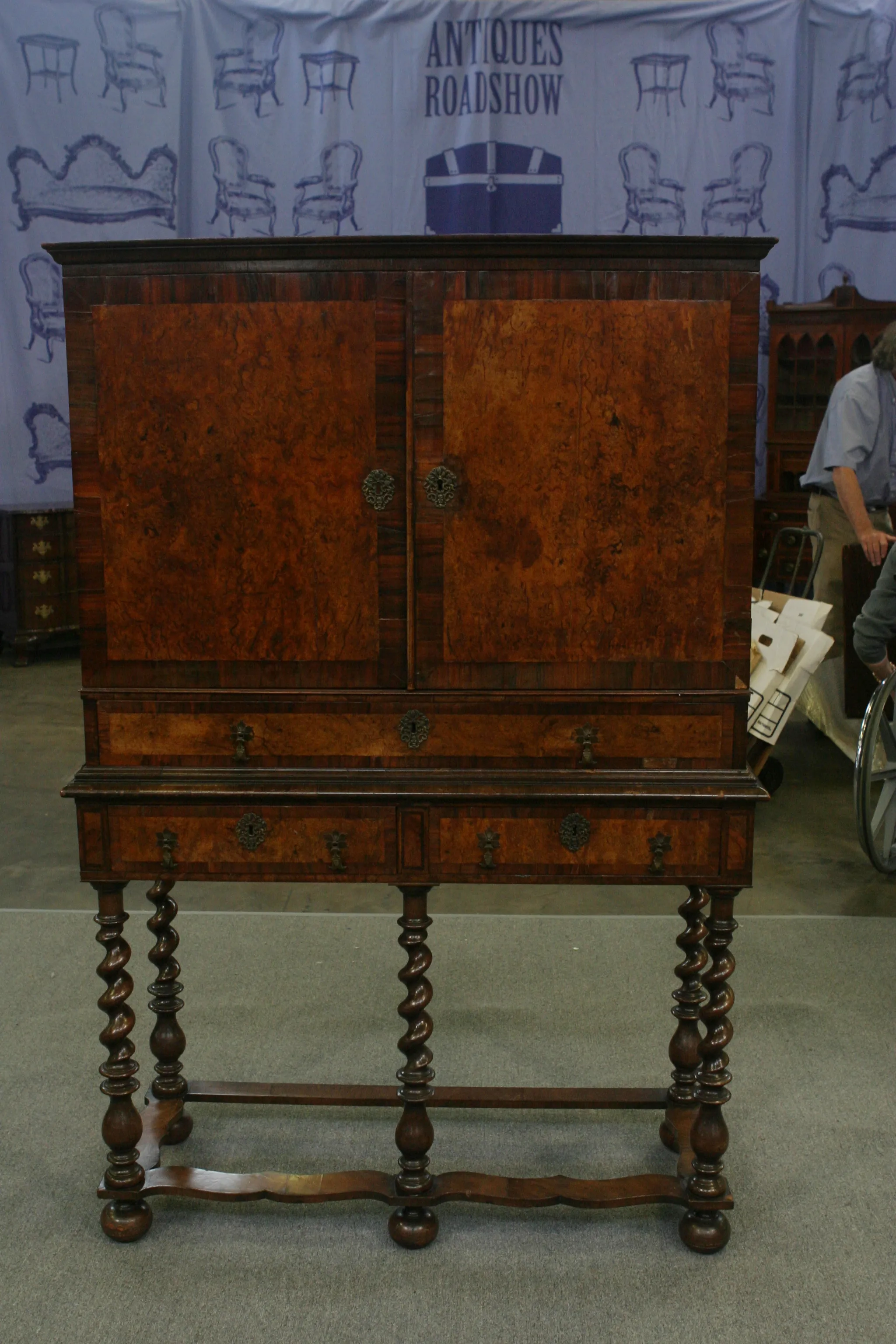
APPRAISER: And certainly this Victorian oak sideboard can't escape the milieu in which it was made, and that is the late 19th century. Victoria comes to the throne in 1837, and she's the longest reigning monarch in English history.
GUEST: That's true, yeah.
APPRAISER: Her beloved husband, Albert, dies in 1861...
GUEST: Mm-hmm.
APPRAISER: And she goes into mourning, and she pulls the entire country into mourning with her.
GUEST: Yes, she did.
APPRAISER: And here we have this very dark piece of oak furniture, which fit into the style of the day. They were fuming this furniture with ammonia to turn the very beautiful mellow yellow colored oak that we revere here so much in America, they were making it darker, mimicking the furniture that one would have found in medieval England.
GUEST: Is the carving machine done?
APPRAISER: Absolutely not.
GUEST: Not?
APPRAISER: No.
GUEST: I'm surprised.
APPRAISER: This is a handmade piece of furniture, and when we move to the lower case, you will see that it has wonderful columns along the front. Do you know the name of these columns?
GUEST: Um...is it barleycorn?
APPRAISER: Barley twist.
GUEST: Barley twist, okay.
APPRAISER: Is what they call it in England. But in fact they are copies of Solomonic columns, which you find in the Vatican.
GUEST: How wonderful.
APPRAISER: Any idea of the value today on a piece like this?
GUEST: I don't think it's worth that much because it's a large piece. I would hope I might be happily surprised.
APPRAISER: In the scheme of things, I would say, if we saw this at auction, we might be estimating it in the $2,000 to $3,000 range.
GUEST: Okay, that's kind of what I thought.