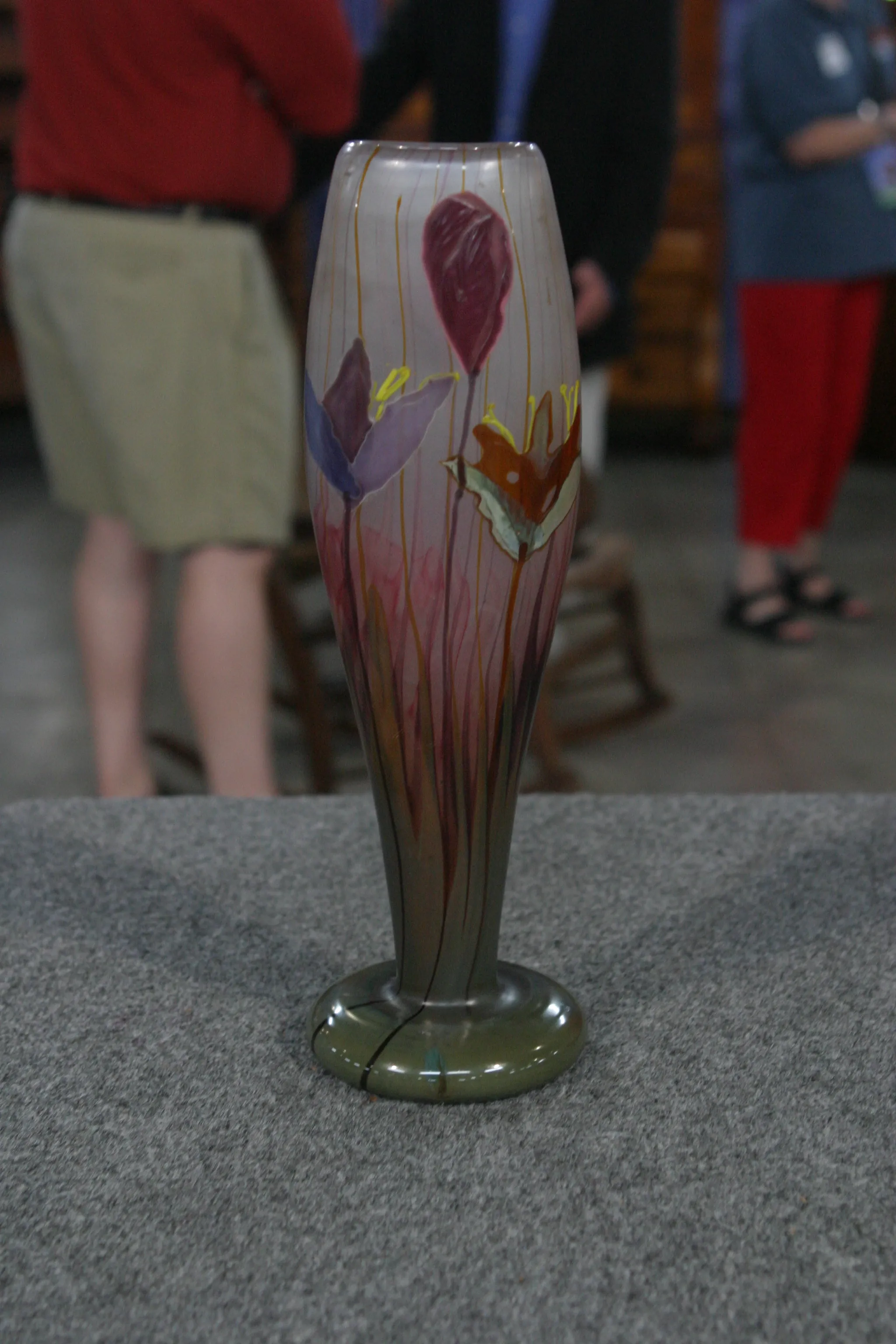
GUEST: I brought a piece of Murano glass. My father was a security salesman in Portland, Oregon, and occasionally, some of his clients would give him a gift as a thank you for the work he was doing, and this was a piece that they gave to him.
APPRAISER: And when did you acquire it?
GUEST: I think it was probably in the early '70s. It was on display in our family home, but actually, my taste is a little more Asian and Chinese art, so it's really been packed away for years. But I've always been curious if it's a piece of tourist glass or if it's actually an art piece of glass, so I just wanted to understand a little bit more about its history.
APPRAISER: Well, it is a piece of art glass,that I can assure you. It was actually made at a company called Cappellin Venini, or Venini, which was based in Murano. Murano is an island in Venice where there's a huge history of glass-making. All the Venetian glass comes from there. This is called a Veronese vase. Veronese was an Italian painter. In Venice, there's a painting of the Annunciation, and I believe there is a vessel in the painting that looks like this.
GUEST: I see.
APPRAISER: That's what inspired this design. It was first designed by Vittorio Zecchin in 1921, and he was the first director of the firm of Cappellin Venini. He was born in 1878, and this was the big vase that he designed for them back in 1921. It as first shown in 1922 at the Autumn Salon in Paris, and it has actually become a signature vase for Venini. They made it over a long period of time. This particular one was made between 1925 and 1935.
GUEST: Really, wow.
APPRAISER: The reason I know that is because of the mark on the underside. It says "Venini Murano," and it's the two-line signature. Later, in the 1950s, the signature became a three-liner, but this is the two-liner signature. The other reason I feel that this is an earlier version of the vase is it's got some imperfections in it, like I can see a thread of glass coming through here, and it's not absolutely perfect. And also, the color itself is more of an earlier color. The later ones, most of them I think are smaller and the colors are almost an opaline. So in terms of value, I would put a retail value on this piece of $3,000 to $4,000.
GUEST: Oh, that's great! Yeah, super.