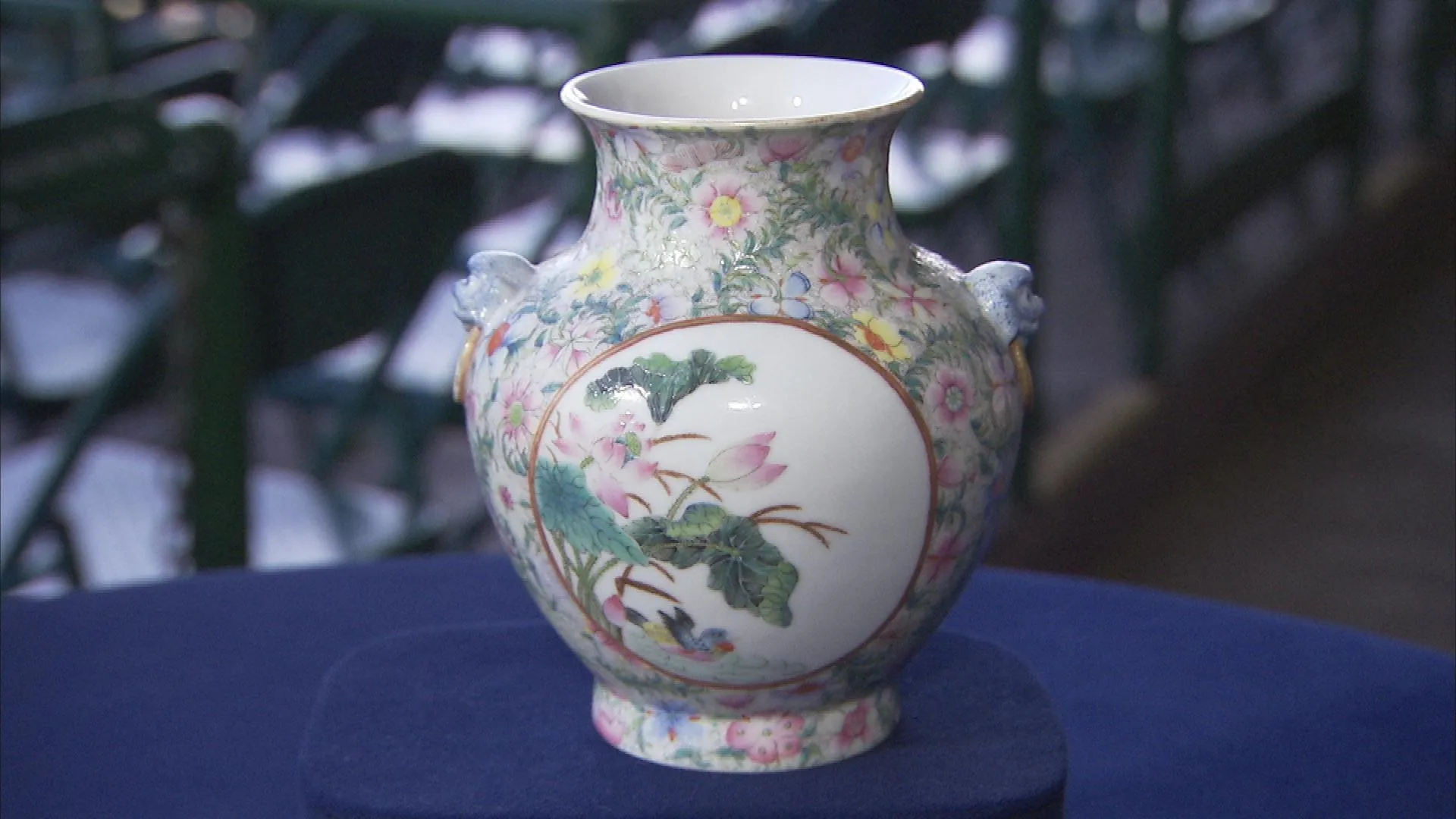
GUEST: I brought this. I guess it's a vase-- that was my best guess-- that I got from an estate sale in Orlando.
APPRAISER: How recently did you get it?
GUEST: I think it was January.
APPRAISER: Okay, and what attracted you to this piece?
GUEST: I just thought it was really unusual. I liked the colors, and I thought the metal details on the outside was pretty unusual.
APPRAISER: Did you pay a lot for this?
GUEST: I did not, I paid $75. I didn't think that was too much. I thought it was very pretty, so...
APPRAISER: No, it really wasn't too much, actually.
GUEST: Oh, well, good.
APPRAISER: What you've brought is a piece of bronze mounted Tiffany pottery. When we think about Louis Comfort Tiffany and Tiffany Studios, we always think about the glass and the windows and the lamps. But people don't really know so much about the art pottery. And that was a very special part of Tiffany Studios. There is a sticker on the underside, which is the Tiffany Studio sticker. And it actually says "Glass" on it, but that's typical. The stickers only say "Glass" on them, even though this is pottery. Now, there's another mark where it says, "B.P. 522, L.C. Tiffany Favrile." And that is typical. You would find this on a piece of bronze pottery.
GUEST: Okay.
APPRAISER: One of the reasons Tiffany started to make pottery was because up until about 1903, he was working in concert with other American pottery companies, and he would pair his shades with pottery bases made by the American pottery companies. So he decided, "Gee, why can't I make my own pottery bases?" So initially the output for Tiffany pottery were pottery bases. By 1904, the business evolved more towards the art pottery. This piece probably dates from after 1905. It has a wonderful glaze. It's actually a high fired glaze that is reminiscent of a glaze that you would find on Chinese porcelain. What's interesting about this piece, though, is the bronze mount. It's an early example of a bronze mount, and it's one of very few known. Unlike the later bronze mounted pottery pieces, this piece was cut out from sheet metal-- each piece that you see, these beautiful leaves here and the berries-- and then it was actually assembled on the vase itself. So it was soldered together, and then it was plated after that.
GUEST: I've wondered how they did that.
APPRAISER: It's just exquisite. What's interesting is that if this were... the vase were by itself, it would be worth $3,000 to $4,000 retail. But what makes it valuable is the work on it. And the work on it makes this piece... a retail value would be $9,000 to $12,000.
GUEST: Wow.
APPRAISER: So you did really well.
GUEST: Wow, that's much more than $75.
APPRAISER: Thank you for bringing such a great piece. When I saw it, I went, "Oh!"
GUEST: Well, thank you. I'm extremely happy.