GUEST: Years ago, I would take my children for a walk to the park, and there was this elderly lady that lived near the park, and I would say "hello" and she would say "hello" and one day I looked and I noticed that she had this crock where the water would come down. And I said, "Aren't you afraid that that is going to break in the winter?" And she says, "Well, I have nothing else to keep my water in." So I offered her ten dollars and I said, "Would you want to buy a container or a bucket?" And she says, "That's fine." And so I gave her the ten dollars and I sent my husband down and he got it, and it stayed in my basement for years... years. So that's what I know about my crock.
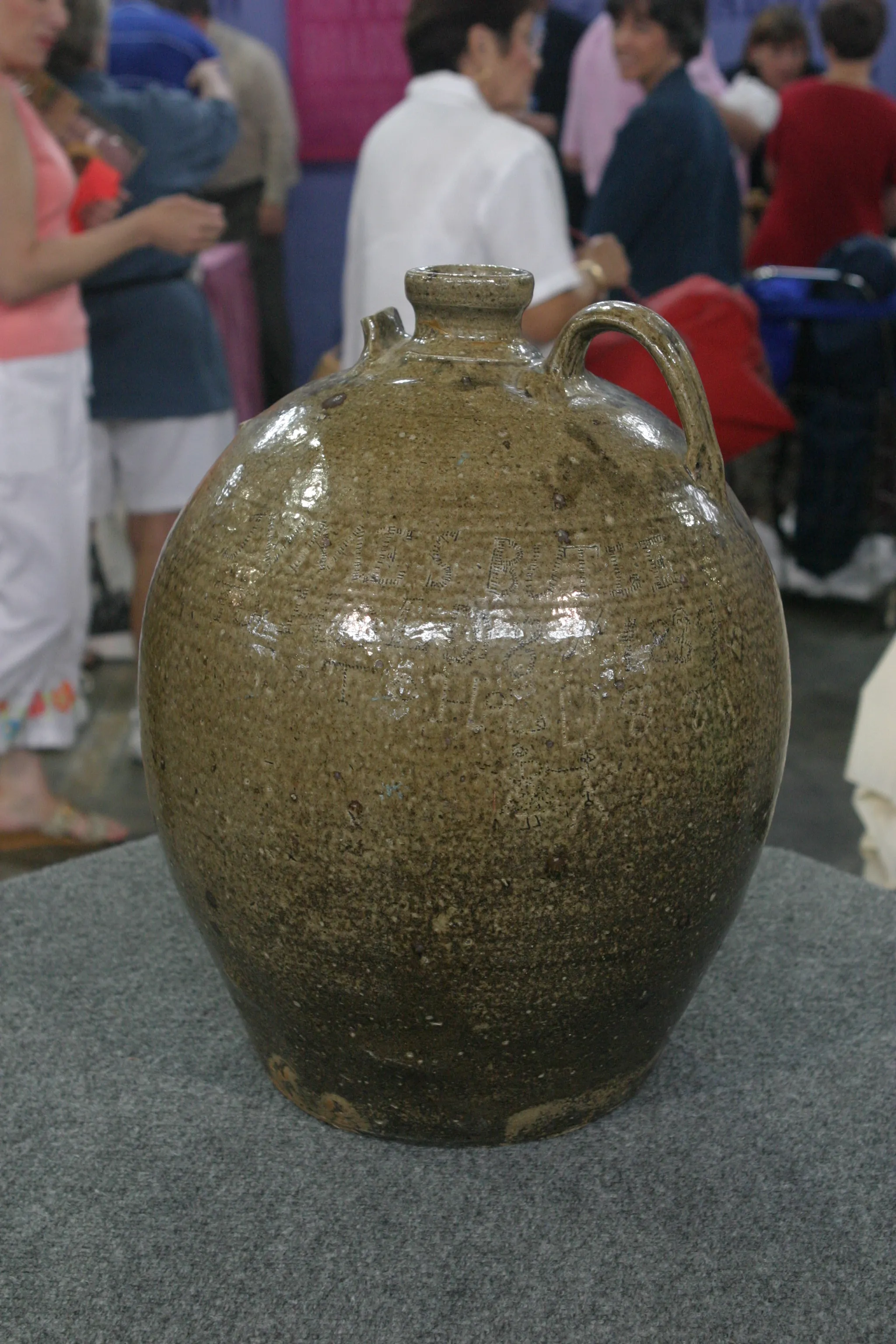
APPRAISER: Well, as you can see on the front, the crock was made by Thompson & Williams in Morgantown, West Virginia, which is a little south of Pittsburgh.
GUEST: Yes.
APPRAISER: And there was a potting industry there, as there was indeed up and down between here and there. And Thompson & Williams was a small partnership, active only for about three years, right around the time of the centennial. They opened in 1875 and closed in 1878. So there isn't much pottery made by them.
GUEST: Okay.
APPRAISER: It's a 20-gallon crock. You see very few of them. They're not easy to make. And you can see that this one has suffered a little, but it's survived. It's had bits here stuck on to it, possibly from being too close to something else in the kiln. It hasn't lost anything. That's just kiln damage. And the top of it is a little sagged in one area. But generally, it survived enough that it could be used. These were used or storage, largely, for liquids and also for pickles.
GUEST: I thought maybe sauerkraut?
APPRAISER: Sauerkraut-- the German immigrant families in that part of the world...
GUEST: Okay.
APPRAISER: Would routinely make sauerkraut and keep it over the winter.
GUEST: I see.
APPRAISER: And pickles were a big thing.
GUEST: Yes, correct.
APPRAISER: And you can make a lot of pickles in this.
GUEST:(laughing): Yes, a lot of pickles.
APPRAISER: The value of American crocks depends on a number of things. Condition is important, and this one's okay. It's not the best we've ever seen, but all the damage is sort of original, if you like.
GUEST: Right.
APPRAISER: Age-- this has good age. The maker-- this is not a well-known or well sought-after maker, but rarity helps. And then there's ornamentation and decoration. This is heavily decorated. There's nothing extraordinary about it.
GUEST: No.
APPRAISER: They did stencil a good deal, and they also painted. These flourishes are painted on. But it's such a big thing.
GUEST: Okay.
APPRAISER: Now, I did speak to some of my colleagues, and we collectively feel that if this came at auction, it would carry an estimate of at least $3,000.
GUEST: Oh, boy. Thank you.
APPRAISER: Now, it could go as high as $5,000, too.
GUEST: Okay, all right.
APPRAISER: And that would depend on who fancied it on the day.
GUEST: Yeah, who wanted it at that time.
APPRAISER: It all depends on who wants it and who wants a 20-gallon crock.
GUEST: Who wants a 20-gallon crock.
APPRAISER: From this maker.
GUEST: Thank you so much. I never dreamed it would be... Ten-dollar investment!
APPRAISER: Now, what are you planning to do with it now?
GUEST: It has a home in my dining room. I have pampas grass in it.
APPRAISER: That's perfect.
GUEST: But you know what? If anybody's interested... sold!
(both laughing)
GUEST: Thank you so much.
APPRAISER: You're very welcome.
GUEST: You made my day, you made my year.
APPRAISER: I'm very happy to hear that.
GUEST: Oh, thank you so much.