GUEST: Friend of mine that I lived with was a florist and he got it from a lady that he housesat for. And we always had it in our house. It always had fresh flowers in it. It was always great for great big ginger, bird of paradise, big tropical plants that we have down in Florida is what we used it for.
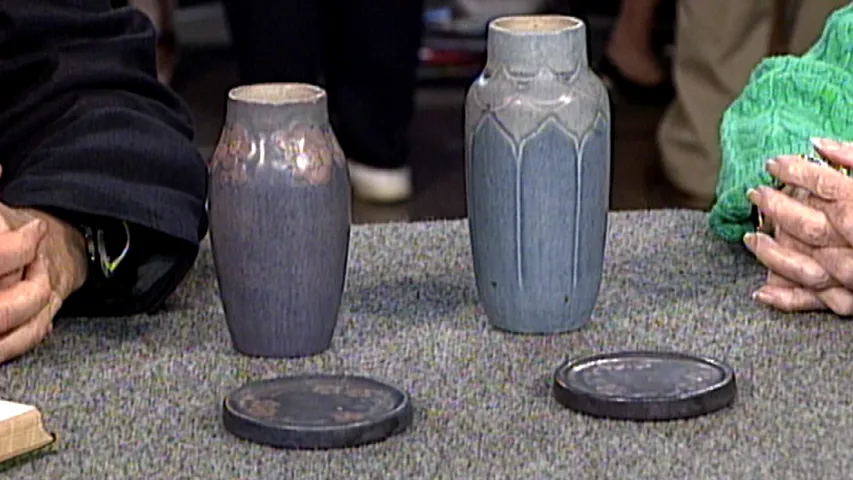
APPRAISER: But you know this is a piece of Teco pottery from the Chicago area. The thing about this vase-- Teco made two different types of pottery. They made a very organic ware, and they made a rather rectilinear or architectural ware. And obviously we have a fairly architectural piece here. You can see the strapped buttresses coming up and down the side of the piece. That's what they were known for. You have to bear in mind that Chicago at the time was in the process of being rebuilt after the great Chicago fire. And so these new structures were going up and it influenced the decorative art that was featured inside of these buildings at the time. So, Teco became very famous for many reasons, not the least of which is the quality of their commercial art ware. This is a molded pot. Teco was in business for a while, but this pot probably dates to about 1910. Oh, by the way, here's the mark on the bottom of the piece. It's die stamped into the pot. Very typical for Teco. But, you know, they produced the same mold for a period of time, so the pot could have been made 1906, 1916, somewhere around there.
GUEST: Wow.
APPRAISER: But, 1910 is a safe bet. This is bigger than most Teco. It's got the same glaze that most Teco comes with, this matte green.
GUEST: Yeah. I've always loved the color. It's just great in the house and with house plants.
APPRAISER: There is some damage, obviously. There is four or five small nicks on the pot. If you look inside the piece, you can see deposits from where it was used for plants and flowers over the years. The deposits on the inside can be taken out with naval jelly.
GUEST: Okay.
APPRAISER: Okay?
GUEST: I can do that.
APPRAISER: The chips aren't really bad enough. There's scallop shell edge chips that can be repaired.
GUEST: Do you recommend that?
APPRAISER: I would leave it alone, myself.
GUEST: Okay.
APPRAISER: And I would soak this-- because it's very dirty, I would soak this in something to leach the dirt out of the porous surface of the finish. But, all things considered, the pot's in pretty good condition. It really has very little damage. So, if this pot were in mint condition it would be worth more, but still, in the condition it's in, it's a $15,000 piece of pottery.
GUEST: Oh, my God!
APPRAISER: In perfect condition this is about a $20,000 to $30,000 piece of Teco.
GUEST: Oh, my gosh. I had no idea. None whatsoever.
APPRAISER: It's a really good, strong, solid piece of Teco.
GUEST: Had no idea of the worth.