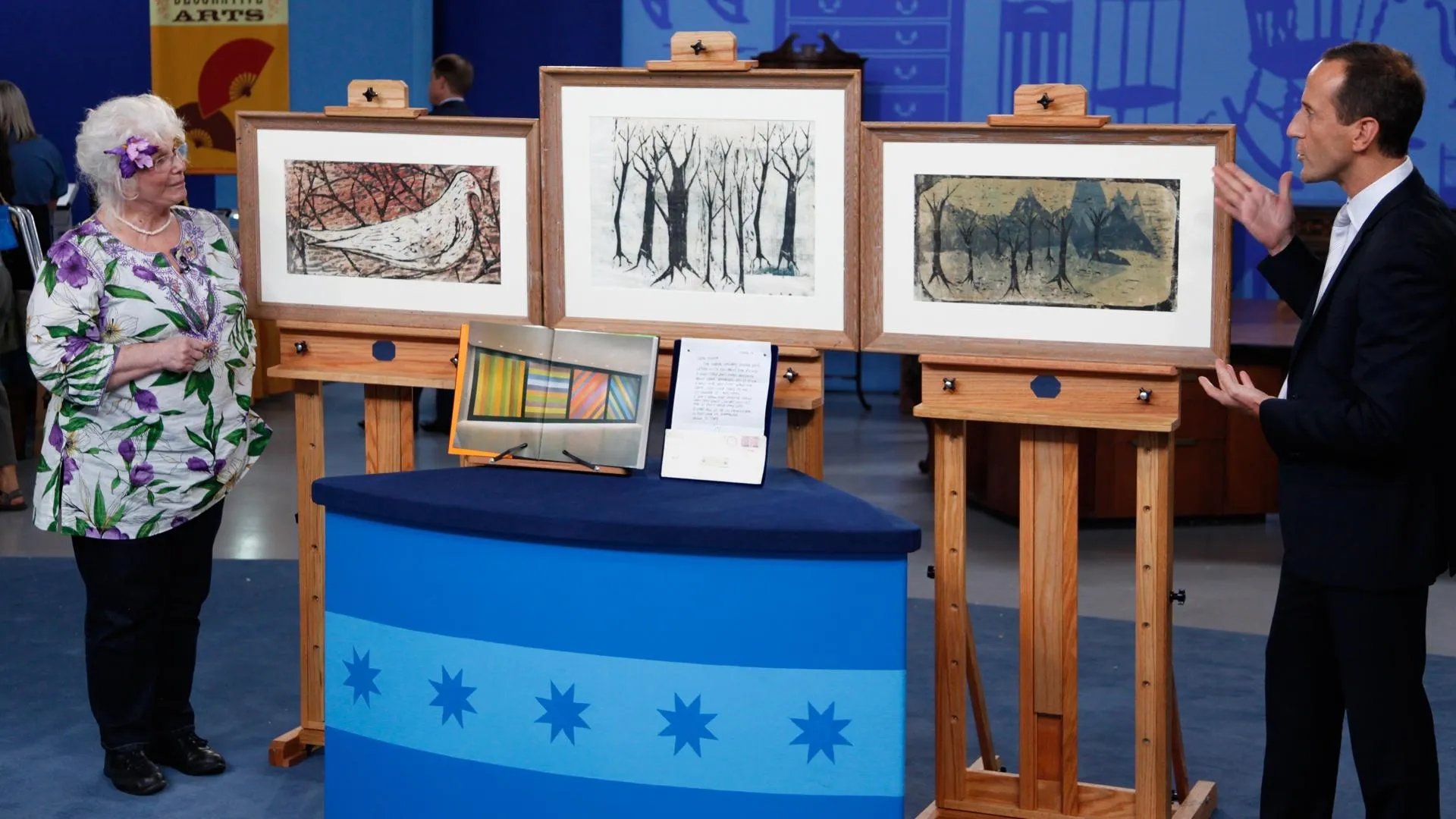
Sol LeWitt Woodcuts, ca. 1955
GUEST: They're by Sol LeWitt. I received them in the mail as a wedding gift in early 1956. They came to me because I married a buddy of his that served with him in the Korean War. I was in a local celebration, got to be crowned queen, my husband-to-be was a reporter for the newspaper, and so they did a photoshot in the story, and the Associated Press picked it up. And Sol LeWitt was walking on the street in his neighborhood and looked over and saw this picture.
APPRAISER: This was in New York?
GUEST: It was in New York. And he said to himself, "I think I know that guy." And of course he read of our pending marriage then, and where we were settled, and mailed them to us.
APPRAISER: They're probably the earliest works I've ever seen by Sol LeWitt. They're virtually from his student days.
GUEST: I've wondered about that.
APPRAISER: So as you were saying, LeWitt served in the Korean War in the 1950s.
GUEST: Right.
APPRAISER: He then went to New York and studied art. And in 1960, he got a job at the Museum of Modern Art. And that sort of gelled what he was thinking in terms of modern conceptual art. He's a real big deal in contemporary art. And anybody who knows his work, as you see in that book illustration there, which is from a recent retrospective of his work, that's what you think of, very minimal, very linear. These don't look anything like what he did.
GUEST: No, they don't. And I thought they might not have much value because of that.
APPRAISER: Now, what do you think of them?
GUEST: My husband then when he saw them, he said, "I never liked this modern art stuff," and threw them in a wastebasket.
APPRAISER: Even though they were from his buddy?
GUEST: Yeah, right, yeah.
APPRAISER: So you saved them from the garbage.
GUEST: I saved them because we were living on a part-time income and didn't have anything to put on the wall. I've come to love them.
APPRAISER: A lot of times, early work like this by artists that doesn't look anything like what they developed into is thrown away, and it's not treated with the care that their known work is. They're not signed, so how do we authenticate them? That's the question.
GUEST: Well, he wrote and wanted to buy them. He said it was his artwork.
APPRAISER: And it's perfect that you saved that too. You have a letter here from the 1970s from Sol LeWitt to you, asking if he could buy each of them for $200?
GUEST: $200 each, yeah.
APPRAISER: And you decided to hold onto them at that point.
GUEST: I did.
APPRAISER: And did you know at that point that he was famous?
GUEST: Well, actually, he had come to my area and done some line drawings in a visual arts center, and his picture appeared in the newspaper. Up until then, the '70s, I didn't know he was gaining fame. So I wrote to his gallery. I just wanted to know how to get them recognized and approximate value.
APPRAISER: Well, I find it interesting that he cared enough to write you back and sought out trying to buy these back.
GUEST: Yeah, that was really neat.
APPRAISER: He was famous by that point. He had had his first one-man exhibition in New York in 1965. And by the mid-'70s he had gained traction as the premier minimal conceptual artist in New York. These look like they're in great shape for their age. We determined they were about 57 years old.
GUEST: 57 years old, yeah.
APPRAISER: They're each colored wood cuts, and they would have been printed from several different blocks, a different block for each color. LeWitt did hundreds of works in painting, in prints, drawings, sculpture. The closest comparable I have to this is just a year ago a very early woodcut from the 1950s by one of LeWitt's contemporaries, Roy Lichtenstein, was sold at auction, and its value was around $10,000.
GUEST: Oh, okay, uh-huh.
APPRAISER: Even though they're prints, and therefore multiples, these are very likely the only examples left. I would conservatively put replacement values on them somewhere between about $7,000 and $10,000 each on these.
GUEST: Oh, okay.
APPRAISER: So upwards of $30,000 for the three.
GUEST: All right, all right. Does his letter have any value?
APPRAISER: The letter adds to the provenance, and without that, you have unsigned prints and a story. The letter itself is worth several hundred dollars, but it adds to the value of these prints.
GUEST: Right, okay.

$21,000 - $30,000 Insurance
Featured In
episode
Seattle, Hour 1
ANTIQUES ROADSHOW rocks out at Seattle’s EMP Museum and discusses Jimi Hendrix!
Paper and Cardboard
appraisal
appraisal
appraisal
appraisal
Understanding Our Appraisals
Placeholder