GUEST: This rug came to us from my sister-in-law Joan. We got that when we were remodeling my daughter's room, and I asked her, "Do you have anything that might go into the room?" And she said, "Well, let's see about this rug." And I took a look at it, and some of the colors, like some of the greens in here, they matched her room, and so that's how we got it.
APPRAISER: And do you know where they got it from? Is it something they purchased?
GUEST: My husband's grandmother, I have no idea where she got it from.
APPRAISER: So she got it from your husband's grandmother.
GUEST: Yes.
APPRAISER: When do you think she would have acquired it, what year?
GUEST: She moved to Yakima around 1907, and that's when they built their home, so it could have been around 1910.
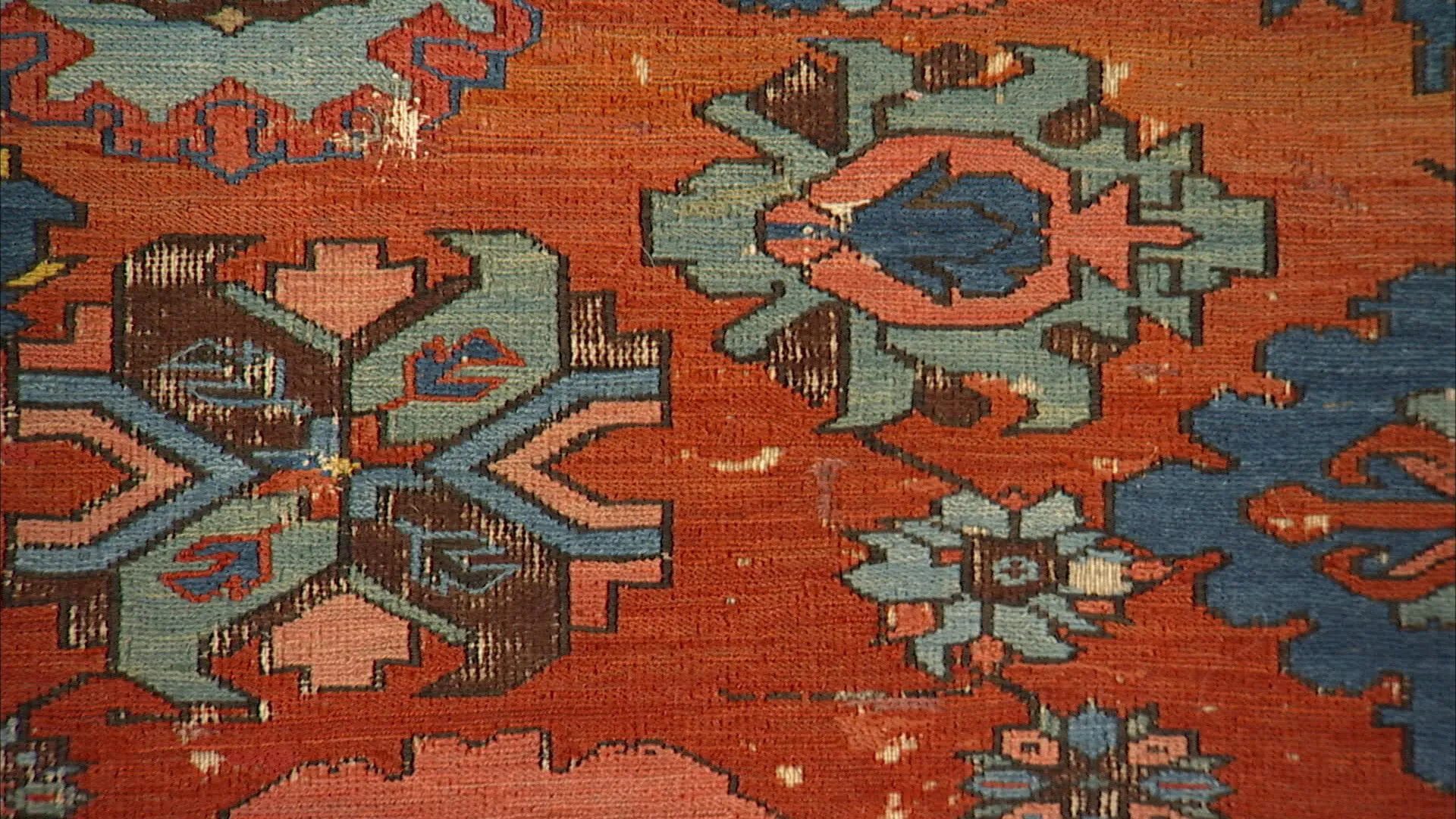
APPRAISER: It's a Senna rug from Northwest Persia, which is present-day Iran, woven in the 1880s.
GUEST: Wow.
APPRAISER: And it was probably new in the United States when your ancestor bought it in 1907, 1910. This is a prime example of the craze for Oriental rugs at the turn of the 19th and 20th century, where anyone with any sort of wealth or a little spare money when they were setting up household would have wanted to buy a rug. And it's really a wonderful example of Senna weaving from the period. It's got wonderful soft color. At one point you had mentioned that you thought the colors had faded, or someone had mentioned to you...
GUEST: Yes, yes.
APPRAISER: But actually, it hasn't. It's really in pretty much full original color.
GUEST: Oh, my goodness.
APPRAISER: There's been some light fading from the rug, but it would have happened within the first four or five years of its life. The transition in color you see from here where it seems quite bright, to where it gets a little light is something called abrash, in rug terms. It's where yarns from different dye lots were used, so it was all red, but the reds were dyed at different times, and so they oxidize and fade out differently. And rugs are woven, where they start here, and they just knot up in horizontal lines. So if that line's consistent, it's really a result of abrash. It's not because you've had it exposed in the wrong spot or something. It would have happened if it was just sitting in a dark closet over time through the oxidation.
GUEST: Okay, okay.
APPRAISER: What is very interesting about this group of Sennas is that they're not based on traditional carpet designs. They're based on textile designs. So if you see this element, which is called a boteh, and then with stylized vinery, it's a pattern that we in the West call a paisley, based on paisley shawls. And that's exactly where the Senna weavers, the women weaving this rug, were picking up the pattern was from a shawl, as opposed to a traditional carpet design. And in my opinion, they're a little bit more unusual, and they're just a little bit more visually exciting, where it's an overall design, as opposed to the typical medallion corners and borders. And your condition is marvelous. Do you use the rug?
GUEST: Yes, we do. We've used it ever since we got it, which has been about eight years. We keep it on the bedroom floor.
APPRAISER: A bedroom's a good spot for it because you're not usually walking on hard-soled shoes.
GUEST: It's low traffic in that spot. And she is not in the room anymore also.
APPRAISER: Okay. Well, if this was to come up for auction today, I think a good auction estimate would be $6,000 to $8,000.
GUEST: (laughing) You're.... oh, my God! Okay, I just never ever thought of that.
APPRAISER: And what's really interesting is that's reflecting a fairly weak market for rugs of this type. In the past, ten years ago, 15 years ago, a rug like this would have easily sold in the $10,000 to $15,000, $12,000 to $18,000 range. So it's really extremely good quality, and it's something that you should...
GUEST: I should take it off the floor.
APPRAISER: No, no, absolutely not. You have it in the right spot in a bedroom. Rugs are made to go on the floor. It looks best that way; enjoy it.
GUEST: Okay, well, thank you.