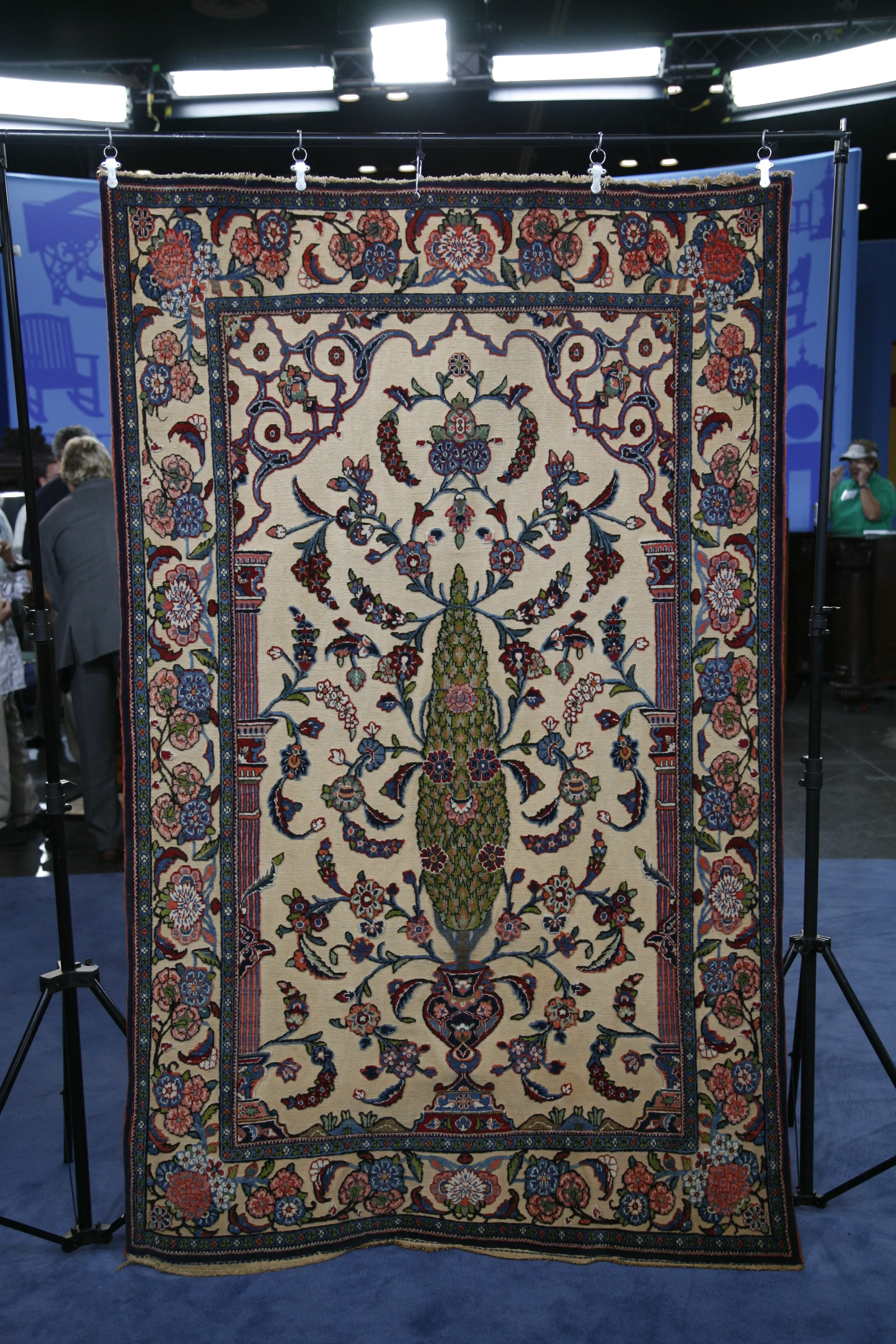
GUEST: This rug belonged to my in-laws, and as long as I knew them, they had it hanging in their home. They loved the rug. They told us it was from Iran. They had a business dealing with a couple who they were friends with, and the business dealing didn't go well and they felt bad about it, and they knew my mother-in-law admired the rug, so they gave it to her because they felt bad about the business loss. I don't know how old it is. I know they acquired it in the 1960s.
APPRAISER: Okay, well, the rug is a Persian rug. It was made in Iran, and it's called an Isfahan. And Isfahan is the city where the workshop was that made it. I would say that it was made somewhere in the '60s, so it was probably a new rug when it was given to your in-laws. There were a lot of rugs that were sold in the '60s, and rugs were very, very popular. This one is made by a particular workshop which is called Seirafian. And there's a signature at the bottom, and it is both in Farsi and in English.
GUEST: Okay.
APPRAISER: And so it says, "Made for Seirafian, Isfahan." What's interesting about that is that Seirafian is the best recognized maker of these Isfahan rugs, but he didn't start using the English superimposed on the Farsi until around the '60s, and that's one of the things that helps me to date the rug. The rug is extremely finely woven. I did a knot count on it. The knots per square inch amount to about 1,000 knots per square inch.
GUEST: That's high.
APPRAISER: Which is mind boggling in terms of workmanship. People that appreciate Persian city workshop rugs really value the fineness of the weave, and that's very, very fine. Now, the majority of rugs that were made in the post-war era, '50s and '60s, in Iran have not been good investments, but this is one of the most desirable types of Persian rugs, and Seirafian has a magic name in the marketplace. The Middle Eastern market is buying these back, and it's a revival of a tradition with the design elements going back to the classical carpets from the 15th century, but the coloration in this rug is unlike the rugs that would have been made in Iran in the late 19th or early 20th century. This is in an era where they were using synthetic dyes and natural dyes, so I would estimate that the red is probably synthetic, the blue is indigo, which is a natural dye, and the various shades of green would also be natural. It's beautifully preserved, and that's probably because it's been hanging on a wall. You still have it hanging on a wall?
GUEST: Yes, we do.
APPRAISER: And is it out of direct sunlight?
GUEST: It is.
APPRAISER: Any idea of the value?
GUEST: We thought maybe $10,000.
APPRAISER: In today's market, I think a serious collector would pay $15,000 for this rug.
GUEST: Well, my mother-in-law would be very happy to know that. She was always very proud of it.