GUEST: I mostly collect folk pottery, but this particular collection is of the Scheiers. In 2001, I viewed an exhibition at William King Museum of a retrospective of their work. They first started in Norris, Tennessee, which is near here. They set up their first pottery in Glade Springs, Virginia, which is just a little bit north of Abingdon, Virginia.
APPRAISER: When was that?
GUEST: I want to say that's in the late '30s, maybe 1938, perhaps.
APPRAISER: Okay.
GUEST: The retrospective had examples of their early work from when they were working there on through to their more famous work when they were working in New Hampshire, and then also in Arizona and so forth.
APPRAISER: I arranged these chronologically and the two pieces closest to you are earlier examples of their work. Could you tell us about the first one?
GUEST: It was on the cover of the catalogue for the exhibition, or a similar piece was. So I was able to recognize that. If you feel it, compared to their later work, it's more primitive and clunky. It's heavier by a great deal than their... They're really known for their really thin ware.
APPRAISER: So the early work's from the Hillcrock pottery. Also, the figurine's typical of the early work. And I think it's fair to say that they started as folk potters, this Edwin and Mary Scheier. They were working at University of New Hampshire. In 1940 they were taken on. At some point, they stopped being folk potters and they started being 20th century potters, and not many artists made that shift in the ceramic arts, and you can see the radical difference from Grandma reading to this kind of plugged-in psychedelic neo-African design on a hand-thrown pot, which is typical of the work in the '60s and '70s. In this charger dated 1991, they maintained the biblical scenes they used throughout their career. What do you know about the piece of artwork up here?
GUEST: I read in the book on Edwin and Mary Scheiers where Edwin did some paintings on Japanese vellum. That's about all I know about that piece. I'm not sure exactly even when it was made.
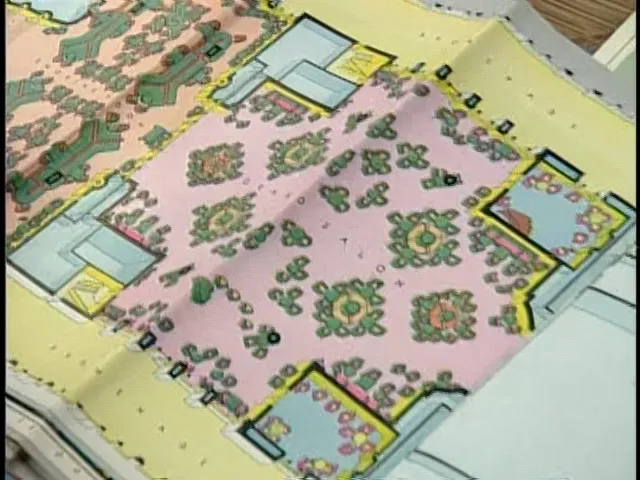
APPRAISER: They've done weavings. They went to Mexico in '57 and they studied weaving in Oaxaca. Sand paintings they also learned in Mexico. This painting was probably done in around 1961, and these are the rarest of their non-ceramic work, from what I've seen. This is a really good compendium of the work done by the Scheiers over about a 60-year period. So how much did you pay for the Hillcrock pottery vase?
GUEST: I paid $100 and probably I think the same for the figurine. The vase, I paid I believe $400. That one, I paid around $100 for. For the painting, I paid $65.
APPRAISER: In terms of values, the piece closest to you, that would appeal to a hard-core collector because their early work is extremely rare. And I would think that at auction, a piece of their earliest work in vase form would be between $1,000 and $1,500. I've seen figures like this sell. The most recent one sold for a little over $2,000, you might be surprised-- at auction-- to hear. The Adam and Eve has a crack running through the middle, so that limits the value. Probably at auction about $500 to $700 on that one. Now, this one has a couple chips at the bottom. In spite of that, I think at auction-- because this is really what they're known for and this is from their prime period-- somewhere between $3,000 and $4,000 at auction. And then finally, the painting, which is not what people typically look for in Scheiers' work, but I think the auction price on that is somewhere between $1,500 and $2,000. So altogether, you have work worth between $7,000 and $10,000 in Scheier at auction.
GUEST: Well, that's amazing. Thank you for your information.