San Francisco Cable Car Front Panel, ca. 1900
GUEST: I believe this is the front panel of a cable car from San Francisco. I acquired it two or three years ago at an auction. I said, "That's something I have to have." It's a piece of art, so, and, and a iconic piece of San Francisco history.
APPRAISER: Yes.
GUEST: Possibly.
APPRAISER: Possibly.
GUEST: Yes.
APPRAISER: Yes, and what did you pay for it?
GUEST: Uh, $900.
APPRAISER: The Presidio and Ferries Railroad Company started operations in San Francisco in 1880. They started by doing a very long run from downtown San Francisco out to the Presidio Military Reservation.
GUEST: Right.
APPRAISER: That was their original purpose.
GUEST: Right, this one from Market Street.
APPRAISER: From Market Street, which is downtown.
GUEST: Right.
APPRAISER: They ran a cable car system, and it ran up until 1906, when there was a catastrophic event in San Francisco-- the earthquake.
GUEST: Right.
APPRAISER: Many of the cars were destroyed.
GUEST : Right.
APPRAISER: Parts were salvaged. They rebuilt, as they did with the city, and they were purchased by the City of San Francisco in 1913. This front of a cable car is what you're thinking it is. The design pattern is identical to what I've seen on some of the vintage cars. When we examine it forensically, you have a, a front that's made of separate individual boards. It's put together in a tongue- and-groove construction. Tongue-and-groove construction was very, very popular in the late 19th century. These two boards-- this one and the one over there with the large hole in it-- they're a different wood. They were a harder wood because there was a bolt that went through here, and that's what bolted it to the front of the cable car. Then they were covered with a fascia board. And we clearly see the oxidation mark. When we examine the paint, we see beautiful gilt, gold letters. And this would have been painted on by an employee of the cable car company. And they were called carriage painters. They were very, very expert at doing this beautiful gold lettering. And when we look at the patina on this lettering, we see real age. This is exactly what you want to see when it comes to gilt lettering. It's absolutely authentic. Dates to the late 19th century. This metal bezel, that held the glass lens. Behind there, originally, was a fuel light that would shine out and magnify onto the street. So you have an authentic front of a San Francisco cable car.
GUEST: All right.
APPRAISER: Which is pretty amazing piece of, of history.
GUEST: Right. Great, I love it.
APPRAISER: Now, I'm going to place a retail value on it today of $5,000 to $7,000.
GUEST: Okay.
APPRAISER: So I think you did very well.
GUEST: That's great.
APPRAISER: Congratulations.
GUEST: All right.
APPRAISER: And it's real.
GUEST: It's real-- that's what I...
APPRAISER: Isn't that exciting?
GUEST: Well, it is. I like real, not fake.
APPRAISER: (laughs): I, I think...
GUEST: Or copies.
APPRAISER: I think we all do.

$5,000 - $7,000 Retail
Featured In

episode
Filoli, Hour 2
Golden State treasures shine at Filoli, with an appraisal valued up to $150,000!
2D Art
appraisal

appraisal
Frank Zappa Painting, ca. 1960

appraisal
Edgar Alwin Payne Painting, ca. 1925
appraisal
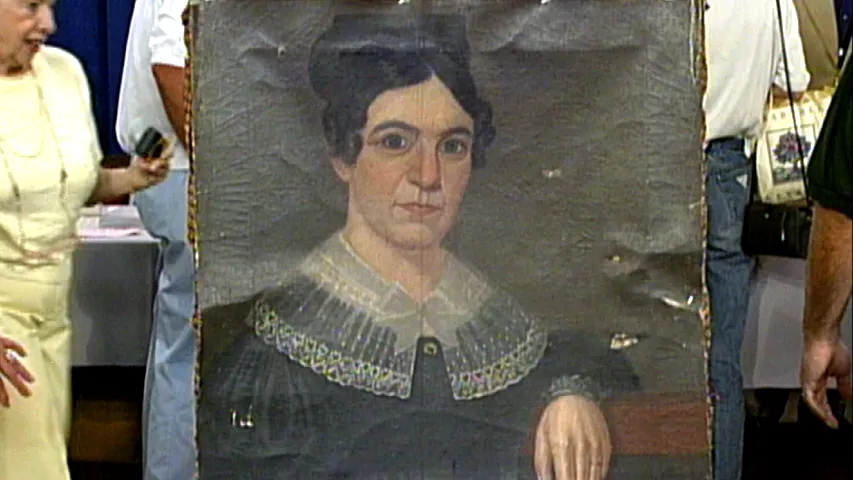
American School Portrait, ca. 1820
Understanding Our Appraisals
Executive producer Marsha Bemko shares her tips for getting the most out of ANTIQUES ROADSHOW.
Value can change: The value of an item is dependent upon many things, including the condition of the object itself, trends in the market for that kind of object, and the location where the item will be sold. These are just some of the reasons why the answer to the question "What's it worth?" is so often "It depends."
Note the date: Take note of the date the appraisal was recorded. This information appears in the upper left corner of the page, with the label "Appraised On." Values change over time according to market forces, so the current value of the item could be higher, lower, or the same as when our expert first appraised it.
Context is key: Listen carefully. Most of our experts will give appraisal values in context. For example, you'll often hear them say what an item is worth "at auction," or "retail," or "for insurance purposes" (replacement value). Retail prices are different from wholesale prices. Often an auctioneer will talk about what she knows best: the auction market. A shop owner will usually talk about what he knows best: the retail price he'd place on the object in his shop. And though there are no hard and fast rules, an object's auction price can often be half its retail value; yet for other objects, an auction price could be higher than retail. As a rule, however, retail and insurance/replacement values are about the same.
Verbal approximations: The values given by the experts on ANTIQUES ROADSHOW are considered "verbal approximations of value." Technically, an "appraisal" is a legal document, generally for insurance purposes, written by a qualified expert and paid for by the owner of the item. An appraisal usually involves an extensive amount of research to establish authenticity, provenance, composition, method of construction, and other important attributes of a particular object.
Opinion of value: As with all appraisals, the verbal approximations of value given at ROADSHOW events are our experts' opinions formed from their knowledge of antiques and collectibles, market trends, and other factors. Although our valuations are based on research and experience, opinions can, and sometimes do, vary among experts.
Appraiser affiliations: Finally, the affiliation of the appraiser may have changed since the appraisal was recorded. To see current contact information for an appraiser in the ROADSHOW Archive, click on the link below the appraiser's picture. Our Appraiser Index also contains a complete list of active ROADSHOW appraisers and their contact details and biographies.


