Ruth Muskrat Bronson Archive, ca. 1923
GUEST: This belonged to my great-great-aunt Ruth Muskrat Bronson. She was a civil rights activist. She was an author, a poet, a songwriter, an educator. To me, uh, she is so special-- she was a woman before her time, and she did a lot of things for Native American people that we can all still be proud of today.
APPRAISER: What was her era, so to speak?
GUEST: She was born in 1897. This picture was taken in 1923, when she was a junior in college at Mount Holyoke. And this is at the White House in Washington, D.C.
APPRAISER: Okay.
GUEST: This is my Aunt Ruth, and this is President Calvin Coolidge. And this is a book that she presented to him that day. And she also gave a speech that day.
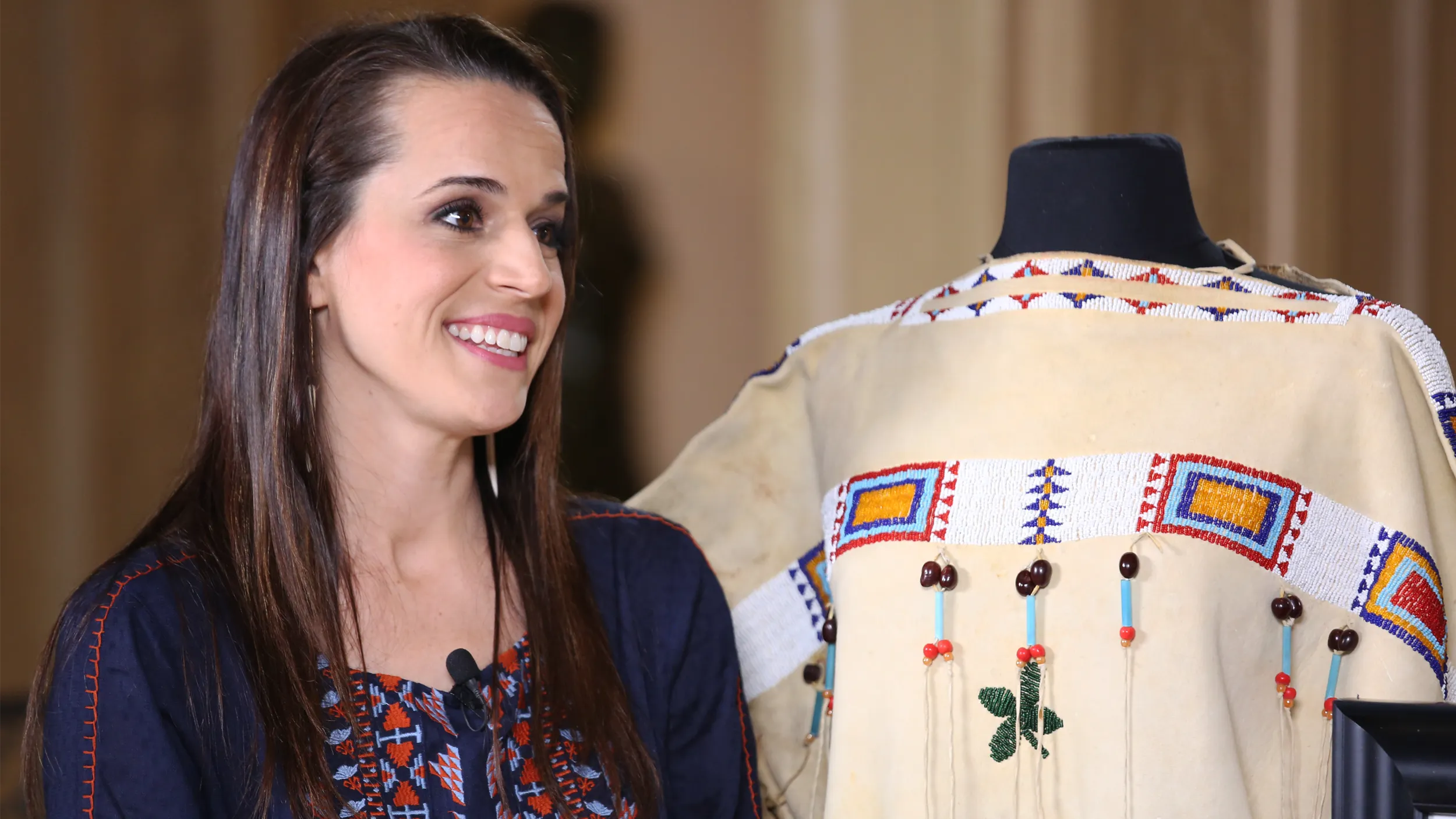
APPRAISER: Is the dress that you're standing by the one she's wearing in that photograph?
GUEST: This is the dress that's in the photograph, yes.
APPRAISER: Okay. And, and that's the same dress that's in this photograph. Were the moccasins and the dress created for the presidential event?
GUEST: That's my understanding, yes. They were intentionally not Cherokee items...
APPRAISER: Mm-hmm.
GUEST: ...so that she could be representative of more than just her tribe and be representative of all American Indians.
APPRAISER: This is the speech that she delivered at the White House, is that right?
GUEST: Yes. And to read through that speech, it gives me goosebumps. She said such amazing things that President Coolidge invited her to come to the White House for lunch at a later date, which she did.
APPRAISER: In the speech, she tells who made the beadwork. Both the moccasins and the dress were made here in Oklahoma by Cheyenne bead-workers. The hides are brain-tanned deerskin, which were never inexpensive. They were always, incredibly high price to get them. They were difficult to make. And I thought the moccasins might be Lakota because of the designs. But then I got to looking, and there's a welt right here between the sole and the beaded uppers. You notice that trait in lots of Cheyenne moccasins from Oklahoma, you know, the Southern Cheyennes. Do you know what she was talking to the president for?
GUEST: Well, this was the Committee of One Hundred in 1923, and I believe she was asking for civil rights for Native American people.
APPRAISER: Right.
GUEST: And also fighting for Native Americans in the laws that were be, being created at that time and talking about the "Indian Problem." And she wanted the president to hear from an Indian what the real Indian Problem was, and it wasn't what the other people were calling the Indian Problem. She wanted everyone to accept Native Americans as Americans and to allow them to be educated just like everyone else.
APPRAISER: Yeah, I saw in the letter, she's asking for education for all.
GUEST: Yes.
APPRAISER: Where did she live?
GUEST: She was from Grove, Oklahoma.
APPRAISER: Oh, yeah.
GUEST: She was my great-grandmother's sister, and that's where our whole family was from. That's where our allotment land, uh, we still have that allotment land, um, but she, she lived in Washington, D.C. She worked there for the government, for the B.I.A., and then she retired in, uh, Phoenix, Arizona. She was helping different tribes her entire life. When she passed away, I believe she was in Arizona working for water rights for tribes out there.
APPRAISER: Oh, yeah, that's a big deal.
GUEST: Yes.
APPRAISER: She's asking for what we consider basic human rights...
GUEST: Absolutely.
APPRAISER: ...in this country today in the '20s. And, and after that, you get the Depression, and things really got bleak. Now people have awakened to these situations, but they didn't do it without a pushback. And that's why a lot of rules have been passed, laws have been enacted, everything from the Native American Sovereignty acts to NAGPRA, the Native American Graves Protection and Repatriation Acts. And they protect this cultural patrimony that's been handed down, in your case, through your family, but also in national input. And this was the early days of all that. These were the people that pushed that to try to make it happen. When you brought this dress in and the moccasins, I looked down and I said, "Yeah, nice moccasins, nice dress." In this condition, and mainly because they're late, if you were going to see these things at auction, you'd expect 'em to bring $800 to $1,200. But that's not what's here. That's not what this is about. This is about, this woman wore these things to represent a pan-culture, almost, that spread across the United States that she was fighting for, for rights for. When you start looking at it from that point of view-- her meeting with the president, the original speech-- and I think you're talking, for all of that you have here-- and you have more, you have more archival material, more photographs-- if you were to bring these up for insurance, it gets more like $8,000 to $12,000.
GUEST: Wow! And these things are priceless to our family.
APPRAISER: Oh, I'm sure.
GUEST: So, yes.
$35,000 - $35,000 Insurance
$8,000 - $12,000 Insurance
Featured In
episode
Philbrook Museum, Hour 1
Travel to Tulsa for ROADSHOW appraisals at Philbrook Museum. Which is worth $71,000?

episode

episode
Celebrating Native American Heritage
Celebrate incredible art and artifacts from Indigenous creators and history makers.
Appraisal Extras

article
Read a Speech by a Native American Activist from the Early 1920s
Read the full speech that activist Ruth Muskrat Bronson addressed to President Coolidge regarding education for all Native Americans in 1923.
Books & Documents

appraisal
Dr. Seuss “Kangaroo Bird," ca. 1938

appraisal
1903 Jack London Call of the Wild Book with Letter

appraisal
1903 - 1908 Camera Work Magazines

appraisal
1851 First Edition "Pearl of Great Price"
Understanding Our Appraisals
Executive producer Marsha Bemko shares her tips for getting the most out of ANTIQUES ROADSHOW.
Value can change: The value of an item is dependent upon many things, including the condition of the object itself, trends in the market for that kind of object, and the location where the item will be sold. These are just some of the reasons why the answer to the question "What's it worth?" is so often "It depends."
Note the date: Take note of the date the appraisal was recorded. This information appears in the upper left corner of the page, with the label "Appraised On." Values change over time according to market forces, so the current value of the item could be higher, lower, or the same as when our expert first appraised it.
Context is key: Listen carefully. Most of our experts will give appraisal values in context. For example, you'll often hear them say what an item is worth "at auction," or "retail," or "for insurance purposes" (replacement value). Retail prices are different from wholesale prices. Often an auctioneer will talk about what she knows best: the auction market. A shop owner will usually talk about what he knows best: the retail price he'd place on the object in his shop. And though there are no hard and fast rules, an object's auction price can often be half its retail value; yet for other objects, an auction price could be higher than retail. As a rule, however, retail and insurance/replacement values are about the same.
Verbal approximations: The values given by the experts on ANTIQUES ROADSHOW are considered "verbal approximations of value." Technically, an "appraisal" is a legal document, generally for insurance purposes, written by a qualified expert and paid for by the owner of the item. An appraisal usually involves an extensive amount of research to establish authenticity, provenance, composition, method of construction, and other important attributes of a particular object.
Opinion of value: As with all appraisals, the verbal approximations of value given at ROADSHOW events are our experts' opinions formed from their knowledge of antiques and collectibles, market trends, and other factors. Although our valuations are based on research and experience, opinions can, and sometimes do, vary among experts.
Appraiser affiliations: Finally, the affiliation of the appraiser may have changed since the appraisal was recorded. To see current contact information for an appraiser in the ROADSHOW Archive, click on the link below the appraiser's picture. Our Appraiser Index also contains a complete list of active ROADSHOW appraisers and their contact details and biographies.


