GUEST: This is my great-grandfather, and he was a businessman. He owned an insurance company in the early 1900s, and he was very successful.
APPRAISER: You said he was from Pittsburgh?
GUEST: Well, he's originally from Newark, New Jersey, but he started his business in Pittsburgh, Pennsylvania, which is where I'm from, and this vase belonged to him. He had a number of things.
APPRAISER: You think he might have traveled a bit, which is how he picked up some of these things?
GUEST: He traveled extensively.
APPRAISER: Do you know if he went to Europe at all?
GUEST: Probably. I'm not sure, though.
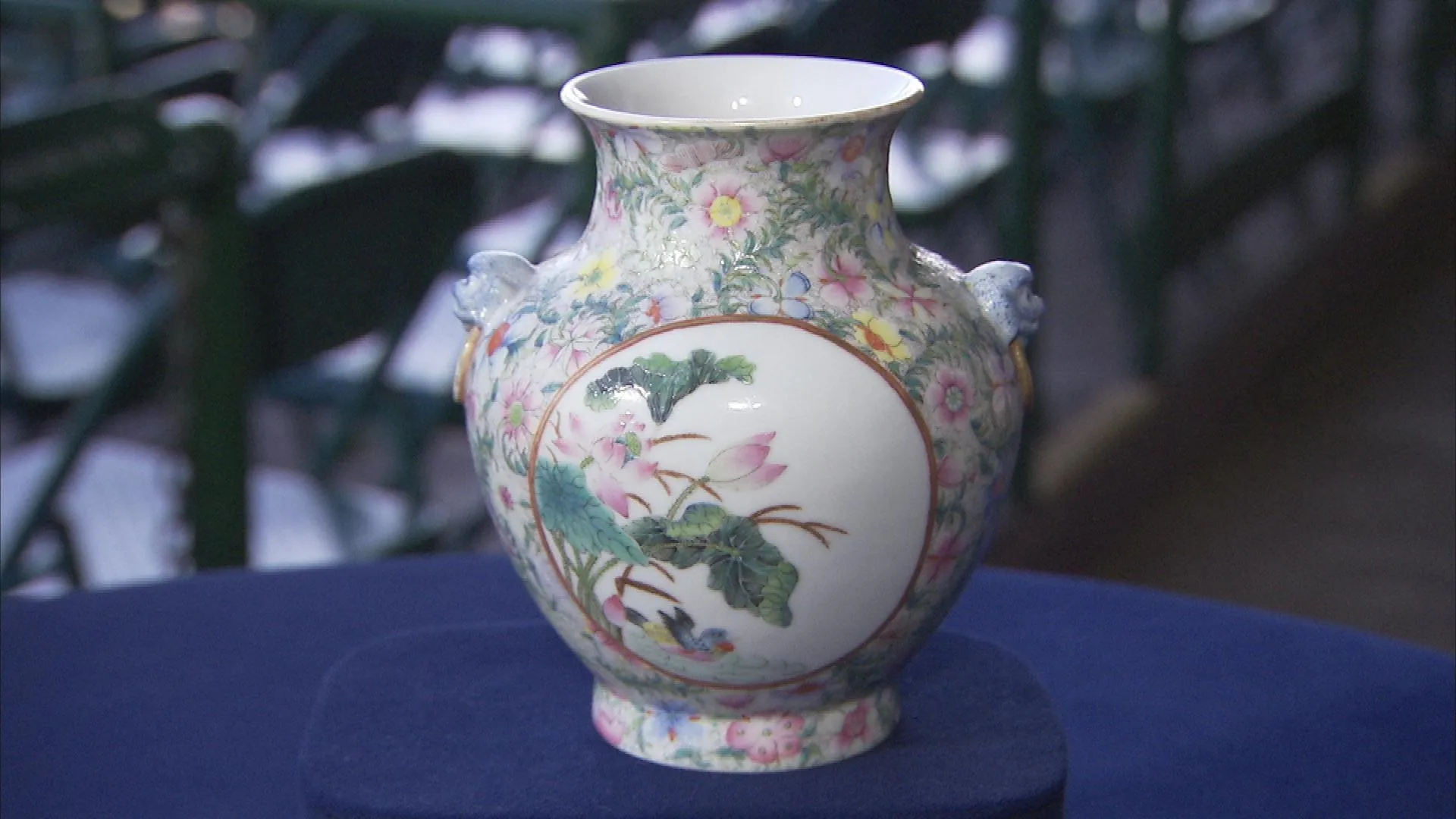
APPRAISER: Well, the reason I ask is because the vase that we're looking at is a European vase. It's a piece of Royal Bonn, and this is a very English-influenced piece of German artware, but is exceptional. And we sort of have a joke at the pottery and porcelain table, which we will never do a piece of Royal Bonn because Royal Bonn, by and large, made a lot of reproductions of Royal Worcester, which was a famous English company. They made mostly earthenware copies, usually decorated with transfers, which are decals, sometimes by hand, but not terribly inspired. It was very derivative ware, and so we see a lot of it, we don't look forward to seeing it, and then along comes this piece. This is exceptional, and they made a series of artware pieces from about 1900 to 1910, and they were in the style of Liberty, which is a very famous company from England. William Morris worked for Liberty, Archibald Knox, I mean, really first-rate designers, and they influenced what was going on in the decorative arts around Europe around the turn of the century. The decoration, which is painted in bright enameled colors, is hand-painted, hand-designed. I'll show you the mark on the bottom. It says "Royal Bonn." I'm not sure if that's an artist's signature. It looks like it is; I'm not certain about that. A lot of factory numbers. It's a German piece. They mark things very well. I'll also show you the inside of this piece, which is important because the pot has a wide, open top, and so your eyes are naturally brought into the piece, and you want to have a decoration that continues over the top, into the pot. It was very well-conceived. The tendril-like handles are reinforced by the decoration, and this has a lot going on, and it all works together, perfectly fired. So, we're pretty excited about
this. Most Royal Bonn is $300, $400, $500 on a good day. My friend Nick Dawes said you can name your price on this one, but we're thinking $2,000 to $3,000 is pretty safe on this piece.
GUEST: Wow, okay.
APPRAISER: I also want to point out that there's no damage, and with a piece with this much curvilinear, undulating handles and rims, you would expect to see some flaws, so your family took really good care of it. Great pot.
GUEST: Thank you.
APPRAISER: We're very happy to see it. Finally, a piece of Royal Bonn we can be excited about, so thank you.
GUEST: I'm glad I was able to bring it.
APPRAISER: It's a pleasure.