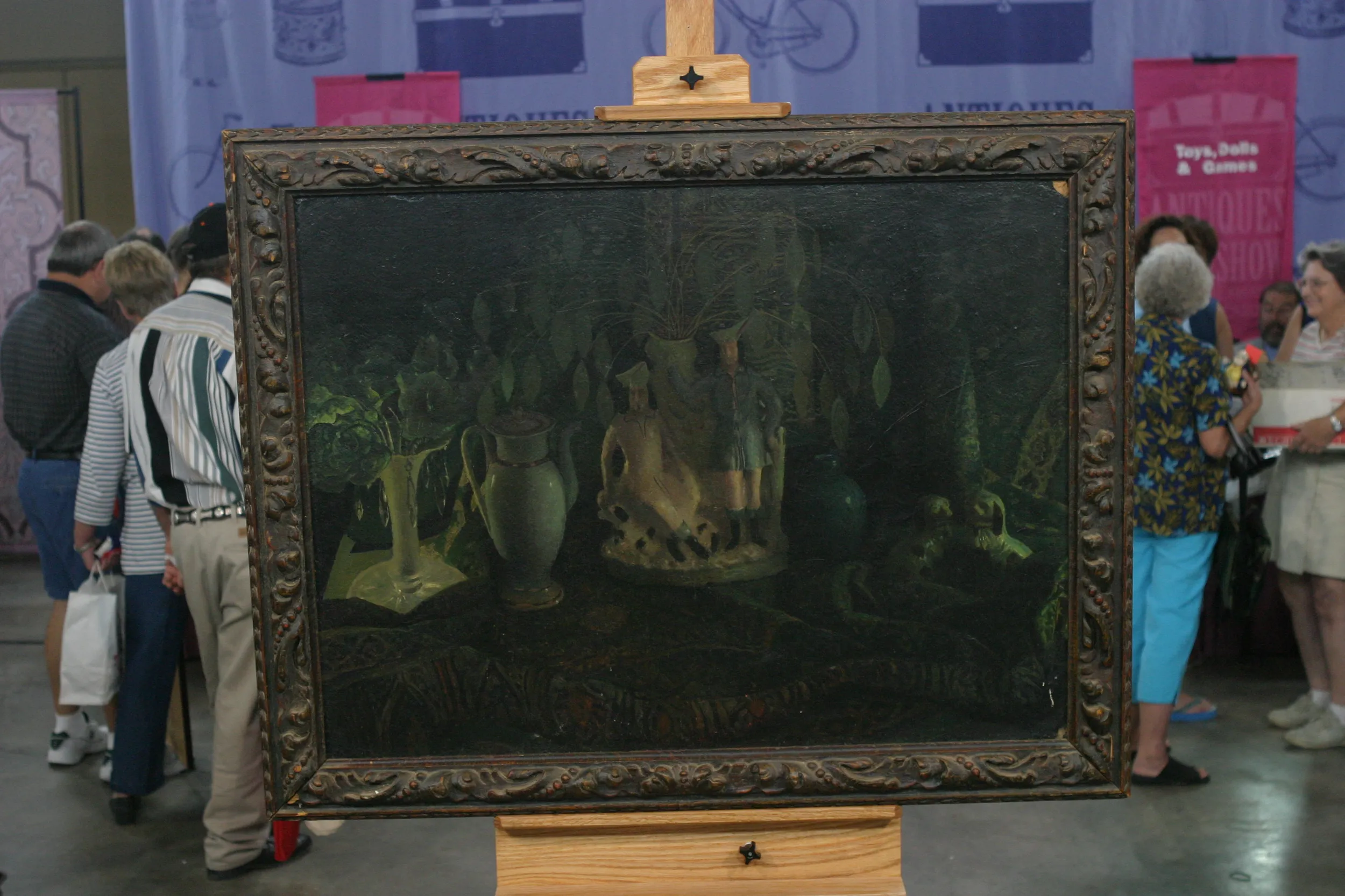
GUEST: My grandfather was an artist, and he had a great eye for art, as did my grandmother. My grandmother went to an estate sale one day and ran across this painting. At the time it was signed G. Day, only G. Day. And she recognized it as being good Texas art, and thought my, my grandfather would also appreciate it. She bought it and took it home and did some research, and realized that it was a Robert Wood. I think that they bought it in either the late '60s or the early '70s. I think that it was originally purchased for less than $1,000. My grandfather wanted to get to meet Robert Wood and then also wanted to hopefully increase the value of this painting, so decided to track him down in California and get this painting signed.
APPRAISER: (chuckles) I, I wouldn't want to disappoint your grandfather, but it actually doesn't really affect the value.
GUEST: The value.
APPRAISER: I mean, it's really neat, but we know who G. Day is, so...
GUEST: Right.
APPRAISER: Where was the fated garage sale?
GUEST: In San Antonio.
APPRAISER: Robert Wood is actually English, but he, he moved to America as a young man-- he was 21-- in 1910, and lived all over America, doing kind of the hobo experience, if you will.
GUEST: Okay.
APPRAISER: Random jobs, trains. Painting all the while. But he settled in San Antonio in 1923. He was there for a number of years, all the way through 1940. He did end up in California. Was it Laguna where they tracked him down?
GUEST: I believe so.
GUEST: And I don't know the date for sure. Early in the '70s is my understanding.
APPRAISER: Well, he died in 1979. This particular painting is oil on canvas, signed lower right, G. Day, and also signed Robert Wood, which I've never seen before. I think there were very few people who tracked him down and had him re-sign them.
GUEST: (laughs)
APPRAISER: He also, during this period, was signing his works "Trebor," T-R-E-B-O-R, which is just Robert backwards. There are lots of stories about why, and I think all of them are apocryphal. I don't think anybody knows, but he only did that between 1924 and 1940. The two other signatures.
GUEST: Okay.
APPRAISER: G. Day and Trebor. And then after that, the remainder of his work is all signed Robert Wood. I notice on the back there's an appraisal. I'm going to call it an appraisal, because it says, "$5,000," and then it says "Robert Wood" underneath it. And I'm wondering, when they took it to him, if maybe at the time, he assigned that value and then signed his name underneath. We see the stamps, that the copyright is reserved by the artist, and that the painting is by Robert Wood, which probably wouldn't be on there from a painting like this, circa 1930. So I would imagine those were added, as well, when he reviewed the painting and modified the signature for your family. Wood is famous for a bunch of different subjects, but in particular the bluebonnets are something of a signature topic for him, and they also are among his most valuable paintings. This would be a strong example of paintings of this period. At auction right now, I think a reasonable estimate would be in the realm of $15,000 to $25,000.
GUEST: Wow. That's incredible.
APPRAISER: There's literally over a million prints of some of his more famous paintings. That's where most people know Robert Wood.