GUEST: This was a family piece and it's been passed down.
APPRAISER: How long have you owned it?
GUEST: 50 years is all I can go back.
APPRAISER: When we appraise something, the first thing we try to do is look at proportion and design and try to regionalize it.
GUEST: Okay.
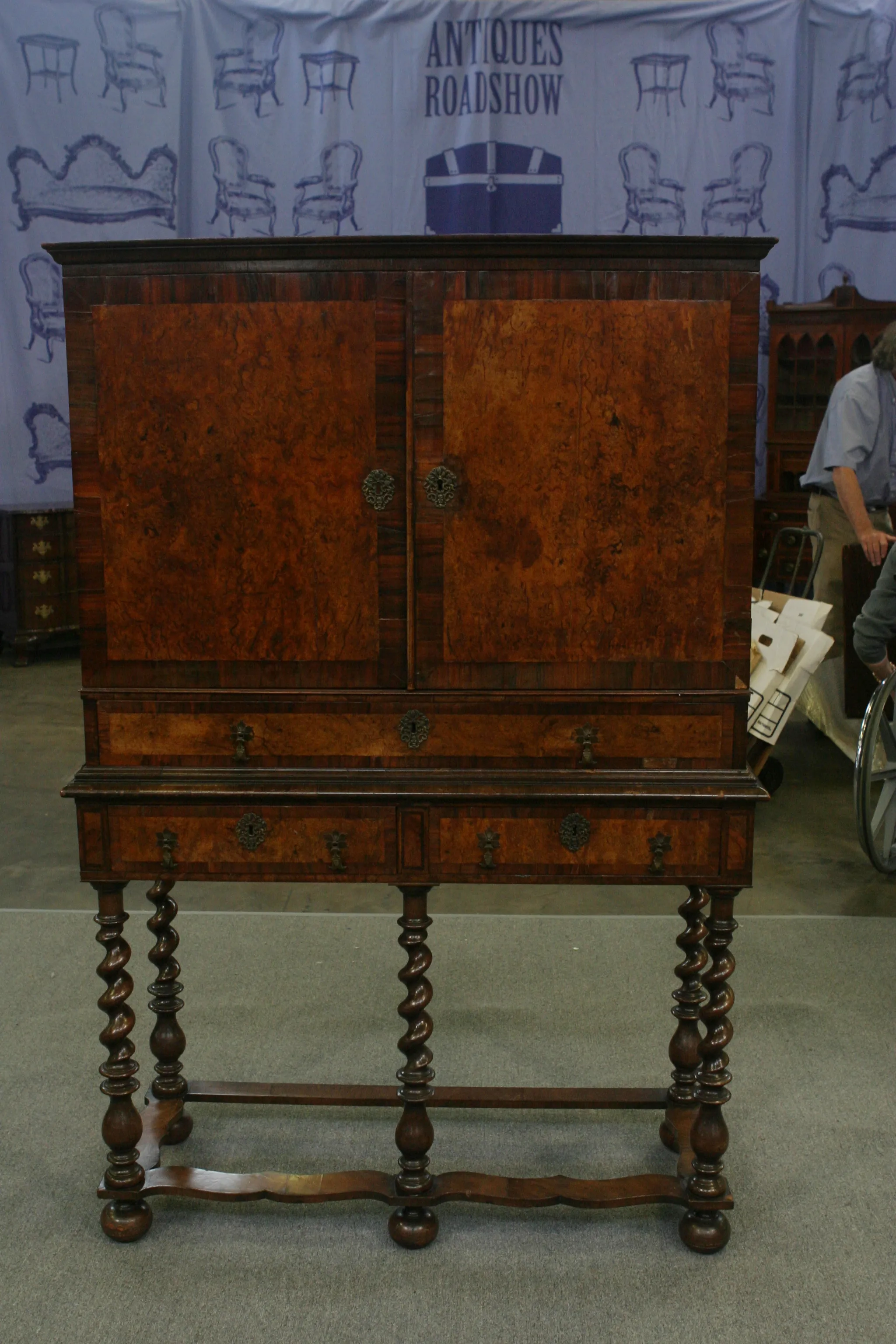
APPRAISER: And everything I'm seeing here, which is the bonnet top, these carved fans on the upper and lower drawers, the veneer on the front of the drawers, which is crotch-figured mahogany, these finials and then the cabriole legs and the base with these little pad feet. All of those are characteristics of Boston, Salem, Massachusetts, around 1760. If you look at this from a design point of view, the bonnet is a little bit lower. It's compressed.
GUEST: Okay.
APPRAISER: When these master craftsmen in Boston made a piece, they made a piece very vertical and it just flew up in the top. Another thing we have here is in terms of the width. The width is not... it's not narrow enough. This piece proportionally is a little bit too wide. It should be more vertical.
GUEST: Okay.
APPRAISER: As we look a little bit closer, in the 18th century, we wouldn't have seen rosettes on the top of the bonnet. The bonnet would finish in a very simple, angular terminus. One of the factors to evaluate a piece of furniture is looking at wear. And I don't see any splits or breaks on the edges of these lips. This fan is carved in a way that's not as well articulated as they would in the 18th century. These are a little bit-- if I may say-- crude.
GUEST: Okay.
APPRAISER: The other problem we have is on the base, we wouldn't have seen carved acanthus leaves during the Queen Anne period. They just left it plain.
GUEST: Okay.
APPRAISER: Now if we open up the drawers, we're going to look at the construction. And someone, I think, has stained these drawers in order to...
GUEST: ...make it look old.
APPRAISER: Make it look old. Exactly. So this piece was probably made to deceive. Probably made in the 1920s.
GUEST: Okay.
APPRAISER: If you look at the nails here, that's a round head nail, and you should see a rose head nail. So these are some of the details that are important to help authenticate American furniture.
GUEST: Okay.
APPRAISER: So being a 1920s highboy, it's probably in the area of $1,500 to $2,500.
GUEST: Okay.
APPRAISER: And that's an auction price. Now, had this been original, one sold privately once in the range of $600,000 with all the extras.