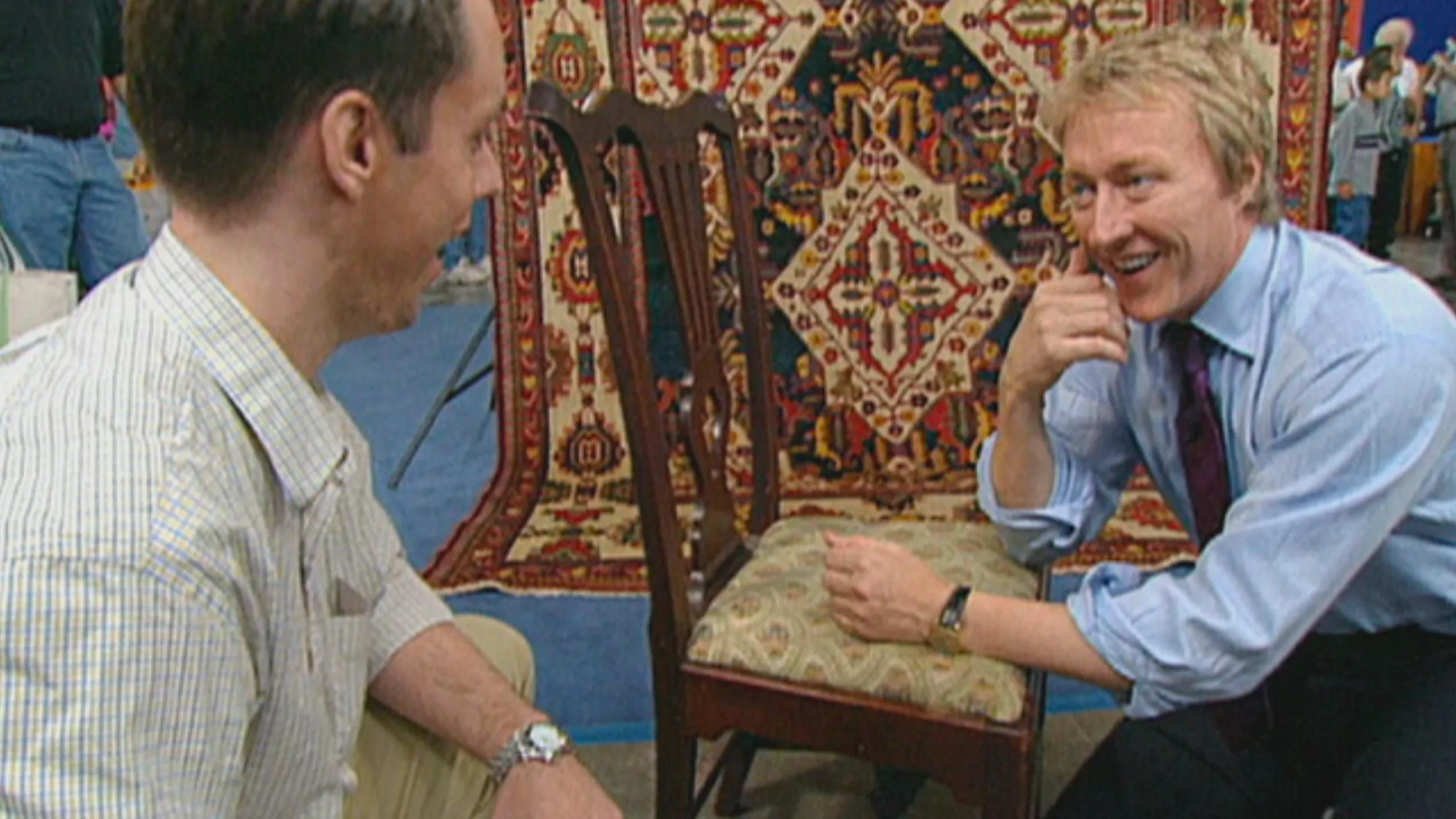
Queen Anne Maple Side Chair, ca. 1750
GUEST: This chair, as far as I know, originally belonged to Jonathan Edwards back in the 1700s, and it was, uh, passed down through his family, and then on to my family through my great-great-grandfather. And so I'm not directly related to Jonathan Edwards.
APPRAISER: Right.
GUEST: It was a stepmother...
APPRAISER: A stepmother.
GUEST: That gave the chair to my great-great-grandfather.
APPRAISER: You now own it, you inherited it, right?
GUEST: Yeah, it sits in my bedroom.
APPRAISER: It sits in your bedroom. Do you sit in it once in a while?
GUEST: (chuckling) Ah, no.
APPRAISER: Okay, Jonathan Edwards is one of the great mid-18th-century American philosophers and theologians.
GUEST: Right.
APPRAISER: He was absolutely one of the most incredible orators. He gave a lecture called "Sinners in the Hands of an Angry God" in 1741. He was very
famous during his own time, very well-known.
GUEST: Right, right.
APPRAISER: So the fact that he owned this chair, I think is really, is really great.
GUEST: Yeah.
APPRAISER: This was made in Boston.
GUEST: Oh, wow.
APPRAISER: About 1740 to probably 1755.
GUEST: Okay.
APPRAISER: So the way we know it's, it's old is to flip it upside down and look at these tool marks. Do you see, even though some varnish is coming
over...
GUEST: Mm-hmm.
APPRAISER: ...over the edge, these nice, uneven tool marks?
GUEST: Yeah. And this chair was made by one of probably 25 to 30 chair makers working in Boston, somewhere in between 1730 and 1750.
APPRAISER: We have a Queen Anne back here with this yoked crest rail...
GUEST: Right.
APPRAISER: ...which is attached to these stiles on each side. This vase-shaped, elongated splat, which is classic Boston.
GUEST: Mm-hmm.
APPRAISER: Now, this type of chair made in Boston during this time-- mid-18th century-- had two types of seats you could have. You could have a
rectilinear seat-- one that's rectangle.
GUEST: Okay.
APPRAISER: Or the compass seat. This is a compass seat. You see how it's curved, it kind of rounds?
GUEST: Mm-hmm.
APPRAISER: And that was the more expensive model. If you come down to the legs, it has these nice, shaped brackets, these cabriole legs, and these beautiful pad feet. All joined by stretchers with arrow-turned ends, here at terminals. This is a replaced seat cover, right?
GUEST: Yes.
APPRAISER: What's the story?
GUEST: Uh, my grandfather wove this to cover the, um, seat cover that was already on there.
APPRAISER: Okay, I asked you before if I could possibly make a little cut somewhere, right? And you said it was okay? I did make a cut-- now, you haven't seen this yet, I know, right?
GUEST: (laughing) My mother is going to kill me.
APPRAISER: Close your eyes, you're gonna be okay. Okay, okay, so, no, it's okay. But you know why? Because you're not going to be able to see it. But I did make-- see, a little cut. You can see here that underneath, it does not have, unfortunately, the original, the original covering.
GUEST: Oh, okay.
APPRAISER: This is chair number four. You see this? See this four right there?
GUEST: Yeah.
APPRAISER: And this maple frame that's under here-- if it's maple, if it's original-- would also have a four there that would match. Now, do you mind if I make a little tiny cut right there and look at the frame?
GUEST: Well, I can replace this part, right?
APPRAISER: No, no, all I'm do-- I make a little incision right here and peek.
GUEST: Right.
APPRAISER: Do you want me to do it? Is it okay?
GUEST: I do want to know.
APPRAISER: You want to know.
GUEST: Sorry, sorry, Grammy.
APPRAISER: Do you want to know? Okay, we're going to do it, I'm going to cut really, really carefully, we're going to take a peek and see if that's the
original maple frame. It is. You see that beautiful color?
GUEST: Right.
APPRAISER: That's period 1740, and that helps the value. And probably somewhere on there-- there it is, look at that, look, Megan. One, two, three, four.
GUEST: Mm-hmm.
APPRAISER: Matching that one, two, three, four on the chair.
GUEST: Okay.
APPRAISER: Original seat frame.
GUEST: Great.
APPRAISER: If it didn't have the provenance, it would just be a nice, basic chair, probably, I'd say, in a shop, $3,000.
GUEST: Okay.
APPRAISER: With the provenance of Jonathan Edwards, it probably is upwards of $5,500, and maybe even a little more.
GUEST: Okay.
APPRAISER: Because it's this great history, okay?
GUEST: Yeah.
APPRAISER: Would you like to know what it'd be worth if you had, if you could find the original cover?
GUEST: Absolutely.
APPRAISER: You could probably add another $20,000.
GUEST: Wow.
APPRAISER: So maybe that's somewhere in your family.
GUEST: (laughing) Yeah.
APPRAISER: Look in the attic, okay?
GUEST: I'll ask again.
APPRAISER: Oh, yeah, ask again, okay?
GUEST: Yeah.
APPRAISER: Okay.

$2,500 - $3,500 Retail
$3,000 - $5,500 Retail
Featured In
episode
Baltimore, Hour 1
Roadshow host Mark L. Walberg wanders the whimsical and elegant Ladew Topiary Gardens.
episode
Vintage Baltimore 2021, Hour 2
What are treasures from the 2007 Baltimore ROADSHOW worth now?
Wood
appraisal
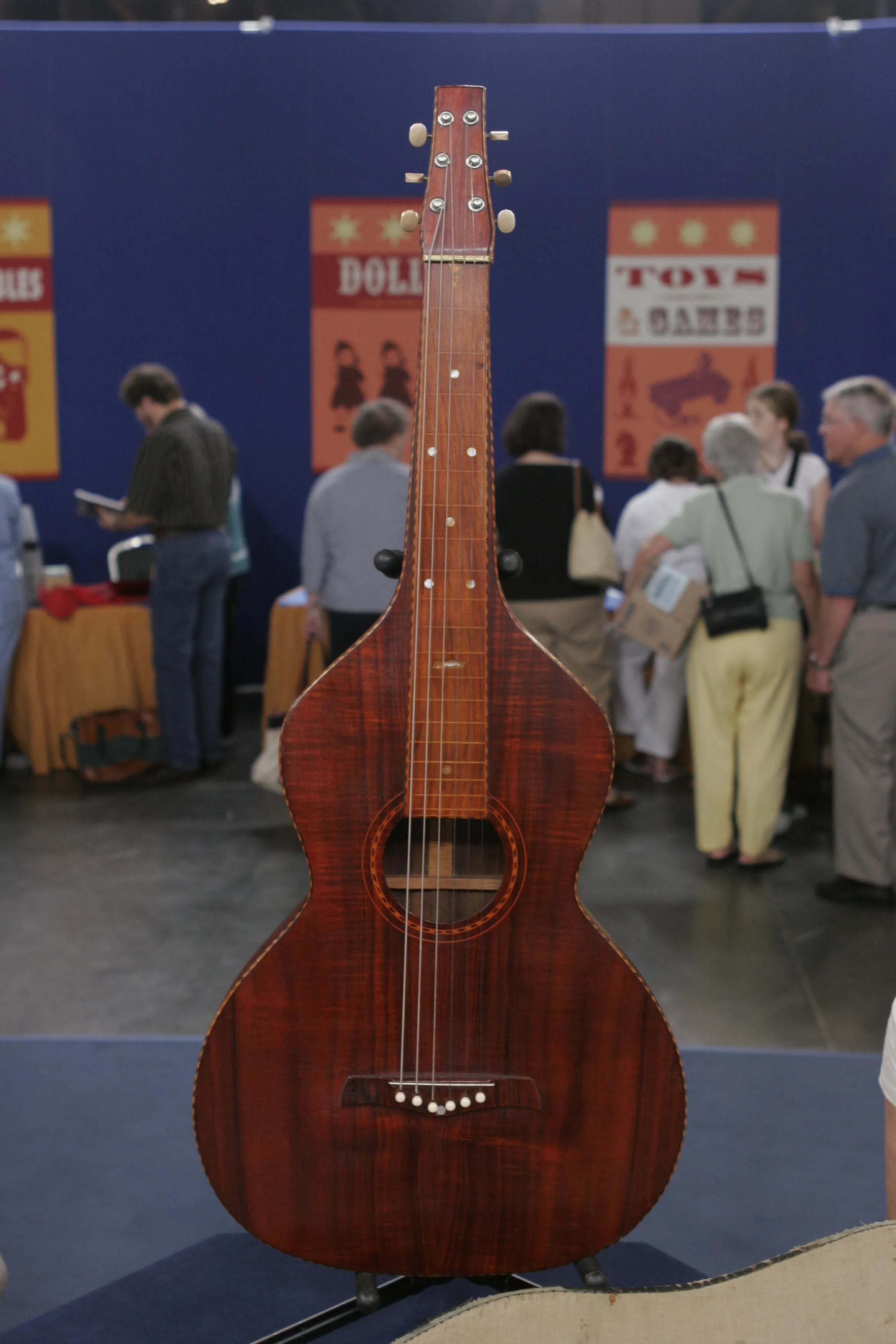
Weissenborn Style 4 Guitar, ca. 1925
appraisal
Eskimo Hunting Helmet, ca. 1820
appraisal
appraisal
Duncan Phyfe Sewing Table, ca. 1805
Understanding Our Appraisals
Executive producer Marsha Bemko shares her tips for getting the most out of ANTIQUES ROADSHOW.
Value can change: The value of an item is dependent upon many things, including the condition of the object itself, trends in the market for that kind of object, and the location where the item will be sold. These are just some of the reasons why the answer to the question "What's it worth?" is so often "It depends."
Note the date: Take note of the date the appraisal was recorded. This information appears in the upper left corner of the page, with the label "Appraised On." Values change over time according to market forces, so the current value of the item could be higher, lower, or the same as when our expert first appraised it.
Context is key: Listen carefully. Most of our experts will give appraisal values in context. For example, you'll often hear them say what an item is worth "at auction," or "retail," or "for insurance purposes" (replacement value). Retail prices are different from wholesale prices. Often an auctioneer will talk about what she knows best: the auction market. A shop owner will usually talk about what he knows best: the retail price he'd place on the object in his shop. And though there are no hard and fast rules, an object's auction price can often be half its retail value; yet for other objects, an auction price could be higher than retail. As a rule, however, retail and insurance/replacement values are about the same.
Verbal approximations: The values given by the experts on ANTIQUES ROADSHOW are considered "verbal approximations of value." Technically, an "appraisal" is a legal document, generally for insurance purposes, written by a qualified expert and paid for by the owner of the item. An appraisal usually involves an extensive amount of research to establish authenticity, provenance, composition, method of construction, and other important attributes of a particular object.
Opinion of value: As with all appraisals, the verbal approximations of value given at ROADSHOW events are our experts' opinions formed from their knowledge of antiques and collectibles, market trends, and other factors. Although our valuations are based on research and experience, opinions can, and sometimes do, vary among experts.
Appraiser affiliations: Finally, the affiliation of the appraiser may have changed since the appraisal was recorded. To see current contact information for an appraiser in the ROADSHOW Archive, click on the link below the appraiser's picture. Our Appraiser Index also contains a complete list of active ROADSHOW appraisers and their contact details and biographies.


