GUEST: My uncle left this to my sister and me. It was given to him by an American author named Marie Killilea, who he was very good friends with.
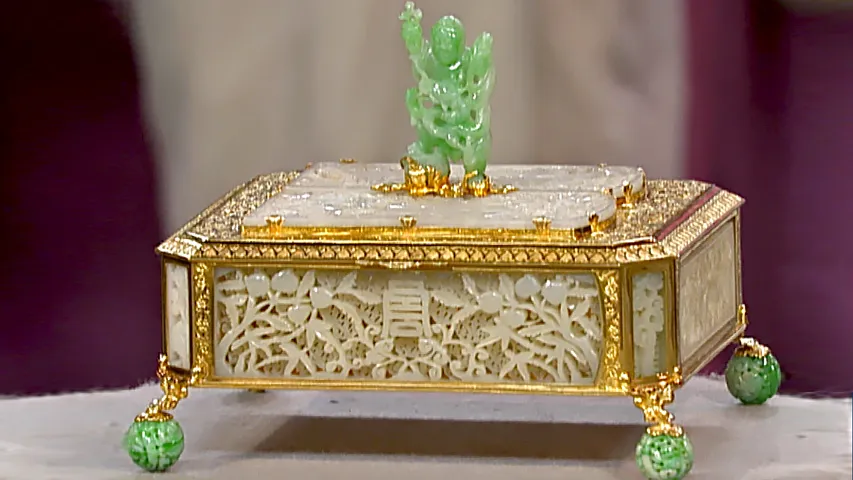
APPRAISER: This is a Chinese jade carving. It's likely that this would have been given originally, so in China, as a wedding gift. Firstly, it's a seated boy. In the Chinese culture it was hoped that the bloodline would continue through marriage and that the married couple would have many boys. These are actually representative of linked coins.
GUEST: Oh!
APPRAISER: This is a celestial ribbon linking coins.
GUEST: (gasps)
APPRAISER: So with marriage, one hopes for children, and we also hope for wealth. So it's a wonderful wedding gift, if one was to receive this during dynastic China. Now, dating the object, this is a celadon jade. There's a little bit of skin to the top, which is that brown hue. The collectors of Chinese jades like skin. It is an imperfection. It is an anomaly to the celadon ground.
GUEST: Okay.
APPRAISER: But it doesn't detract from the value. At times, it actually adds to the value.
GUEST: Okay.
APPRAISER: The carving, one could date to the 17th or the 19th century. The reason I'm omitting 18th is, there was a desire for more pure white jades, and the carving were often ultra-hyper-realistic, so very crisp. This is a little bit more into that 17th or the 19th century. So let's say it could date 200 or 300 years.
GUEST: Okay.
APPRAISER: But dynastic, Qing dynasty China. The stand is likely something done in the '20s to help a dealer or collector elevate the jade, present the jade for sale. It was just common that most of the stands were unrelated to the figure. Do you have any idea of value?
GUEST: I have no idea. (chuckling) I have no idea.
APPRAISER: In a retail setting, it would probably carry a price tag of $7,000.
GUEST: (chuckling): Oh, very nice. Thank you.