GUEST: It came from my great-grandfather on my father's side. Came down through the family to my mother, who stuck it in the closet. She gave it to me in 1970, and it's been in my sideboard since.
APPRAISER: What do you know about it?
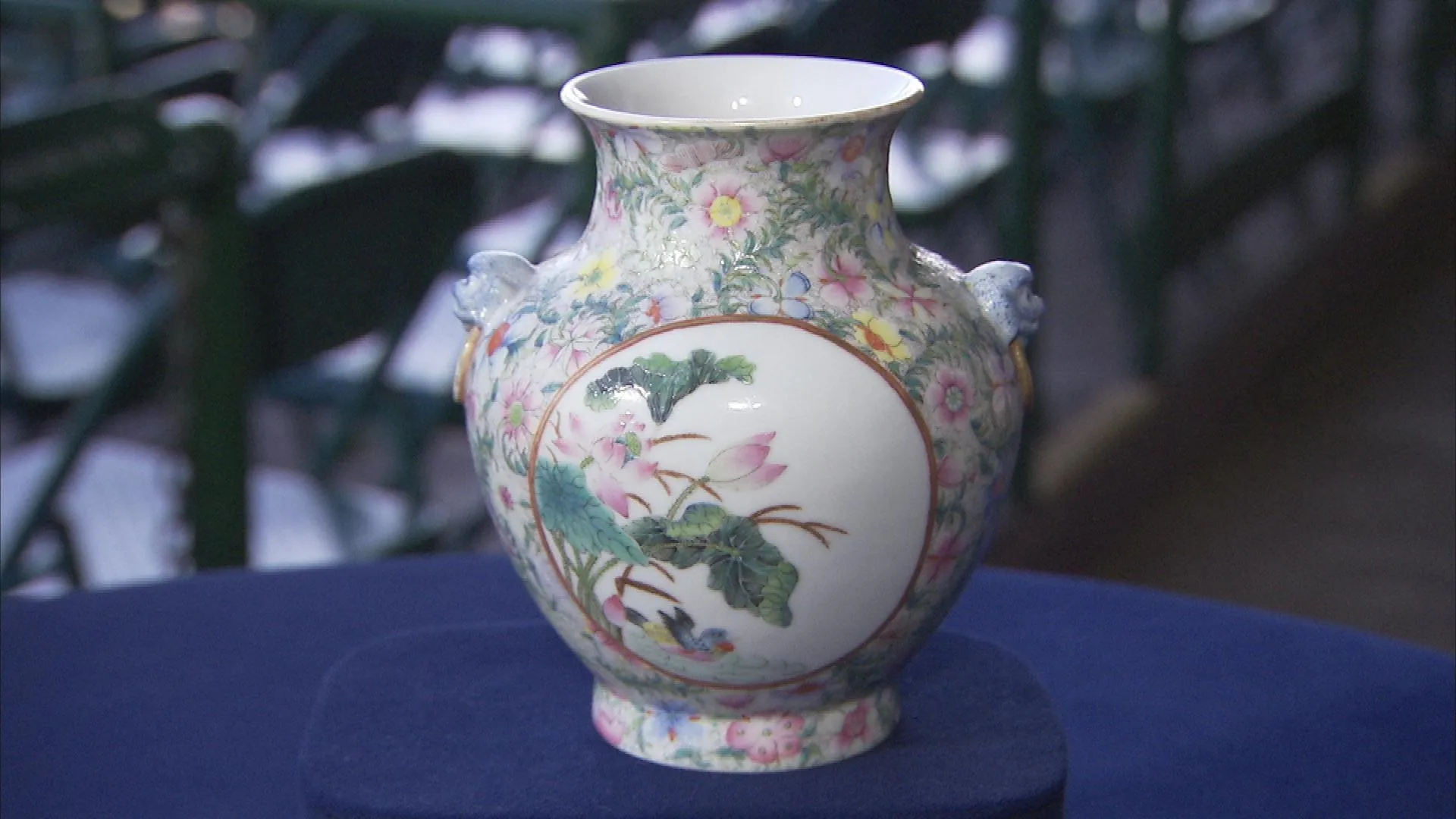
GUEST: It's Chinese, and it's got some figures on the bottom that I don't understand.
APPRAISER: Well, it is Chinese. It's a very classic shape, this pear-shaped vase. It's Qing Dynasty.
GUEST: Qing? Okay.
APPRAISER: And it's actually imperial. Done at the imperial kilns in Jingdezhen, right outside of modern-day Shanghai.
GUEST: Okay.
APPRAISER: And how we know it's imperial is, first of all, by the form, by the glaze quality, and also by the reign mark on the base. The reign mark says, "Made in the Qing Dynasty, during the reign of the Emperor Yongzheng." Yongzheng was an emperor that had a very short reign, from 1723 to 1735. So, porcelain done during his time period, that survived, is exceedingly rare.
GUEST: Wow.
APPRAISER: The glaze quality is really quite good. It's a little bit misfired. It's supposed to be a little bit more rosy, a little bit more raspberry, and so there are some dark patches on the glaze. But it has quality, condition, rarity and provenance. What do you think it's worth?
GUEST: Foggiest idea. A hundred, two hundred?
APPRAISER: At auction, it would bring, conservatively, because of the slightly misfired glaze, about $30,000 to $50,000.
GUEST: You're kidding me!
APPRAISER: No.
GUEST: Wow.
APPRAISER: The Chinese art market is really quite hot now for things made by the imperial kilns.