Pierre Sterlé Bird Pin, ca. 1960
GUEST: We had friends, a wonderful older couple who collected art and wine and beautiful things. And on Christmases and birthdays, around their beautiful dining room table, they would come out and they'd bring a painting, or a piece of silver, or a piece of jewelry like this and gift it to us.
APPRAISER: What year do you figure you got this from?
GUEST: I would think about 1995.
APPRAISER: It's a clip brooch. It's made by a gentleman called Pierre Sterlé. He's born in a... ...somewhat wealthy family in Paris. And World War I, around that time period, his father dies, and he goes to work and live with his uncle, who owns a jewelry store called Maynier-Pincon. Soon after, he's working there and designing, his uncle realizes he's quite talented, and he works there and hones his chops, as they say. But eventually, he moves on. He works for Ostertag, Boucheron and Chaumet. I mean, that-that's a, you know, that's the hit list. I mean, three fabulous French jewelers. But in 1934, he goes out on his own and he opens his first shop. He's known for working with experimental gemstones. Do you have any idea what the head of the bird is made out of?
GUEST: I do not.
APPRAISER: This is a type of rock gemstone that comes from the foothills of Kilimanjaro.
GUEST: Really?
APPRAISER: It's ruby zoisite. It has another name called anyolite. It's ruby crystals embedded in the zoisite matrix, which is the green portion. It's not two stones that were put together.
GUEST: Oh.
APPRAISER: This occurs naturally when these stones were being formed under intense heat and pressure. I called my dad, who's one of the original jewelry guys at the table. He's 95, and without a hesitation, "It's a hummingbird." So we kind of check it out. We're going with hummingbird. For anybody out there thinks it's not a hummingbird, let us know. The next element, the bamboo. Wonderfully, just curved and executed. Then you have the feathers. You notice how they have all this texture?
GUEST: Yes, they do.
APPRAISER: Then you have the accents of the diamond. So it's done in 18 karat gold. There's 66 tiny little stones. They're probably two carats in total. The white sections on top of the 18 karat yellow gold are platinum. On the back, there's some French assay marks. One of the marks is an eagle. It tells us that it's 18 karat yellow gold. It's also signed "Sterlé Paris." And then it has some stock numbers there. Birds were one of his specialties. This is from around 1960. These are highly desirable. At an auction today, I would put this in for $30,000.
GUEST: Really? Really? I can't believe it.
APPRAISER: I'm not done. That's the low. $30,000... ...to $50,000.
GUEST: I can't believe it. It's just beautiful, isn't it?
$30,000 - $50,000 Auction
Featured In

episode
Castle Farms, Hour 3
ROADSHOW returns to storm Castle Farms (nicely) in scenic Charlevoix one final time! — Mon, April 13, 2026
Gold
appraisal
Elgin Student Watch & Papers, ca. 1924
appraisal
Sri Lankan Kastane (Sword), ca. 1800
appraisal
Carved Emerald & Ruby Ring, ca. 1925
appraisal
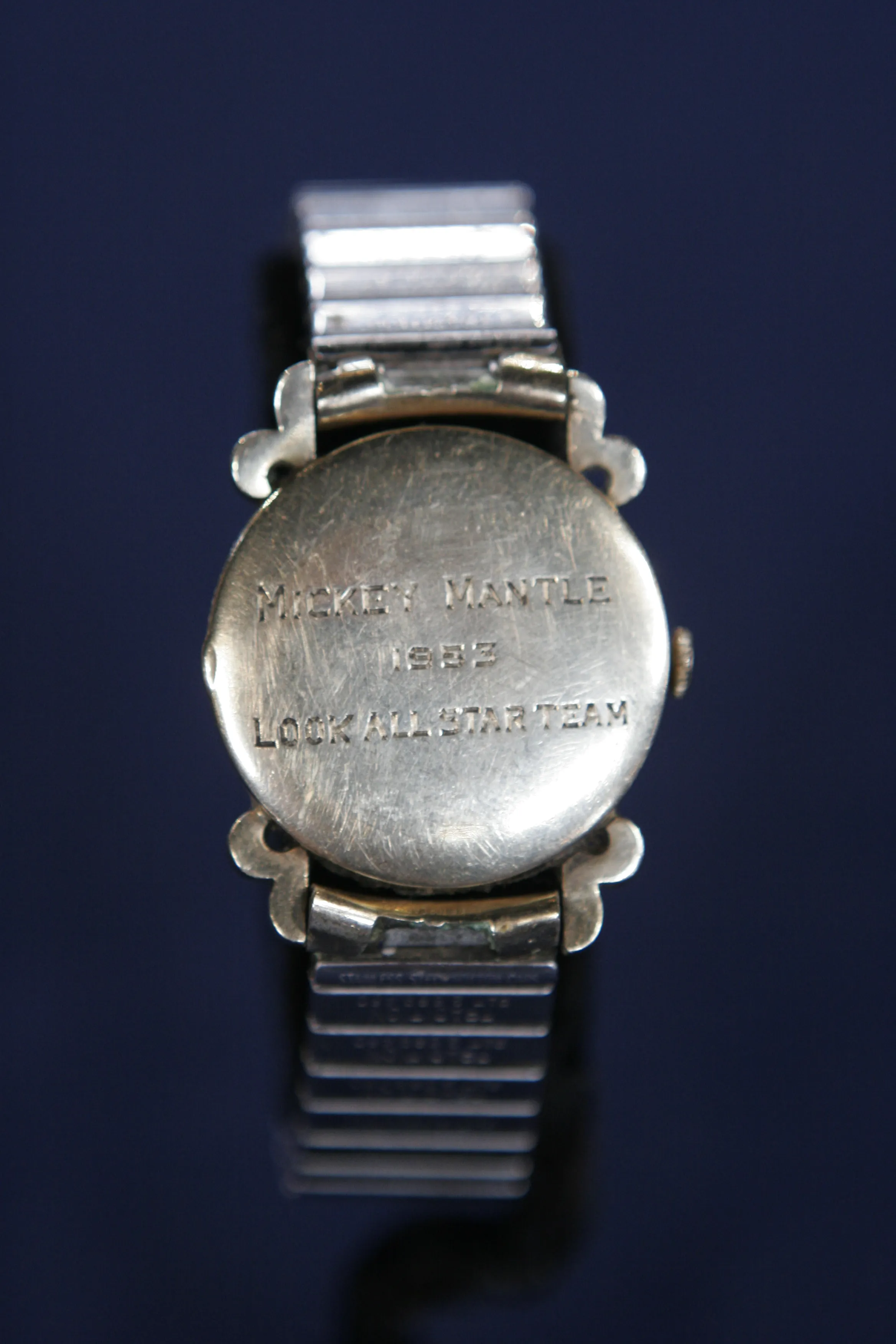
1953 Mickey Mantle All Star Watch
Understanding Our Appraisals
Executive producer Marsha Bemko shares her tips for getting the most out of ANTIQUES ROADSHOW.
Value can change: The value of an item is dependent upon many things, including the condition of the object itself, trends in the market for that kind of object, and the location where the item will be sold. These are just some of the reasons why the answer to the question "What's it worth?" is so often "It depends."
Note the date: Take note of the date the appraisal was recorded. This information appears in the upper left corner of the page, with the label "Appraised On." Values change over time according to market forces, so the current value of the item could be higher, lower, or the same as when our expert first appraised it.
Context is key: Listen carefully. Most of our experts will give appraisal values in context. For example, you'll often hear them say what an item is worth "at auction," or "retail," or "for insurance purposes" (replacement value). Retail prices are different from wholesale prices. Often an auctioneer will talk about what she knows best: the auction market. A shop owner will usually talk about what he knows best: the retail price he'd place on the object in his shop. And though there are no hard and fast rules, an object's auction price can often be half its retail value; yet for other objects, an auction price could be higher than retail. As a rule, however, retail and insurance/replacement values are about the same.
Verbal approximations: The values given by the experts on ANTIQUES ROADSHOW are considered "verbal approximations of value." Technically, an "appraisal" is a legal document, generally for insurance purposes, written by a qualified expert and paid for by the owner of the item. An appraisal usually involves an extensive amount of research to establish authenticity, provenance, composition, method of construction, and other important attributes of a particular object.
Opinion of value: As with all appraisals, the verbal approximations of value given at ROADSHOW events are our experts' opinions formed from their knowledge of antiques and collectibles, market trends, and other factors. Although our valuations are based on research and experience, opinions can, and sometimes do, vary among experts.
Appraiser affiliations: Finally, the affiliation of the appraiser may have changed since the appraisal was recorded. To see current contact information for an appraiser in the ROADSHOW Archive, click on the link below the appraiser's picture. Our Appraiser Index also contains a complete list of active ROADSHOW appraisers and their contact details and biographies.


