Persian Qashqai Gabbeh Rug, ca. 1935
GUEST: In 2019, I was in San Antonio, and there was an auction house I used to go to. I, I love rugs, I have several rugs at home. This one came up for sale, and I really enjoyed the motion in it. It was wool and, I believe, goat hair.
APPRAISER: Mm-hmm.
GUEST: So I just really liked the colors. I think I paid about $100.
APPRAISER: Wonderful-- do you have any idea what type of rug it was or where it came from?
GUEST: No, and I do have, uh, a gentleman here in St. Louis that I do take rugs to, and he had no idea...
APPRAISER: Okay.
GUEST: ...of its history or background.
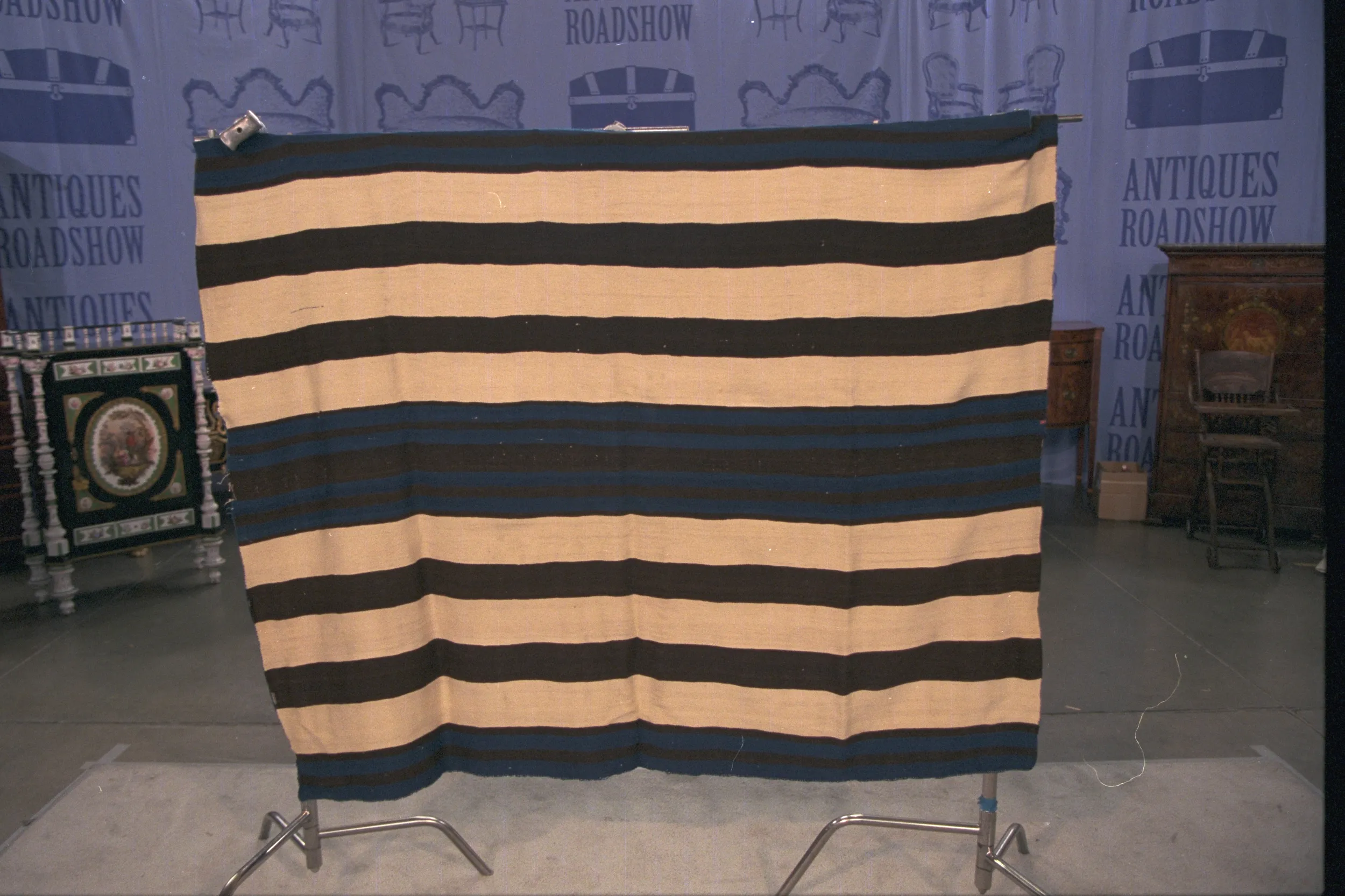
APPRAISER: All right. This rug was woven by the Qashqai tribe in the Zagros Mountains in Southern Persia. So technically, it's a tribal rug. It's referred to as a gabbeh, and "gabbeh" in Persian translates to raw, uncut, and natural. It's raw because they're using natural wool for the majority of the wool. It's not heavily dyed. Uncut would refer to the pile. It kind of has a shaggy, long pile to it. And that's also related to the weave quality, it's rather coarse. This rug is maybe about 50 knots per square inch, or less. So it would make it one of the coarser Persian rugs that are woven. As this rug is a tribal rug, they didn't have a large supply of wool when they were weaving it, so they used different dye lots of wool. And as you can see, there's a line over here of demarcation where the brown color is slightly lighter and slightly darker. This is a term that's referred to as abrash-- it's natural. Especially in nomadic pieces, you tend to see that occurring. The value of these rugs really is in their pattern. These abstract geometric designs are very bold and graphic, and they're very popular-- they always have been. This one was woven around 1940, and with the resurgence of contemporary design, they became very popular in the late '90s up until the current day. Most of these were small in size. Naturally, there's a demand to get this aesthetic in room-sized pieces. So, they started making modern reproductions of them in Iran, India, and Pakistan. So this really is what set the whole wheel rolling in the first place. Do you have any idea what this rug is worth?
GUEST: $100?
(both laugh)
GUEST: I, uh... No, I have-- I have no, no idea.
APPRAISER: Okay. It's really in fine condition, and, uh, this rug would retail for between $3,500 and $4,500.
GUEST: Oh, I did good.
APPRAISER: So, it's really wonderful.
GUEST: Thank you so much.

$3,500 - $4,500 Retail
Featured In

episode
Grant's Farm, Hour 2
ANTIQUES ROADSHOW harvests hidden treasures at historic Grant’s Farm in St. Louis, MO. — Mon, May 4, 2026
Textiles & Needlecraft
appraisal
Navajo Ute First Phase Blanket, ca. 1850

appraisal

appraisal

appraisal
Mary Balch School Mourning Picture, ca. 1805
Understanding Our Appraisals
Executive producer Marsha Bemko shares her tips for getting the most out of ANTIQUES ROADSHOW.
Value can change: The value of an item is dependent upon many things, including the condition of the object itself, trends in the market for that kind of object, and the location where the item will be sold. These are just some of the reasons why the answer to the question "What's it worth?" is so often "It depends."
Note the date: Take note of the date the appraisal was recorded. This information appears in the upper left corner of the page, with the label "Appraised On." Values change over time according to market forces, so the current value of the item could be higher, lower, or the same as when our expert first appraised it.
Context is key: Listen carefully. Most of our experts will give appraisal values in context. For example, you'll often hear them say what an item is worth "at auction," or "retail," or "for insurance purposes" (replacement value). Retail prices are different from wholesale prices. Often an auctioneer will talk about what she knows best: the auction market. A shop owner will usually talk about what he knows best: the retail price he'd place on the object in his shop. And though there are no hard and fast rules, an object's auction price can often be half its retail value; yet for other objects, an auction price could be higher than retail. As a rule, however, retail and insurance/replacement values are about the same.
Verbal approximations: The values given by the experts on ANTIQUES ROADSHOW are considered "verbal approximations of value." Technically, an "appraisal" is a legal document, generally for insurance purposes, written by a qualified expert and paid for by the owner of the item. An appraisal usually involves an extensive amount of research to establish authenticity, provenance, composition, method of construction, and other important attributes of a particular object.
Opinion of value: As with all appraisals, the verbal approximations of value given at ROADSHOW events are our experts' opinions formed from their knowledge of antiques and collectibles, market trends, and other factors. Although our valuations are based on research and experience, opinions can, and sometimes do, vary among experts.
Appraiser affiliations: Finally, the affiliation of the appraiser may have changed since the appraisal was recorded. To see current contact information for an appraiser in the ROADSHOW Archive, click on the link below the appraiser's picture. Our Appraiser Index also contains a complete list of active ROADSHOW appraisers and their contact details and biographies.


