GUEST: We got this out of a family that lived in Albion, Indiana, in their home. And the story with this, supposedly their family brought it on a wagon train from Pennsylvania to Indiana. And that's really all I know about it.
APPRAISER: That's actually pretty interesting.
GUEST: Yes.
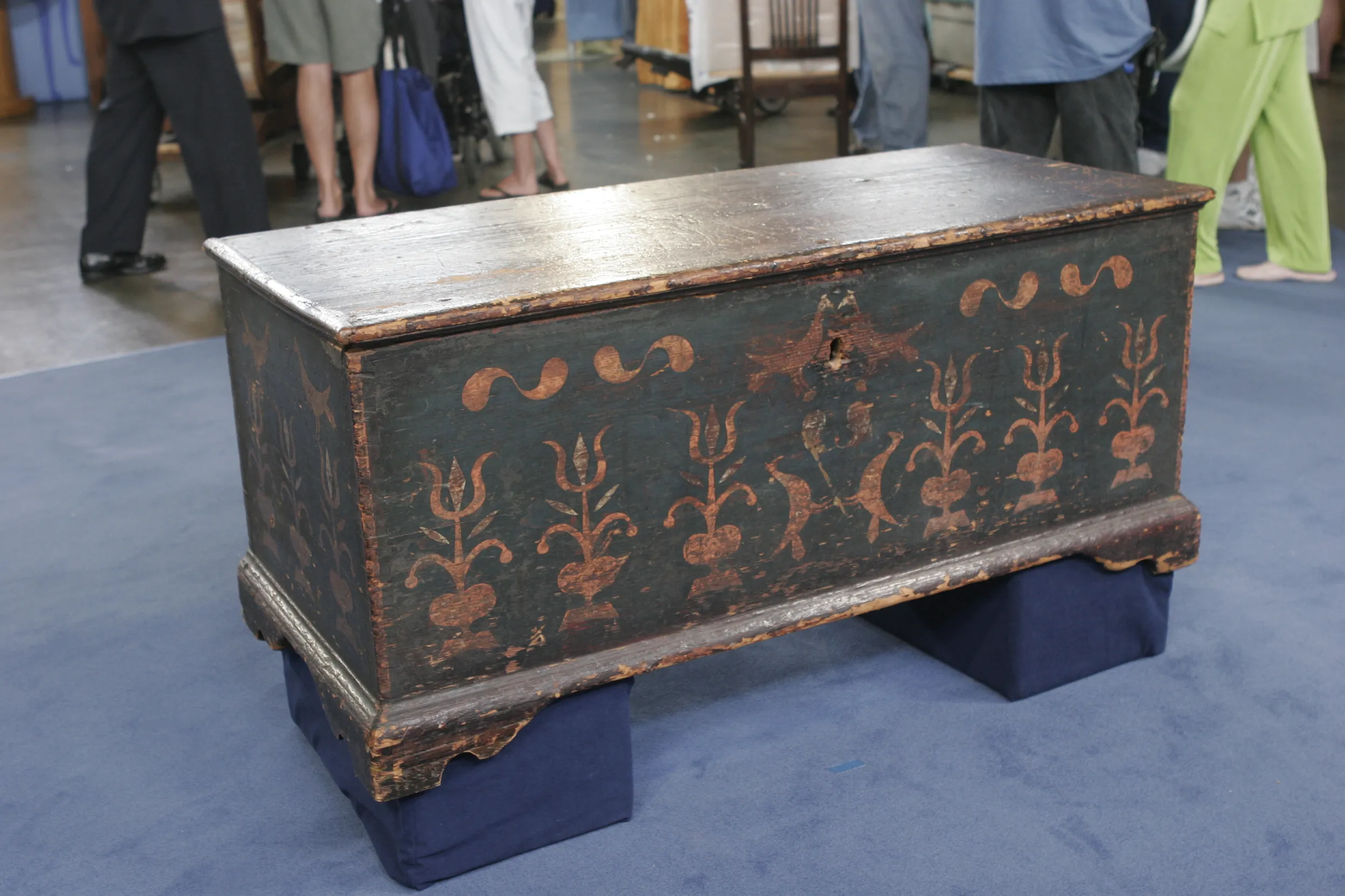
APPRAISER: So this piece is very much decorated in the Pennsylvania German Dutch tradition.
GUEST: Yes.
APPRAISER: So you see these, these motifs repeated over and over. So that's one easy way we could recognize it. It's typical of dower chests or blanket chests that were made in Pennsylvania. They come in a variety of colors, painted decoration. This particular one is relatively simple. So the person who painted this didn't go overboard, but the thing that I found very appealing about it is, I like the palette. These can vary tremendously in value, according to how complex the design and how many colors were used and that sort of thing. But this sort of mustard yellow background and this ocher design, these geometric devices, it's survived in pretty good condition. You might look at the top on this one and say, "Well, it's kind of worn," but oftentimes, when the wear starts, they just strip the paint off the top 'cause it doesn't look good anymore. Thank goodness they didn't do that. These chests are typically made of poplar. Poplar is a wood that has a nice smooth grain and it accepts paint very readily. I'm going to open the lid here. They didn't pick poplar because it's a pretty wood, because it isn't-- it's pretty dull stuff. At some point, these hinges were changed. That's not a big hurt.
GUEST: It isn't?
APPRAISER: It really isn't at all.
GUEST: Okay.
APPRAISER: And there's, there's been some evidence of either a dog trying to get in. Or, who knows, it may be a squirrel or a rat trying to get into what's inside.
GUEST: Yeah.
APPRAISER: I don't know the story behind that. This particular piece can be dated, I would say, about 1830 or so.
GUEST: 1830, wow.
APPRAISER: And if we're... A little bit earlier, we might see what they call a bracket base, rather than having these turned feet. But this is very successful-- it's relatively small, it's well-proportioned, it's in good shape, it's a simple but elegant design. Do you remember what you paid for it?
GUEST: I don't think it was any more than a couple of hundred dollars.
APPRAISER: Do you have any idea as to what it is worth?
GUEST: I did have an antique person offer me $2,000 for it. That was in the '90s, and the painted stuff was sort of a little hot at that time, so I have no clue today, and it would be interesting to find out.
APPRAISER: In this market, which is in many areas somewhat depressed, because younger folks don't take a lot of interest in this material.
GUEST: No.
APPRAISER: But at any rate, I think in an auction situation, I would estimate it probably $1,200 to $1,500, which isn't markedly different from what you were told years ago.
GUEST: Right.
APPRAISER: Do you use it?
GUEST: Actually, my television sits on it.
APPRAISER: If this were refinished, for example, it'd be worth $200 or $300.
GUEST: Yes.
APPRAISER: The value is in the paint.