Paulette Goddard-worn Joseff of Hollywood Brooch
GUEST: I was shopping in Palm Springs, California, about 1996. I saw it, and I noticed that it looked like a prop. It's not fine jewelry, but it looks like a hand-painted watercolor in there. The tag said that it was a piece of costume jewelry worn by Paulette Goddard in the movie Kitty, 1945. So that's what kind of drew me to it.
APPRAISER: How much did you have to pay for it?
GUEST: Uh, $75, I think it was.
APPRAISER: So how long after did you find this photograph?
GUEST: Well, as we had more access to the internet, I found there's quite a few of these publicity photos that you can see the brooch.
APPRAISER: We can very clearly see here in the corner she's wearing it, and it's very easy to identify. And of course, this is Paulette Goddard with Ray Milland from Kitty, 1945, in the role of the kind of street urchin that they were trying to turn into a society lady.
GUEST: Hm.
APPRAISER: So they could marry her off to someone rich and help save their family's fortunes. We do know who made this. There's a man named Eugene Joseff. And one of the signature hallmarks of Joseff of Hollywood is that he came up with something he called the Russian gold-plating technique, which is not Russian, and it's not gold.
GUEST: Right.
APPRAISER: But it sounds fancy. You'll notice on the back, it's kind of a dull gold tone.
GUEST: Right, it almost looked like spray paint.
APPRAISER: He knew that with the studio lights, if you have highly reflective metals, they sometimes catch the light.
GUEST: Ah.
APPRAISER: So he used this dull plating process to avoid things flaring on the cameras. The other thing that jumped out at me is, I noticed the scrawled numbers and letters on the back. There are three digits and a, and a letter. And I recognize that as how they kept their inventory for their stock at Joseff.
GUEST: Ah-hah.
APPRAISER: Because the brilliant thing about Eugene Joseff is that he didn't just make these things and sell them to the films, he rented them. We have faux pearls surrounding this kind of base metal, and we have probably Austrian crystal with glass, and, of course, this watercolor piece underneath.
GUEST: Mm-hmm.
APPRAISER: We're not familiar with any other pieces in their archive that have a watercolor.
GUEST: Right.
APPRAISER: It's trying to look like painted porcelain, basically.
GUEST: Yeah.
APPRAISER: And it's a good fake, because, on camera, you'd never notice that this was a watercolor.
GUEST: Right.
APPRAISER: This piece was probably made sometime in 1943, 'cause filming wrapped on, on this movie in 1944. Given the fact that you have this wonderful picture of her wearing it. I think at auction, it would be somewhere in the $2,000 to $3,000 range.
GUEST: That surprises me. Thank you, that's, that's more information than I ever imagined.

$2,000 - $3,000 Auction
Featured In

episode
Springs Preserve, Hour 2
Head to desert oasis Springs Preserve for treasures that are sure to heat up the market.
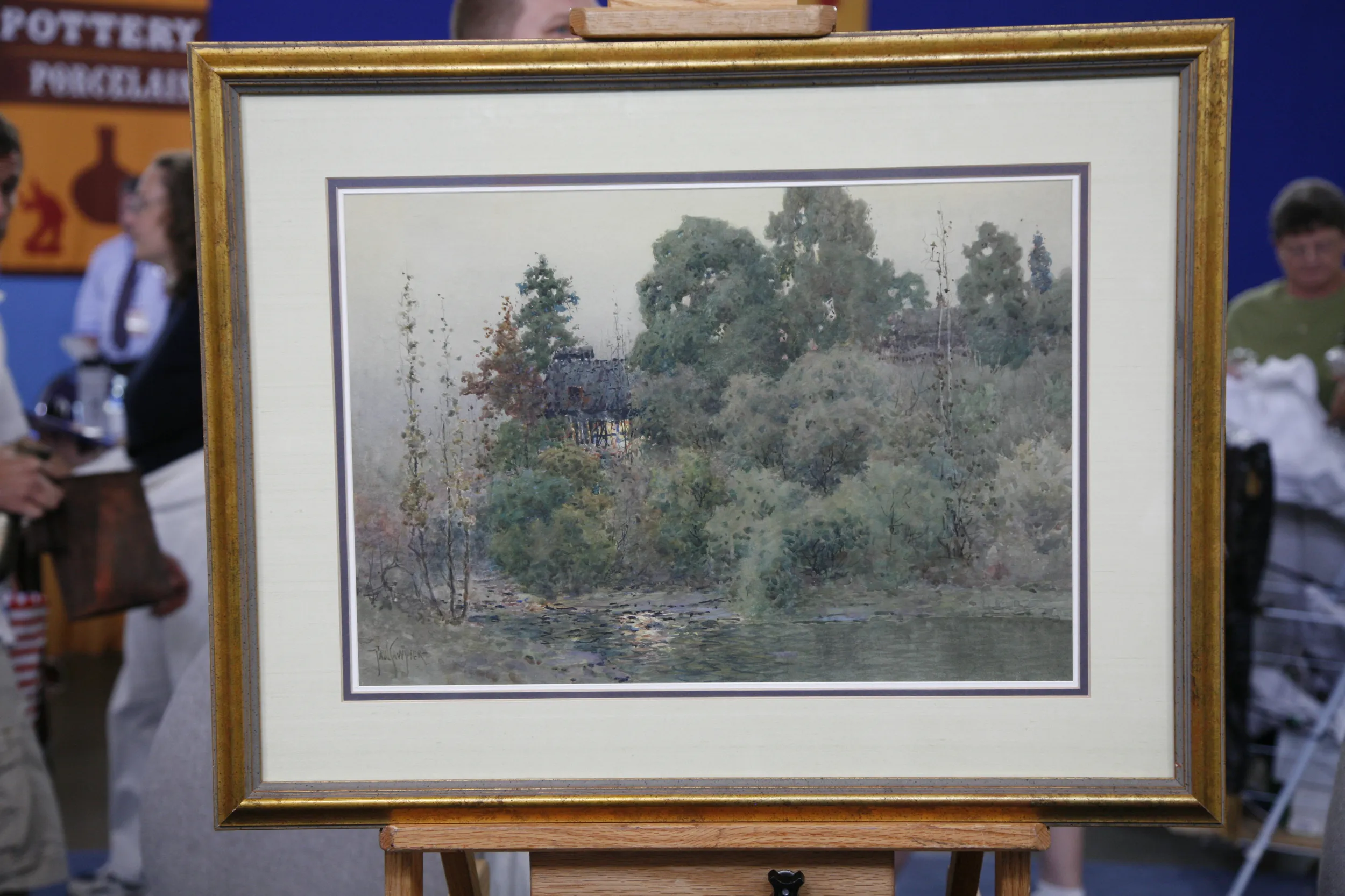
Watercolor
appraisal
Paul Sawyier Watercolor, ca. 1900

appraisal
1843 W. Dittmar Watercolor Portraits

appraisal
1851 View of Cleveland Watercolor

appraisal
Olaf Carl Seltzer Watercolors, ca. 1930
Understanding Our Appraisals
Executive producer Marsha Bemko shares her tips for getting the most out of ANTIQUES ROADSHOW.
Value can change: The value of an item is dependent upon many things, including the condition of the object itself, trends in the market for that kind of object, and the location where the item will be sold. These are just some of the reasons why the answer to the question "What's it worth?" is so often "It depends."
Note the date: Take note of the date the appraisal was recorded. This information appears in the upper left corner of the page, with the label "Appraised On." Values change over time according to market forces, so the current value of the item could be higher, lower, or the same as when our expert first appraised it.
Context is key: Listen carefully. Most of our experts will give appraisal values in context. For example, you'll often hear them say what an item is worth "at auction," or "retail," or "for insurance purposes" (replacement value). Retail prices are different from wholesale prices. Often an auctioneer will talk about what she knows best: the auction market. A shop owner will usually talk about what he knows best: the retail price he'd place on the object in his shop. And though there are no hard and fast rules, an object's auction price can often be half its retail value; yet for other objects, an auction price could be higher than retail. As a rule, however, retail and insurance/replacement values are about the same.
Verbal approximations: The values given by the experts on ANTIQUES ROADSHOW are considered "verbal approximations of value." Technically, an "appraisal" is a legal document, generally for insurance purposes, written by a qualified expert and paid for by the owner of the item. An appraisal usually involves an extensive amount of research to establish authenticity, provenance, composition, method of construction, and other important attributes of a particular object.
Opinion of value: As with all appraisals, the verbal approximations of value given at ROADSHOW events are our experts' opinions formed from their knowledge of antiques and collectibles, market trends, and other factors. Although our valuations are based on research and experience, opinions can, and sometimes do, vary among experts.
Appraiser affiliations: Finally, the affiliation of the appraiser may have changed since the appraisal was recorded. To see current contact information for an appraiser in the ROADSHOW Archive, click on the link below the appraiser's picture. Our Appraiser Index also contains a complete list of active ROADSHOW appraisers and their contact details and biographies.


