Pattern 1777 Short Land Musket Group, ca. 1785
GUEST: As far as I know, this is a model 1777, second model, Brown Bess that came from Dover, New Hampshire, with the pouch.
And as far as I know, it's pretty much untouched.
APPRAISER: How'd you get it?
GUEST: I saw it hanging on the wall of a older couple, friends of mine.
And the pouch was given to me first, and then I purchased the firearm later on.
APPRAISER: Nice, so it all came from the same place.
GUEST: That's correct.
APPRAISER: So let's talk about the pouch first.
It's actually called a cartridge box.
The British called their over-the-shoulder box a pouch, and then what was worn around the waist a cartridge box.
Here, we weren't that particular.
You see them named all sorts of things-- cartridge boxes, cartouche boxes.
They have all different names for them.
Let's take a look inside.
So, we can see it has 24 holes.
One of the tins is missing.
But these would be to hold the cartridges in place and protect them.
And by the number of cartridges and the form of the box, it's probably post-Revolutionary War to the beginning of the 19th century.
Let's go to the gun now.
What we've got, as you mentioned, is a, uh, British Pattern 1777, uh, Short Land musket in really wonderful condition.
And it's great because it's regimentally marked, which we all like to see.
APPRAISER: Um, on the top of the barrel, we've got 65 Regiment, "65 RGT."
And then on the wrist, we've got the brass wrist plate here, with "F-34," for the rack number, for the company, company F, and the number of the man.
So we can definitely tell it's a Pattern 1777 based upon the shortened sear spring lock.
A little bit different than the Pattern 1769 of earlier times.
And the cock is a little bit different than the earlier pattern.
One of the great things that it has, too, is an original whisk-- it's missing the pick, and the whisk would've been used to clean out the pan between shots.
These guns were built, um, by various makers.
There, there were people who would make the barrels, um, the brass parts, the locks, and then they would put it all together.
It's original brown, hasn't been cleaned.
The bayonet is cool in its own right.
Probably not issued with the gun itself, but it's marked "L.I."
and the rack number.
The L.I.
would be for the light infantry company of whatever regiment it was from.
And when they're marked with L.I.
for light infantry, they're a little more collectible than the regular bayonets, with a rack number or without.
What'd you pay for it?
GUEST: $400.
APPRAISER: $400 for the whole group?
GUEST: That's correct.
APPRAISER: Right now, Revolutionary War stuff is fairly hot, uh, but we would put an auction estimate on all of it in the $10,000 to $15,000 range.
GUEST: Mm-hmm!
APPRAISER: Definitely, uh, way more than what you paid for it.
GUEST: Well, thank you very much.
APPRAISER: Well, thank you for bringing it in.

$10,000 - $15,000 Auction
Featured In

episode
Coastal Maine Botanical Gardens, Hour 2
Surprising treasures are in bloom as ROADSHOW continues our fruitful journey to Boothbay, Maine!
Arms & Militaria
appraisal
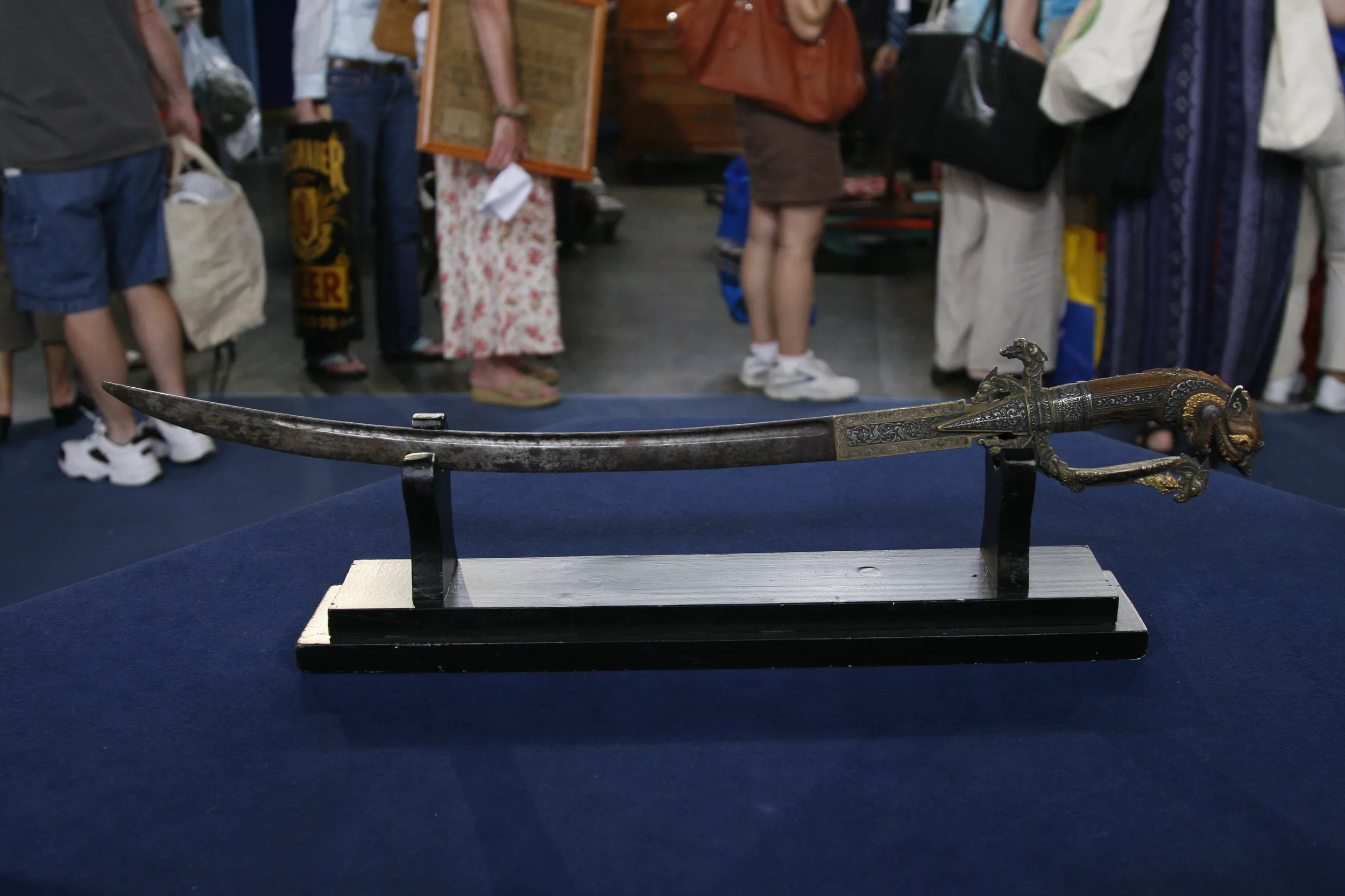
Sri Lankan Kastane (Sword), ca. 1800

appraisal
European Helmet Collection

appraisal
1859 Presentation Kukri Knife

appraisal
Nicolas Lupot Violin & Peccatte-style Bow
Understanding Our Appraisals
Executive producer Marsha Bemko shares her tips for getting the most out of ANTIQUES ROADSHOW.
Value can change: The value of an item is dependent upon many things, including the condition of the object itself, trends in the market for that kind of object, and the location where the item will be sold. These are just some of the reasons why the answer to the question "What's it worth?" is so often "It depends."
Note the date: Take note of the date the appraisal was recorded. This information appears in the upper left corner of the page, with the label "Appraised On." Values change over time according to market forces, so the current value of the item could be higher, lower, or the same as when our expert first appraised it.
Context is key: Listen carefully. Most of our experts will give appraisal values in context. For example, you'll often hear them say what an item is worth "at auction," or "retail," or "for insurance purposes" (replacement value). Retail prices are different from wholesale prices. Often an auctioneer will talk about what she knows best: the auction market. A shop owner will usually talk about what he knows best: the retail price he'd place on the object in his shop. And though there are no hard and fast rules, an object's auction price can often be half its retail value; yet for other objects, an auction price could be higher than retail. As a rule, however, retail and insurance/replacement values are about the same.
Verbal approximations: The values given by the experts on ANTIQUES ROADSHOW are considered "verbal approximations of value." Technically, an "appraisal" is a legal document, generally for insurance purposes, written by a qualified expert and paid for by the owner of the item. An appraisal usually involves an extensive amount of research to establish authenticity, provenance, composition, method of construction, and other important attributes of a particular object.
Opinion of value: As with all appraisals, the verbal approximations of value given at ROADSHOW events are our experts' opinions formed from their knowledge of antiques and collectibles, market trends, and other factors. Although our valuations are based on research and experience, opinions can, and sometimes do, vary among experts.
Appraiser affiliations: Finally, the affiliation of the appraiser may have changed since the appraisal was recorded. To see current contact information for an appraiser in the ROADSHOW Archive, click on the link below the appraiser's picture. Our Appraiser Index also contains a complete list of active ROADSHOW appraisers and their contact details and biographies.


