GUEST: My mother bought it in Phoenix probably about 30 years ago at a yard sale.
GUEST: Her dad was the original horse trader and he always bought and sold things, he always had an eye for value-- an uncanny eye for value-- and this was one that they simply got attached to and hung on to over the years.
APPRAISER: Well, this is certainly a really unusual teapot. Why did you decide to keep it?
GUEST: It was just one that caught our eye. I think it was your mom's favorite piece.
GUEST: It was my mom's very favorite piece.
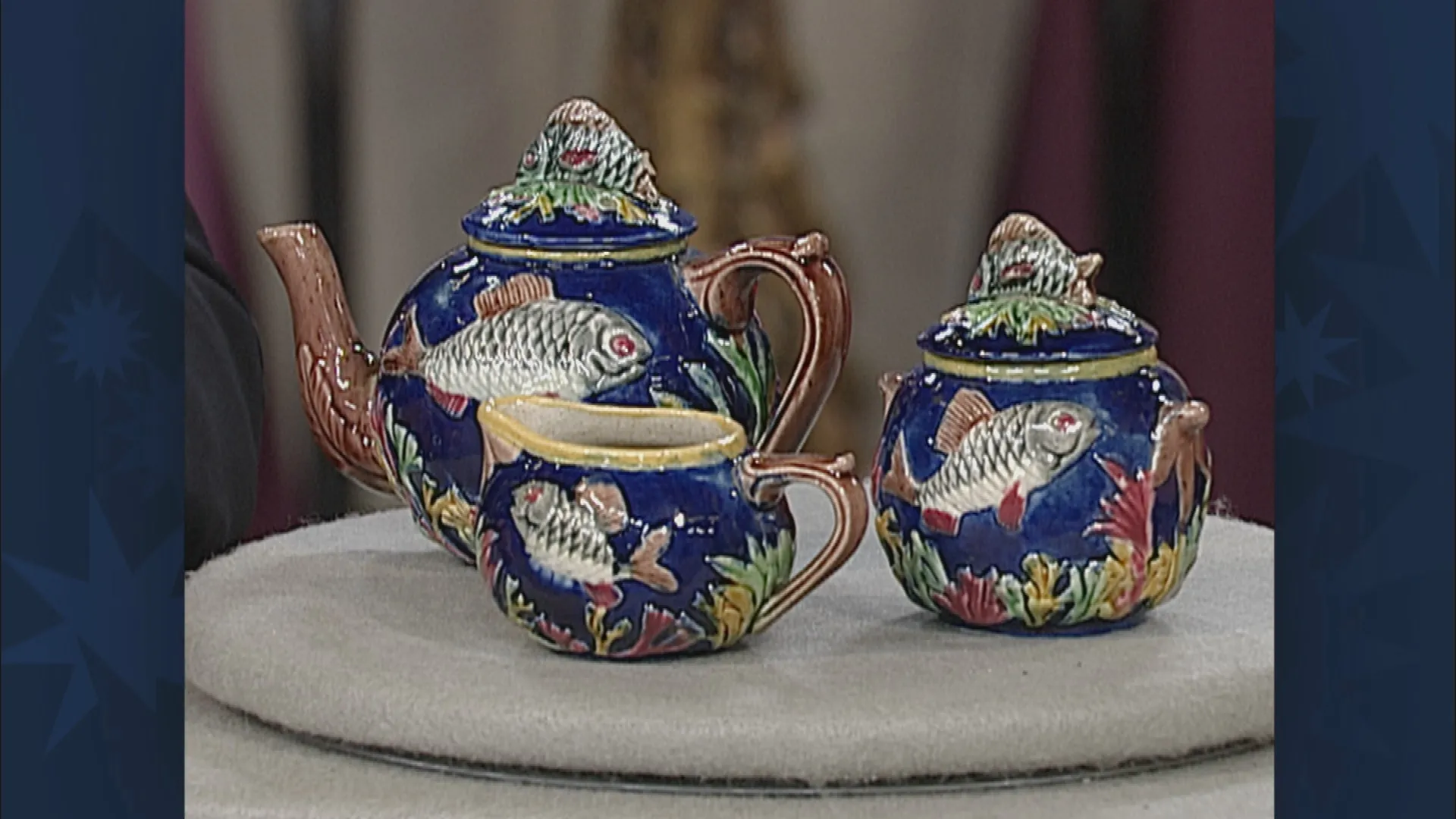
APPRAISER: A lot of people really dislike this sort of thing because it's kind of scary with the snakes, but I myself, I love them. I have some of this sort of ware in my own collection. I'm going to take off the lid very carefully, which is really interesting how the lid is part of the overall design, which is nice. And there's a little note in here, which you've kept. And I love notes. That always makes things more interesting. The note reads: "Cabbage and snake teapot "brought to Montreux by a Swiss family "who lived in France about 1830. Age of pot: probably 1820." Little notes are great. They tend to not always be correct, though. Frequently, there's misinformation on it. I'm going to put it back in the pot and put the lid on. What this pot is, it's a type of Majolica. It's named Palissy ware, which is named after a 16th-century French potter who made pottery which was covered with snakes and lizards, grass, frogs, fish, shells, and these bright greens, browns, ambers, gold colors. It became a big fad in the 19th century. It was made in Portugal, made in France and other countries in Europe. Mostly what we see in Palissy ware are, like, plates and bowls, which are interesting, small vases and so forth. But this one, because it's a teapot, is really great. And another thing great about it, you can imagine that this is very fragile and these leaves and the head and the handles got broken off quite a bit. This one is in almost perfect condition, which is amazing that something would survive. Although the note said 1820, my guess is it's more like 1850, 1875. We don't know for sure because lots of different factories made this sort of thing. But I think the value of this is somewhere between $2,000 and $3,000.
GUEST: Oh, my.
APPRAISER: Thanks for coming. This is really great.
GUEST: (both) Well thank you.