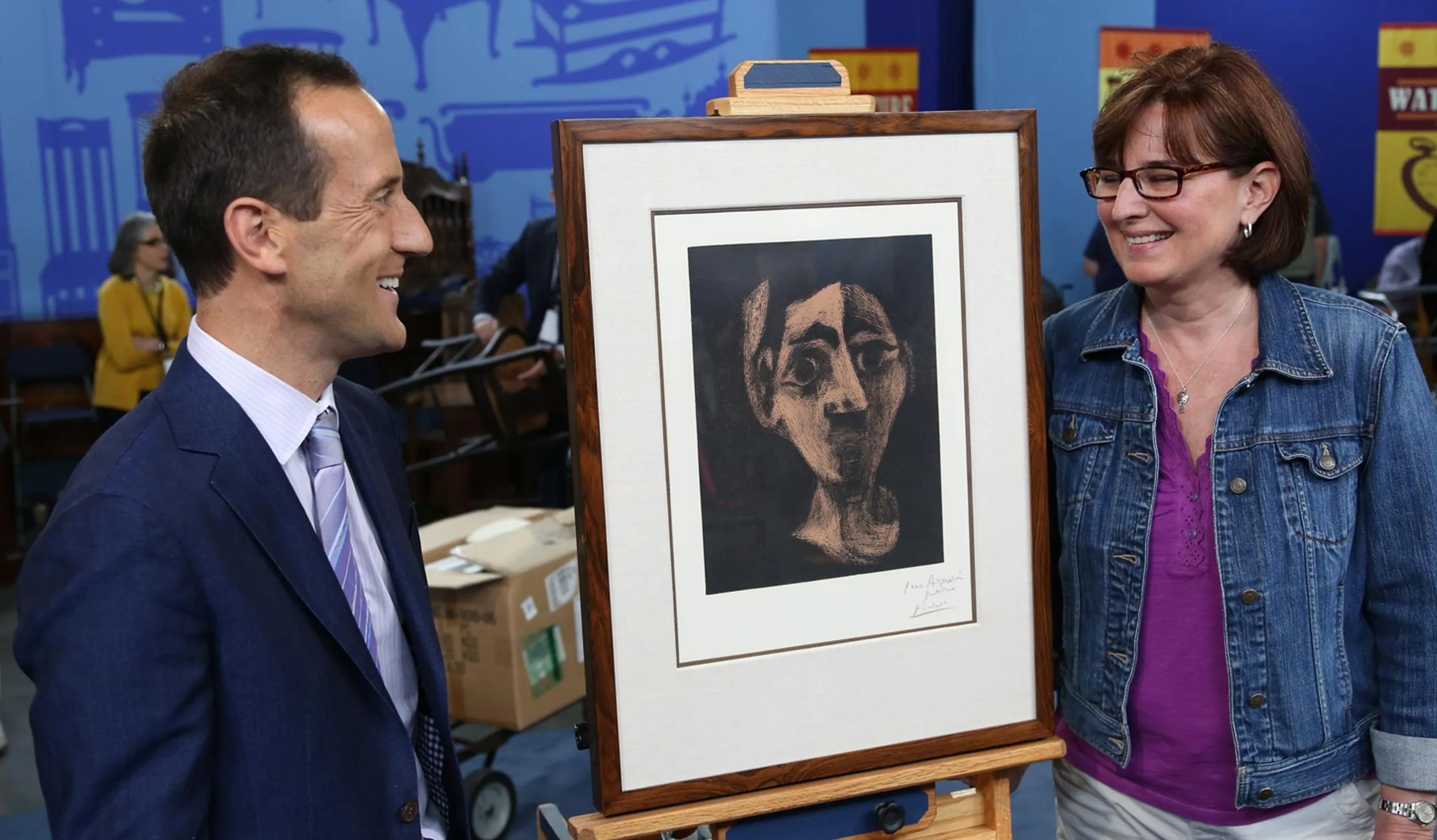
Pablo Picasso Linoleum Cut, ca. 1950
GUEST: Before my husband and I were married, he actually had a lot of artwork hanging in the house, none of which I really cared for, to be... truth be told, but I guess now everyone will know. And there was some excavating going on in the neighborhood. Big kaboom. Everything fell off the walls. And I thought, "Oh, my gosh, this is my perfect opportunity." Everything went in the basement, brought a few things up to kind of hang here and there. He said, "I think you should probably bring the Picasso out of the basement." And I said, "There's not a Picasso in the basement. Surely I would recognize it."
APPRAISER: You said, "The what?"
GUEST: Yeah, exactly.
APPRAISER: So, up came the Picasso.
GUEST: That's really about all I know.
APPRAISER: Did your husband tell you where he had gotten it?
GUEST: He bought it from a fellow that would go back and forth to Europe and get prints and paintings and so forth, bring them back to the Detroit area and sell them. My question about it, and the thing that kind of flagged me was, it's not numbered. And if it's a print, shouldn't the artist number it?
APPRAISER: It should be numbered.
GUEST: Usually, right, they are.
APPRAISER: That's the big question hanging over this one for you? So it's his picture, depending.
GUEST: (chuckling): Right.
APPRAISER: All right, let me tell you a little bit about it. You can see down here it's signed in pencil, "Picasso," and this is actually a dedication right here. The name is Arnèra and we'll get to that in just a moment. Now, I'll tell you it is a color linoleum cut, and it is definitely by Picasso. So it's a genuine original print by Picasso. Linoleum cut is very much like a woodcut only the artist is working on a linoleum block. It's a very interesting process for Picasso. He met up with the printer Arnèra in the late 1940s in the south of France. Picasso had a studio in Cannes and Arnèra was working in Vallauris, so they're nearby. It was about the same time that Picasso started doing all of his ceramics. And it's amazing to me that this is in the late 1940s, early 1950s. Picasso was born in 1881, so already we're dealing with somebody who's well into retirement age. He's starting to experiment with basically new techniques and ideas.
GUEST: Okay.
APPRAISER: At close to 70 years old. It's pretty amazing.
GUEST: Right.
APPRAISER: The idea behind him starting to get into making linoleum cuts, aside from meeting Arnèra, is that he was working with printers in Paris on his etchings and lithographs. And those plates and stones are going back and forth between the south of France where his studio is and Paris. And Picasso, it's thought, wanted more immediacy in his printmaking. So he met with Arnèra and got this idea to start making linoleum cuts because it's using these things that could be printed, basically, in a home studio.
GUEST: Right.
APPRAISER: Or at ArnÈra's studio in Vallauris. And Picasso, like so many things he did, took that medium to its fullest extent. You know, you see the wonderful fineness of the cutting here. It almost looks like a lithograph. It's that detailed. Or a drawing. This thing is also in beautiful condition. No worse for the wear at over 50 years old. This would have been made in the 1950s.
GUEST: Okay.
APPRAISER: And it is initially odd that it's not numbered. He would have made these linoleum cuts in an edition of 50.
GUEST: Okay.
APPRAISER: Now, the wonderful thing about this is that the dedication right here is to Arnèra. In other words it's to the printer. It's to his printer, right. It doesn't get much better than that for provenance.
GUEST: Really?
APPRAISER: So you actually have a proof outside of the edition, which is why it's not numbered.
GUEST: Okay.
APPRAISER: Dedicated by the artist to his printer.
GUEST: Wow.
APPRAISER: That's pretty special. Do you have any idea of its value?
GUEST: I don't. I hope it's worth more than what my husband paid for it.
APPRAISER: Okay, and what did you think that was?
GUEST: He seems to think it was between $5,000 and $6,000.
APPRAISER: Okay, now Picasso, when he started doing linoleum cuts in the late 1940s through the '50s into the early '60s, he produced about 200 different subjects. And this is not one of the more colorful ones he did, not one of the larger ones. But still, it's very important because of that dedication to Arnèra, the wonderful condition it's in, and it's pure Picasso. There's no mistaking that Picasso look in this image.
GUEST: Right.
APPRAISER: As a replacement value, I would put $20,000.
GUEST: Wow.
APPRAISER: Good for taking it out of the basement.
GUEST: Yes.
APPRAISER: Well done. (chuckles)

$20,000 Insurance
Featured In
episode
Junk in the Trunk 4, Hour 1
The first hour of “Junk in the Trunk 4” includes highlights from 2014!
20th Century
appraisal
appraisal
appraisal
Understanding Our Appraisals
Placeholder