Nicholas Heinz Violin Group & French Bow, ca. 1930
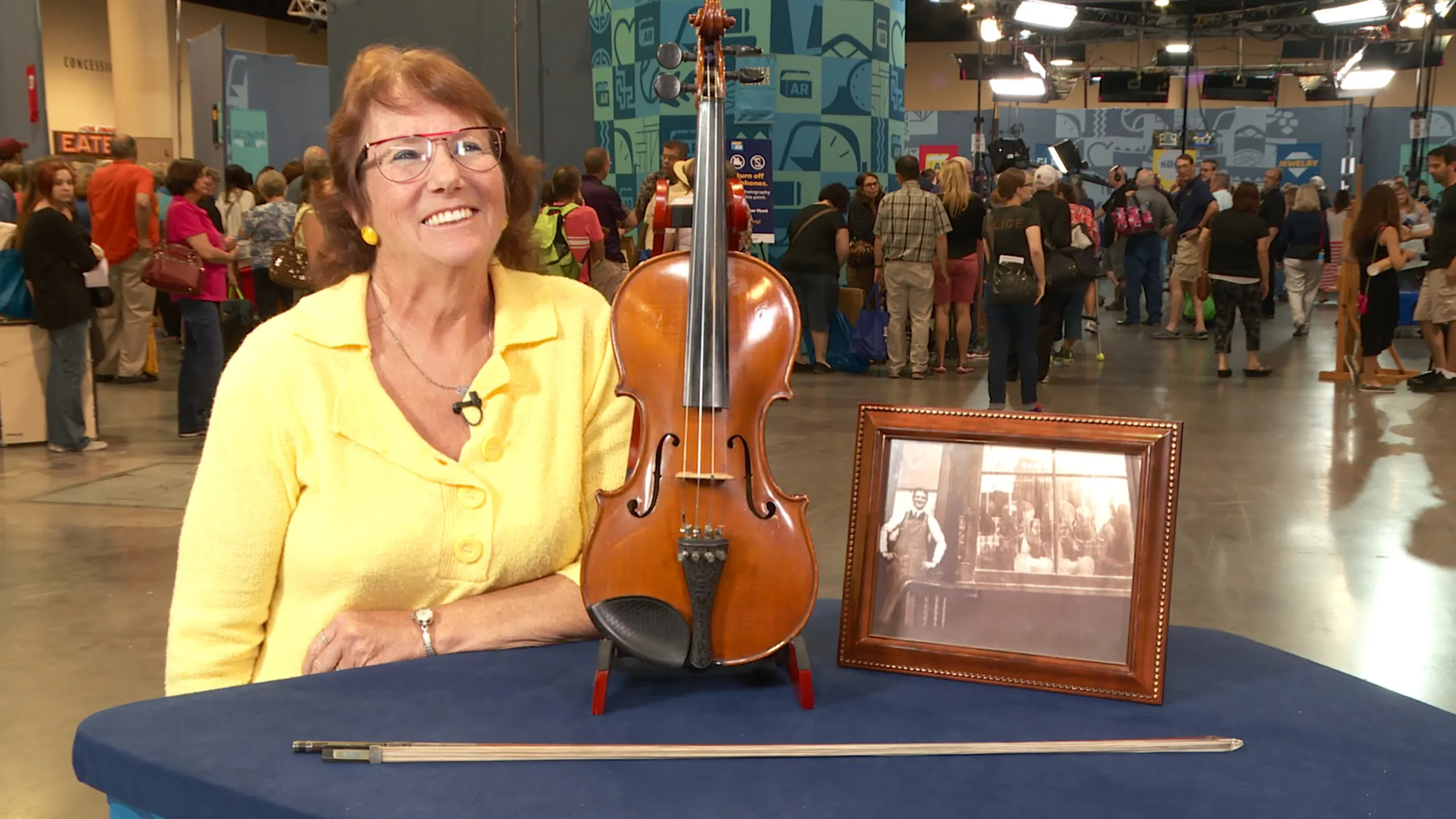
GUEST: I brought in my grandfather's violin. My mom and dad always called him Pops. He died in 1945, so I never got to meet him. But he made violins, and he repaired violins for the Philharmonic, the Boston Pops, the New York Symphony. He worked for a company for a while, and then he opened up his own shop, and when he passed away, my mother took one of his violins, and I played this violin since I was in second grade until I had an injury and could play no more, and I am dying to find out what to insure it for. I've heard the story of my pop for all of my life, what an amazing man he was and everything he'd done, and how he became a violin maker.
APPRAISER: Well, I'm very excited about this violin that you brought in today.
GUEST: I can't wait. (chuckles)
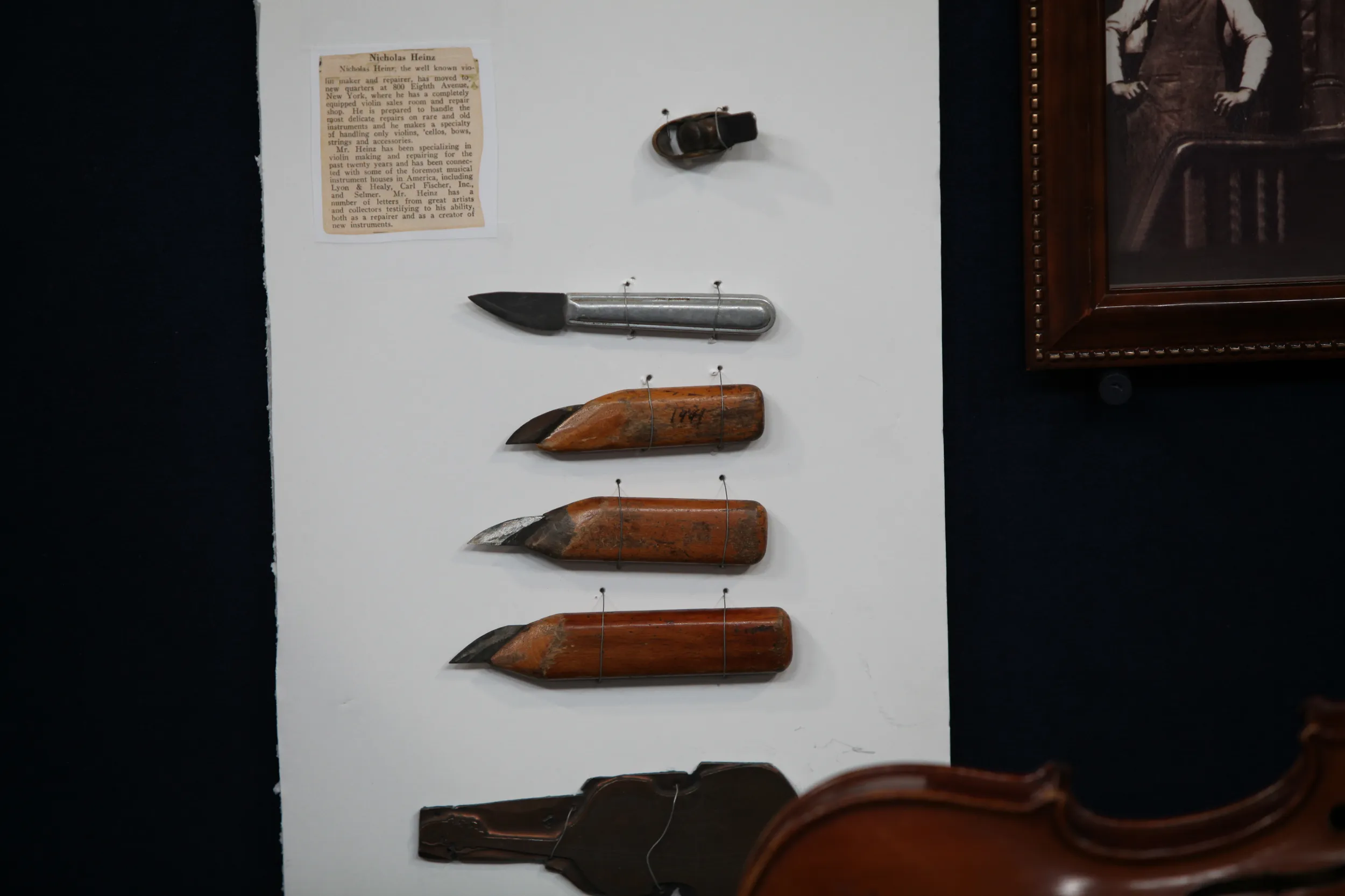
APPRAISER: You brought in his tools. And you brought in a picture of his shop in Manhattan.
GUEST: Yes.
APPRAISER: His name, of course, was Nicholas Heinz.
GUEST: Yeah.
APPRAISER: He started training as a violin maker when he was 14 years old.
GUEST: Wow.
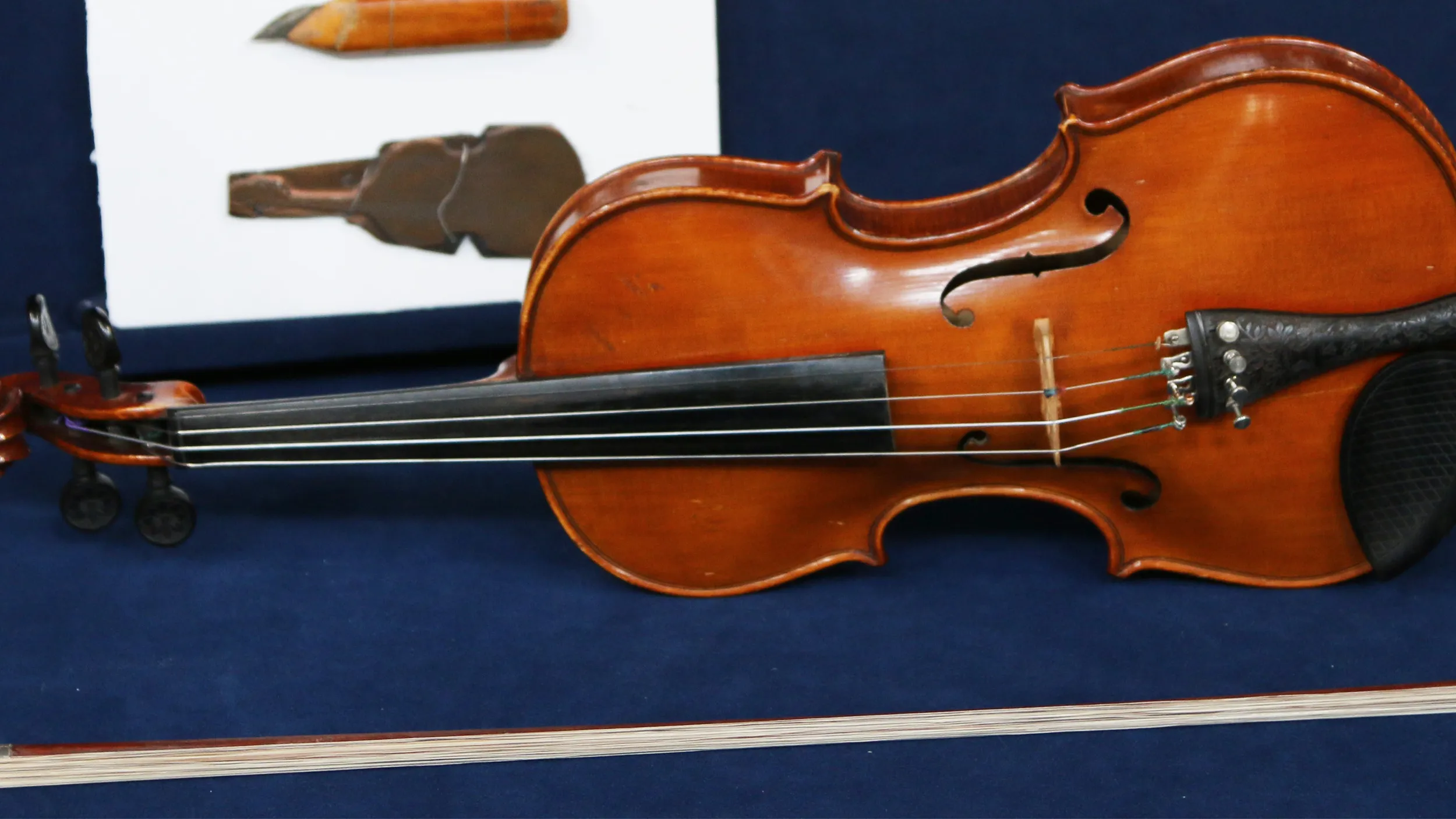
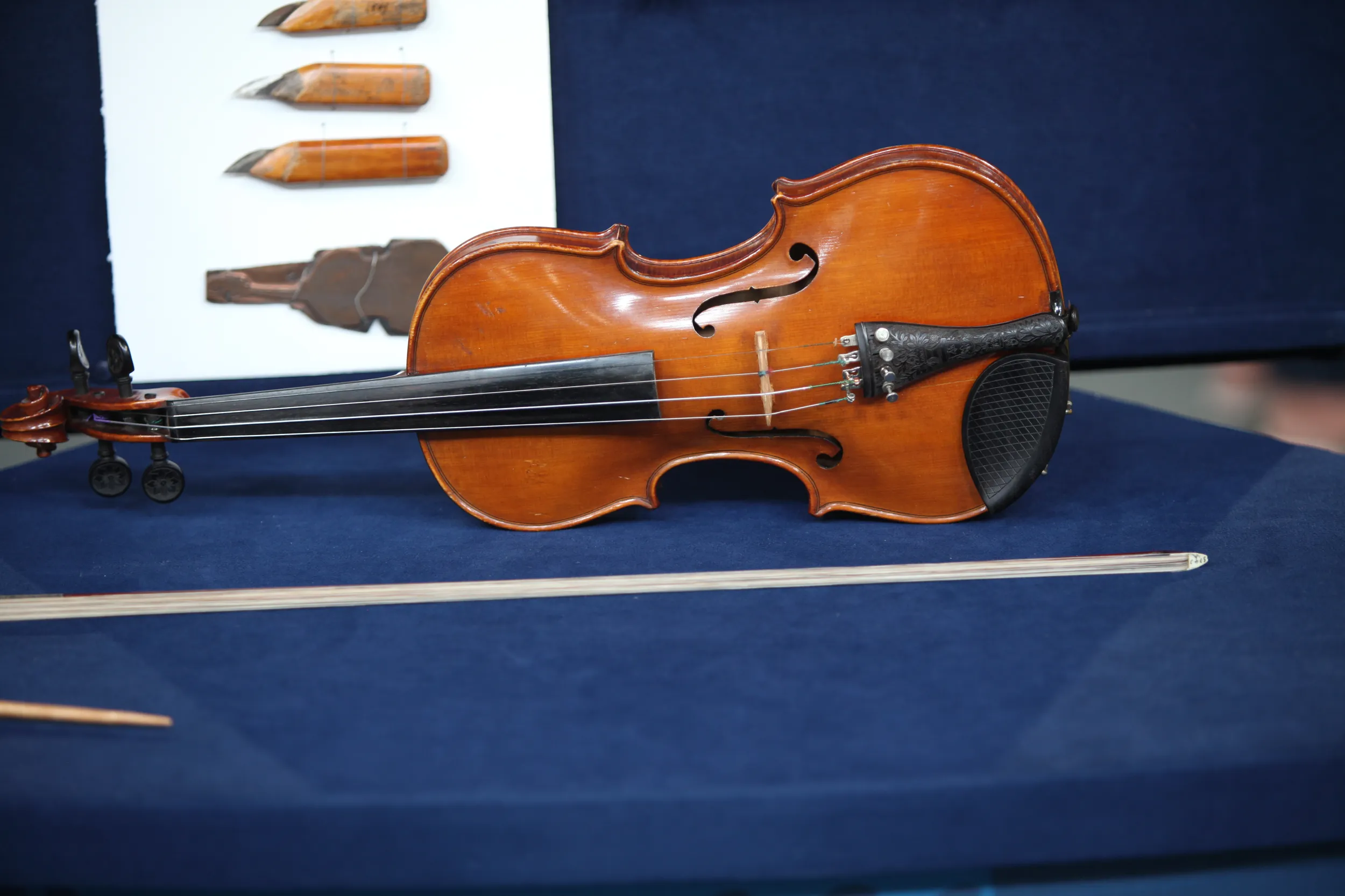
APPRAISER: So he studied with Frederick Koenig, who was a violin maker in New York City. And so your grandfather, from the age of 14 to 19 years old, trained with one of the top makers in the United States. He also worked in Chicago for Lyon and Healy, he worked in Philadelphia, and then he opened his own shop in 1926. So this particular violin that you brought in today has a label on the inside, and it says "Nicholas Heinz, Violin Maker and Repairer," and above that label is a brand that's been branded into the wood that says "N. Heinz." I love this picture. He seems so proud and just brimming full of energy. These are his knives for carving.
GUEST: Correct.
APPRAISER: And this little tiny plane is a violin maker's plane. It's used to do the fine arching that would be around the edges of the instrument. This violin is made in very traditional materials. The belly of the instrument is spruce and the back and the ribs are a flamed maple.
GUEST: Ah-hah.
APPRAISER: And the pegs are carved in a beautiful design, as is the tailpiece. I believe that the pegs and the tailpiece were actually made in Germany, and that he would have purchased them for this instrument.
GUEST: Oh! I thought he made them.
APPRAISER: The bow is a French bow.
GUEST: Huh.
APPRAISER: It is stamped right here, it's stamped "Paris." The tip plate broke off, but it doesn't affect the value, and the tip plate is perhaps ivory. It's either ivory or it's mammoth, but you can't tell by just looking at it, and that can be replaced-- it's not a big deal.
GUEST: Oh.
APPRAISER: So the bow is intact. In the world of retail, I would value this bow at $4,000.
GUEST: Holy Hannah! Wowzer! Shut the front door, girl, are you serious?
APPRAISER: Yeah, it's a beautiful bow.
GUEST: Wow, wonderful!
APPRAISER: The violin, I would value...
GUEST: My baby.
APPRAISER: ...at $12,000.
GUESTS (gasps)
APPRAISER: It's a master-quality instrument.
GUEST: Aw, sweetie, I love that.
APPRAISER: And all of the ephemera that you brought, the tools and the, the pictures and the letters, I would say, in, combined with the value, would add $3,000 to its value.
GUEST: Oh, my goodness.
APPRAISER: So all the ephemera and the violin should always stay together.

$21,000 Retail
$19,000 Retail
Photos

Featured In
episode
Omaha, Hour 1 (2016)
A Grant Wood lithograph, a Daytona Model Rolex, and Prohibition liquor bottles.
episode
American Stories
Celebrate the history of our country through personal accounts behind standout treasures.
Things to Use or Wear
appraisal
Weissenborn Style 4 Guitar, ca. 1925
appraisal
Elgin Student Watch & Papers, ca. 1924
appraisal
appraisal
Duncan Phyfe Sewing Table, ca. 1805
Understanding Our Appraisals
Executive producer Marsha Bemko shares her tips for getting the most out of ANTIQUES ROADSHOW.
Value can change: The value of an item is dependent upon many things, including the condition of the object itself, trends in the market for that kind of object, and the location where the item will be sold. These are just some of the reasons why the answer to the question "What's it worth?" is so often "It depends."
Note the date: Take note of the date the appraisal was recorded. This information appears in the upper left corner of the page, with the label "Appraised On." Values change over time according to market forces, so the current value of the item could be higher, lower, or the same as when our expert first appraised it.
Context is key: Listen carefully. Most of our experts will give appraisal values in context. For example, you'll often hear them say what an item is worth "at auction," or "retail," or "for insurance purposes" (replacement value). Retail prices are different from wholesale prices. Often an auctioneer will talk about what she knows best: the auction market. A shop owner will usually talk about what he knows best: the retail price he'd place on the object in his shop. And though there are no hard and fast rules, an object's auction price can often be half its retail value; yet for other objects, an auction price could be higher than retail. As a rule, however, retail and insurance/replacement values are about the same.
Verbal approximations: The values given by the experts on ANTIQUES ROADSHOW are considered "verbal approximations of value." Technically, an "appraisal" is a legal document, generally for insurance purposes, written by a qualified expert and paid for by the owner of the item. An appraisal usually involves an extensive amount of research to establish authenticity, provenance, composition, method of construction, and other important attributes of a particular object.
Opinion of value: As with all appraisals, the verbal approximations of value given at ROADSHOW events are our experts' opinions formed from their knowledge of antiques and collectibles, market trends, and other factors. Although our valuations are based on research and experience, opinions can, and sometimes do, vary among experts.
Appraiser affiliations: Finally, the affiliation of the appraiser may have changed since the appraisal was recorded. To see current contact information for an appraiser in the ROADSHOW Archive, click on the link below the appraiser's picture. Our Appraiser Index also contains a complete list of active ROADSHOW appraisers and their contact details and biographies.


