Mintons Pâte-sur-Pâte Vases, ca. 1880
GUEST: These belonged to my great-uncle. He was an antique collector. I remember them as a child, sitting up on shelves, very high up. You didn't touch them. There was a built-in bookcase on top, and he had a mirror that was custom made. And the mirror sat, like, vertically behind the vases. That way you could see the backside of the vases, which are also very interesting.
APPRAISER: Absolutely.
GUEST: And then when he passed away, he gave them to my grandma, left a note that when she passed, they were to be passed on to me. My grandma passed in 2012, so I've had them since she passed.
APPRAISER: So what we have here is a matched pair of vases. Now, many pairs of vases made by all kinds of manufacturers are exactly identical. But these are companion vases. Each one has a different scene on the front of similar birds facing in. And this technique is really interesting, it's called "pâte-sur-pâte" which means paste on paste. They originally was just a vase that was kind of this lavender color.
GUEST: Uh-huh.
APPRAISER: And then the decorations were added on top of that. It was painted in layers with white slip. And they were inspired by Japanese design, so we call them Japanism. They were made by Minton. Who was located in England.
GUEST: Okay.
APPRAISER: And this is something that Minton was known for.
GUEST: Okay.
APPRAISER: When they were new, they were very expensive. This was a very tedious, time-consuming process. We have the initials of the man who painted it, and his name is Henry Hollins, and he started working at Minton in about 1873. There's raised, enameled flowers. It's a repetitive pattern in these wonderful greens and turquoise blue. And one color that Minton is especially known for is turquoise. There's not a lot on here, but that's a really nice feature. Then if we turn to the back, we have a completely different "pâte-sur-pâte" design of the same flowers…
GUEST: Mm-hmm.
APPRAISER: …with a wonderful insect. But my favorite part is next.
GUEST: (chuckling): Okay.
APPRAISER: So we turn this one around to look at the back. And there's a wonderful spider web with a spider, and I'm crazy about that. And that makes them so much more interesting...
GUEST: It does.
APPRAISER: ...than just flowers. Flowers are good. Birds are good, too. The spider web definitely helps the value.
GUEST: Really?
APPRAISER: And they both-- the marks are a little hard to see. Mintons with an S.
GUEST: Okay.
APPRAISER: It went from Minton to Mintons in the 1870s. And normally there is an impressed symbol for a date.
GUEST: Okay.
APPRAISER: And these just don't have it, but we still pretty much know where they're from.
GUEST: Okay. Mm-hmm.
APPRAISER: Pretty much probably the 1870s or maybe very early 1880s. There's a chip on the top edge.
GUEST: Right.
APPRAISER: It does affect the value some. A retail price for the pair would be somewhere between $3,000 and $5,000.
GUEST: Okay. Wow.
APPRAISER: If we didn't have this chip...
GUEST: Mm-hmm.
APPRAISER: ...I think we could add another $1,000.
GUEST: Wow.

$3,000 - $5,004 Retail
Featured In

episode
Castle Farms, Hour 3
ROADSHOW returns to storm Castle Farms (nicely) in scenic Charlevoix one final time! — Mon, April 13, 2026
Vase

appraisal
Dirk Van Erp Copper Vase, ca. 1930

appraisal
Venetian Glass Vase, ca. 1935

appraisal
1900 Della Robbia Vase
appraisal
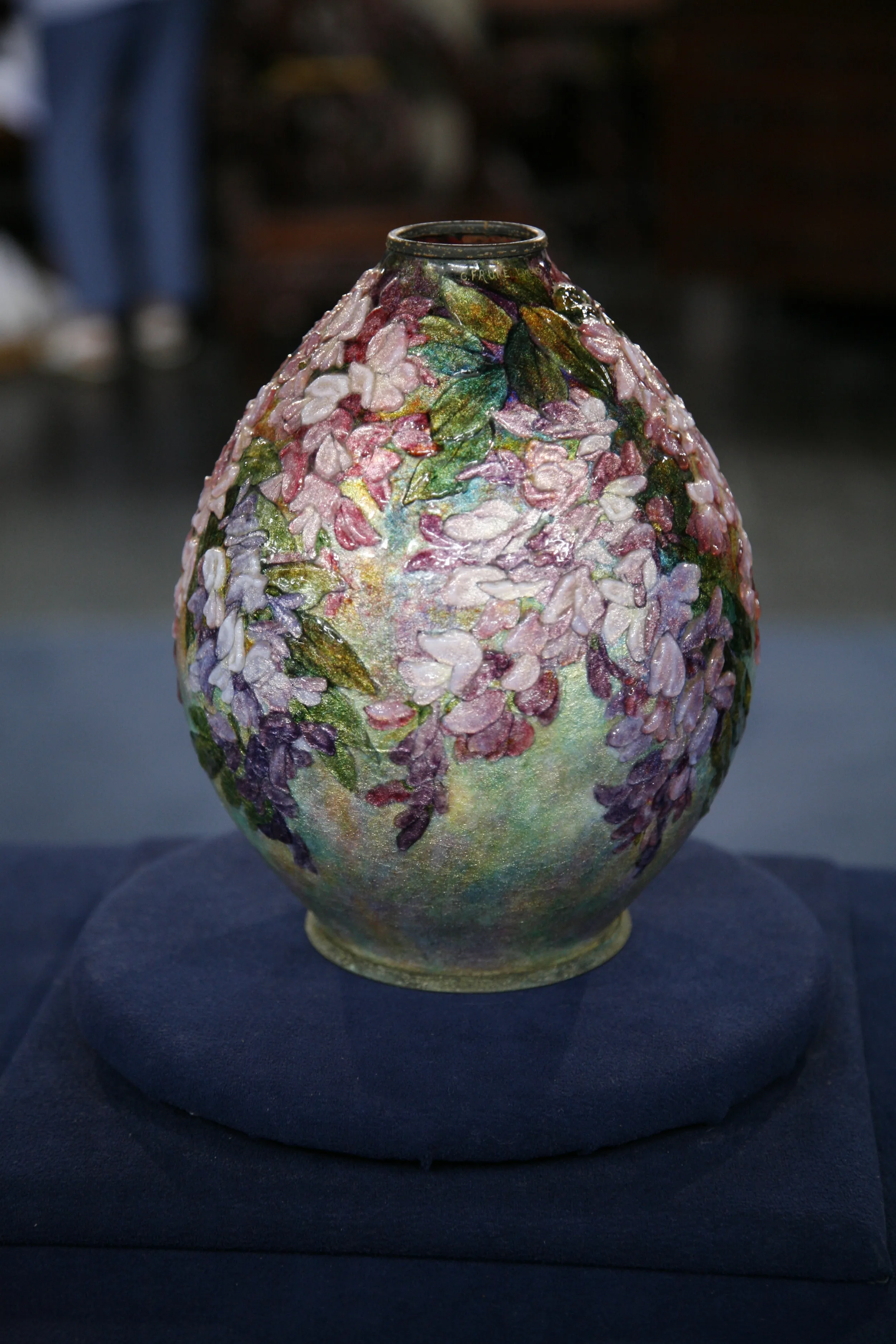
Camille Fauré Enameled Vase, ca. 1925
Understanding Our Appraisals
Executive producer Marsha Bemko shares her tips for getting the most out of ANTIQUES ROADSHOW.
Value can change: The value of an item is dependent upon many things, including the condition of the object itself, trends in the market for that kind of object, and the location where the item will be sold. These are just some of the reasons why the answer to the question "What's it worth?" is so often "It depends."
Note the date: Take note of the date the appraisal was recorded. This information appears in the upper left corner of the page, with the label "Appraised On." Values change over time according to market forces, so the current value of the item could be higher, lower, or the same as when our expert first appraised it.
Context is key: Listen carefully. Most of our experts will give appraisal values in context. For example, you'll often hear them say what an item is worth "at auction," or "retail," or "for insurance purposes" (replacement value). Retail prices are different from wholesale prices. Often an auctioneer will talk about what she knows best: the auction market. A shop owner will usually talk about what he knows best: the retail price he'd place on the object in his shop. And though there are no hard and fast rules, an object's auction price can often be half its retail value; yet for other objects, an auction price could be higher than retail. As a rule, however, retail and insurance/replacement values are about the same.
Verbal approximations: The values given by the experts on ANTIQUES ROADSHOW are considered "verbal approximations of value." Technically, an "appraisal" is a legal document, generally for insurance purposes, written by a qualified expert and paid for by the owner of the item. An appraisal usually involves an extensive amount of research to establish authenticity, provenance, composition, method of construction, and other important attributes of a particular object.
Opinion of value: As with all appraisals, the verbal approximations of value given at ROADSHOW events are our experts' opinions formed from their knowledge of antiques and collectibles, market trends, and other factors. Although our valuations are based on research and experience, opinions can, and sometimes do, vary among experts.
Appraiser affiliations: Finally, the affiliation of the appraiser may have changed since the appraisal was recorded. To see current contact information for an appraiser in the ROADSHOW Archive, click on the link below the appraiser's picture. Our Appraiser Index also contains a complete list of active ROADSHOW appraisers and their contact details and biographies.


