Ming Dynasty Bronze Guanyin, ca. 1620
GUEST: It belonged to my mother, who died about four years ago.
She lived in Tokyo for a long time, and she started a great collection of Asian art.
She would have acquired it sometime in the late 1940s, early 1950s.
APPRAISER: Perhaps part of the occupational forces in Japan at that time?
GUEST: Probably-- my, her... Yes.
My father was in the Marines, and she worked for the State Department.
APPRAISER: I'm not terribly surprised to find that this came from Japan.
It's not originally from Japan, as it is, in fact, Chinese.
GUEST: Ah!
APPRAISER: But it's a Chinese Buddhist bronze.
GUEST: Oh.
APPRAISER: And these were treasured not just in China, but by the Japanese, as well.
So, a great inspiration to Japanese metalsmiths and bronzesmiths are these Chinese bronzes.
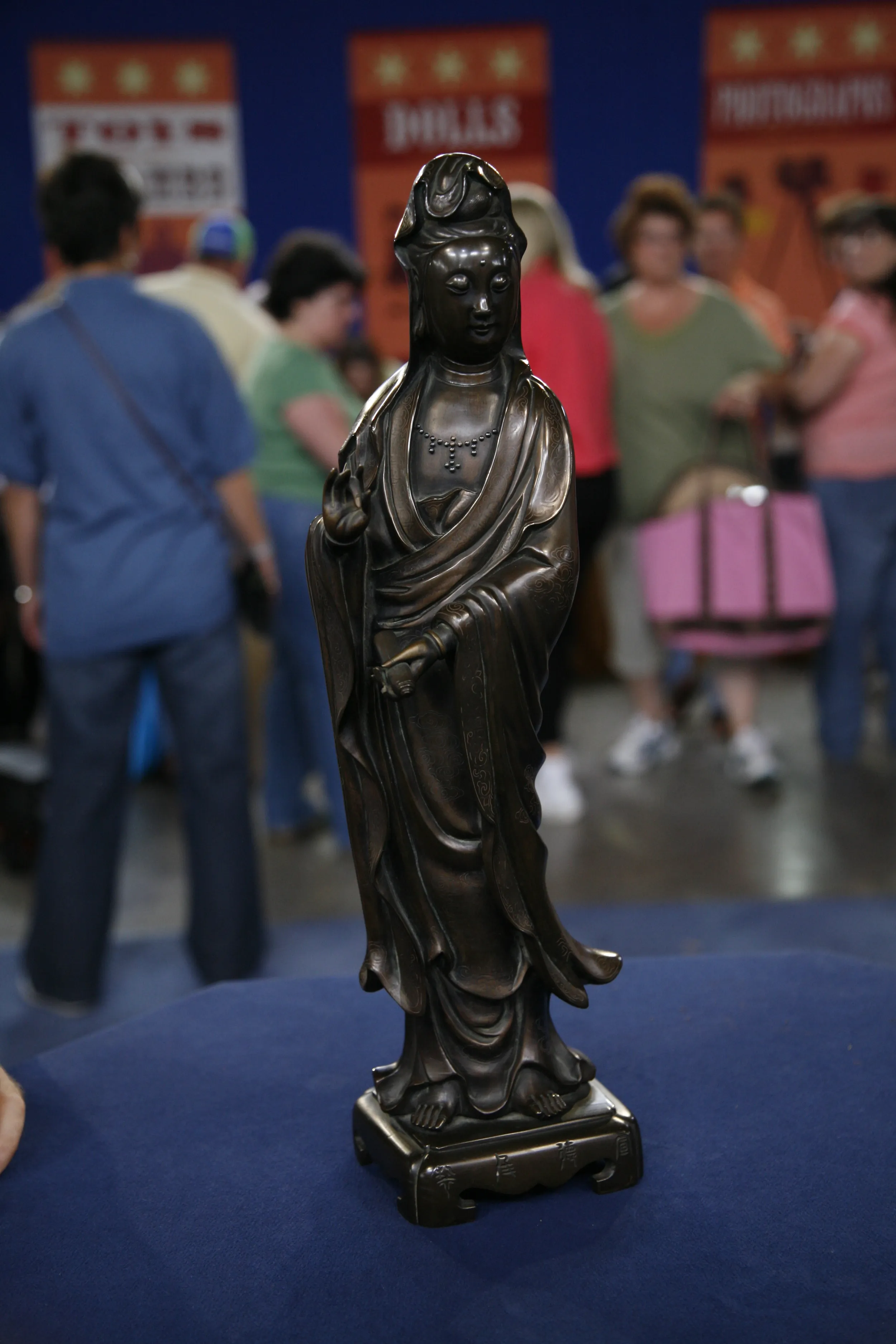
This figure is a specific bodhisattva in the Buddhist tradition, and this is Guanyin.
Guanyin, one could say, is the Buddhist mother of mercy.
Okay.
And a very, very popular figure in Chinese Buddhism.
Guanyin has a bearing that is very serene, protective.
Guanyin bestows peace and mercy and understanding, and so is very inspirational to those who would have an image of Guanyin in the particular shrine or in the temple that they would visit.
She would have been holding, I believe, a lotus flower.
GUEST: Ah!
APPRAISER: Where would it have... So right, right now, she's, she's holding a lotus stem.
There are traces, you may notice, of a little bit of gold.
GUEST: Mm-hmm.
APPRAISER: You have to imagine this completely gilt from top to bottom.
GUEST: (gasps) You're kidding.
APPRAISER: Unfortunately-- no, not at all.
The way the gilding is applied-- and it's best shown in the back-- it's actually a gilt lacquer.
And lacquer degrades.
Lacquer dries out, it flakes away.
So, we can see here, this is a nice little piece of how bright... You can see, the gold hasn't tarnished.
(murmurs) But the lacquer has largely flaked away.
Mm-hmm.
So, it's a gilt lacquer on top of the bronze.
This is from the Ming Dynasty.
This is the second to the last dynastic period in Chinese history.
Specifically, I'd say this dates from around 1600 to 1650... GUEST: Okay.
APPRAISER: ...or so.
Maybe even the late 1500s.
Very distinctive.
Oh.
Very Ming.
One of the reasons I can date this as Ming is the size of the head.
The proportions are such that I think Ming.
Another technique that, I look on the underside, this red color.
GUEST: Mm-hmm.
APPRAISER: This comes all the way back from the casting process.
We're looking at this, and we're seeing evidence of how it came out of the foundry.
This is red clay.
There was a clay core that was put into this cavity to keep the integrity of the bronze... GUEST: Fascinating.
APPRAISER: ...as it was fired.
And that red clay never goes away.
GUEST: That is really cool.
APPRAISER: In today's auction market, I think this would have perhaps a conservative auction value of $7,000 to $10,000.
GUEST: (softly): Wow.
Wow.
(chuckles) My mother would be so excited if she was here.
And I'm also very certain that's not what she paid for it.
APPRAISER: (chuckles) Quite a souvenir.

$7,000 - $10,000 Auction
Featured In

episode
Coastal Maine Botanical Gardens, Hour 2
Surprising treasures are in bloom as ROADSHOW continues our fruitful journey to Boothbay, Maine!
Bronze
appraisal
Late Period Egyptian Bronze Falcon
appraisal
19th & 20th-Century Inkwell Collection

appraisal
Edward Onslow Ford Bronze, ca. 1885
appraisal
19th C. Chinese Bronze Guanyin Figure
Understanding Our Appraisals
Executive producer Marsha Bemko shares her tips for getting the most out of ANTIQUES ROADSHOW.
Value can change: The value of an item is dependent upon many things, including the condition of the object itself, trends in the market for that kind of object, and the location where the item will be sold. These are just some of the reasons why the answer to the question "What's it worth?" is so often "It depends."
Note the date: Take note of the date the appraisal was recorded. This information appears in the upper left corner of the page, with the label "Appraised On." Values change over time according to market forces, so the current value of the item could be higher, lower, or the same as when our expert first appraised it.
Context is key: Listen carefully. Most of our experts will give appraisal values in context. For example, you'll often hear them say what an item is worth "at auction," or "retail," or "for insurance purposes" (replacement value). Retail prices are different from wholesale prices. Often an auctioneer will talk about what she knows best: the auction market. A shop owner will usually talk about what he knows best: the retail price he'd place on the object in his shop. And though there are no hard and fast rules, an object's auction price can often be half its retail value; yet for other objects, an auction price could be higher than retail. As a rule, however, retail and insurance/replacement values are about the same.
Verbal approximations: The values given by the experts on ANTIQUES ROADSHOW are considered "verbal approximations of value." Technically, an "appraisal" is a legal document, generally for insurance purposes, written by a qualified expert and paid for by the owner of the item. An appraisal usually involves an extensive amount of research to establish authenticity, provenance, composition, method of construction, and other important attributes of a particular object.
Opinion of value: As with all appraisals, the verbal approximations of value given at ROADSHOW events are our experts' opinions formed from their knowledge of antiques and collectibles, market trends, and other factors. Although our valuations are based on research and experience, opinions can, and sometimes do, vary among experts.
Appraiser affiliations: Finally, the affiliation of the appraiser may have changed since the appraisal was recorded. To see current contact information for an appraiser in the ROADSHOW Archive, click on the link below the appraiser's picture. Our Appraiser Index also contains a complete list of active ROADSHOW appraisers and their contact details and biographies.


