Mid-20th C. Wilson Tawaquaptewa Kachina Doll
GUEST: It's a kachina doll. It was my father's. He taught school in southern Idaho during the '20s, when they relocated tribal people from different places. They sent children all over the United States, and this young man became a friend of my father's, and, and when he left school, he gave my dad the doll, so...
APPRAISER: Do you know where it came from?
GUEST: From hearing what my dad talked about and what he said, you know, that it was from Southwest America somewhere.
APPRAISER: It's from northern Arizona.
GUEST: Northern Arizona?
APPRAISER: It is a kachina doll, but there's some different things about this one that makes it a little bit special. It's not like most kachina dolls. We actually know who made this doll.
GUEST: Oh, really?
APPRAISER: Yeah. It was made by a guy named Wilson Tawaquaptewa.
GUEST: Oh, my goodness.
APPRAISER: And he was the Hopi chief at Oraibi, but there's two Oraibi villages, and I'm not sure which one it was.
GUEST: See, that name sounds familiar.
APPRAISER: Yeah, but... Because he was the chief, he wasn't going to do something traditional and sell it, and so he made these kachinas that are like no other kachinas.
GUEST: Really?
APPRAISER: You go through the books and you're not going to find one of these, because they most often represent a badger, or they have characteristics of a mouse or some animal in his world out there that's not a traditional kachina, and this is one of them. The way that we spotted it is, he liked to use this indigo color, and... It's this really faded blue here.
GUEST: I never noticed it.
APPRAISER: Yeah, we almost didn't, too. (laughs) Tawaquaptewa worked from about 1930 into the early 1960s. If it wasn't one of his and it was a
kachina that looked like it was from the '30s, like this one, that's worth some pretty good money-- $2,500...
GUEST: Oh, my goodness.
APPRAISER: ...to $3,500. But because it's a Wilson Tawaquaptewa, there's a group of collectors now who recognize his work, who buy his work. On a bad day, this is worth $7,500 to $8,500. Uh...
GUEST: (chuckles)
APPRAISER: If it's a good day and the right collector's in the room, $9,000.
GUEST: My goodness.
APPRAISER: So it's something real special that you ended up with.
GUEST: Oh, no kidding, and to know that you can recognize the maker, you know...
APPRAISER: Yeah.
GUEST: That is, that is amazing. That surprises me, surprises me a great deal.
APPRAISER: Great.
GUEST: Yeah. (laughs) Yeah, it does.
$9,000 - $12,000 Auction
$7,500 - $9,000 Auction
Featured In
episode
Spokane, Hour 1
episode
Vintage Spokane, Hour 1
Discover what Spokane finds from Season 12 are worth now, including a $80K-$120K standout!
Paint

appraisal
Frank Zappa Painting, ca. 1960

appraisal
Edgar Alwin Payne Painting, ca. 1925
appraisal
appraisal
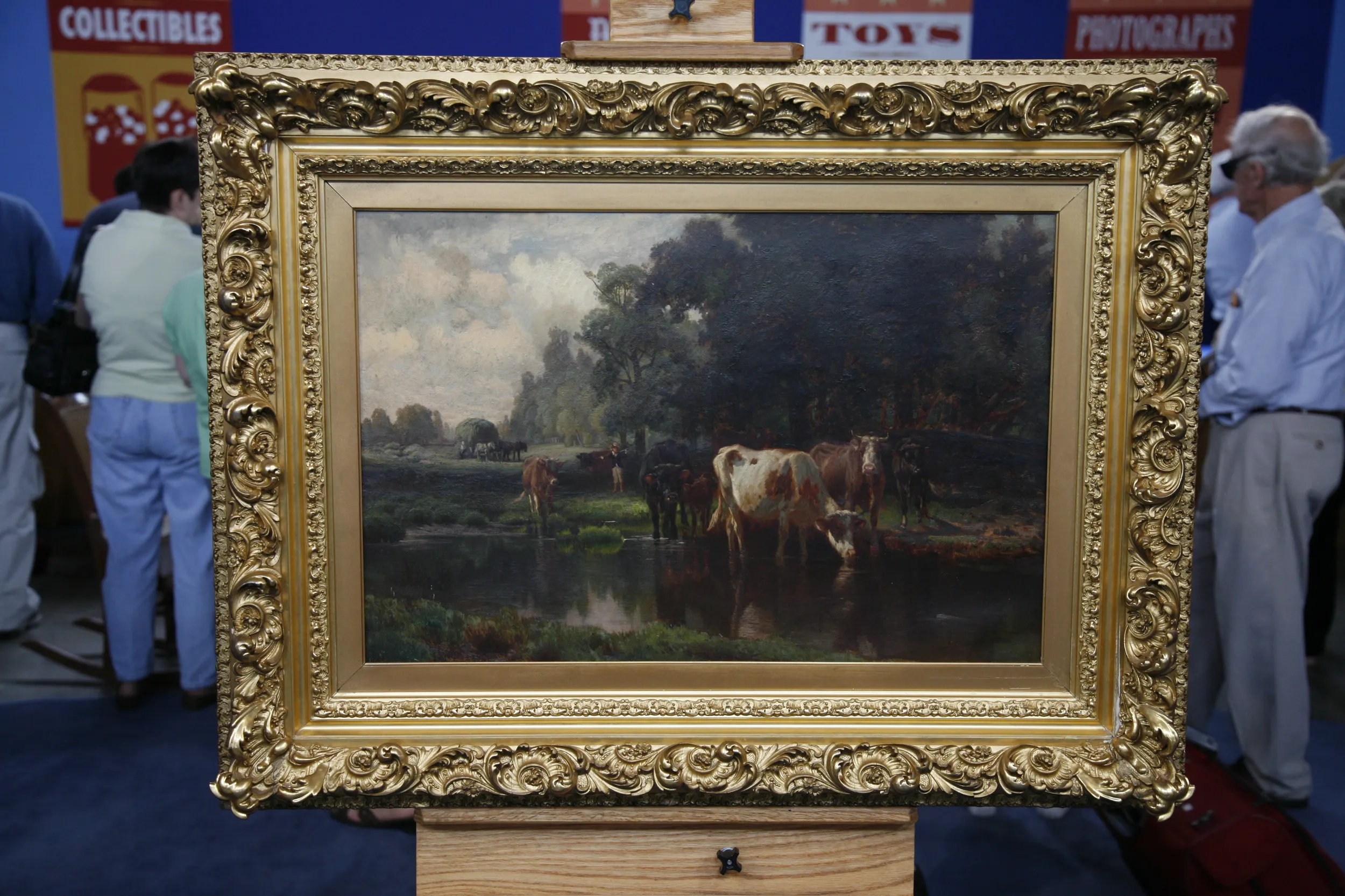
Peter Moran Painting, ca. 1880
Understanding Our Appraisals
Executive producer Marsha Bemko shares her tips for getting the most out of ANTIQUES ROADSHOW.
Value can change: The value of an item is dependent upon many things, including the condition of the object itself, trends in the market for that kind of object, and the location where the item will be sold. These are just some of the reasons why the answer to the question "What's it worth?" is so often "It depends."
Note the date: Take note of the date the appraisal was recorded. This information appears in the upper left corner of the page, with the label "Appraised On." Values change over time according to market forces, so the current value of the item could be higher, lower, or the same as when our expert first appraised it.
Context is key: Listen carefully. Most of our experts will give appraisal values in context. For example, you'll often hear them say what an item is worth "at auction," or "retail," or "for insurance purposes" (replacement value). Retail prices are different from wholesale prices. Often an auctioneer will talk about what she knows best: the auction market. A shop owner will usually talk about what he knows best: the retail price he'd place on the object in his shop. And though there are no hard and fast rules, an object's auction price can often be half its retail value; yet for other objects, an auction price could be higher than retail. As a rule, however, retail and insurance/replacement values are about the same.
Verbal approximations: The values given by the experts on ANTIQUES ROADSHOW are considered "verbal approximations of value." Technically, an "appraisal" is a legal document, generally for insurance purposes, written by a qualified expert and paid for by the owner of the item. An appraisal usually involves an extensive amount of research to establish authenticity, provenance, composition, method of construction, and other important attributes of a particular object.
Opinion of value: As with all appraisals, the verbal approximations of value given at ROADSHOW events are our experts' opinions formed from their knowledge of antiques and collectibles, market trends, and other factors. Although our valuations are based on research and experience, opinions can, and sometimes do, vary among experts.
Appraiser affiliations: Finally, the affiliation of the appraiser may have changed since the appraisal was recorded. To see current contact information for an appraiser in the ROADSHOW Archive, click on the link below the appraiser's picture. Our Appraiser Index also contains a complete list of active ROADSHOW appraisers and their contact details and biographies.


